
Loading, please wait...
LOT 0102
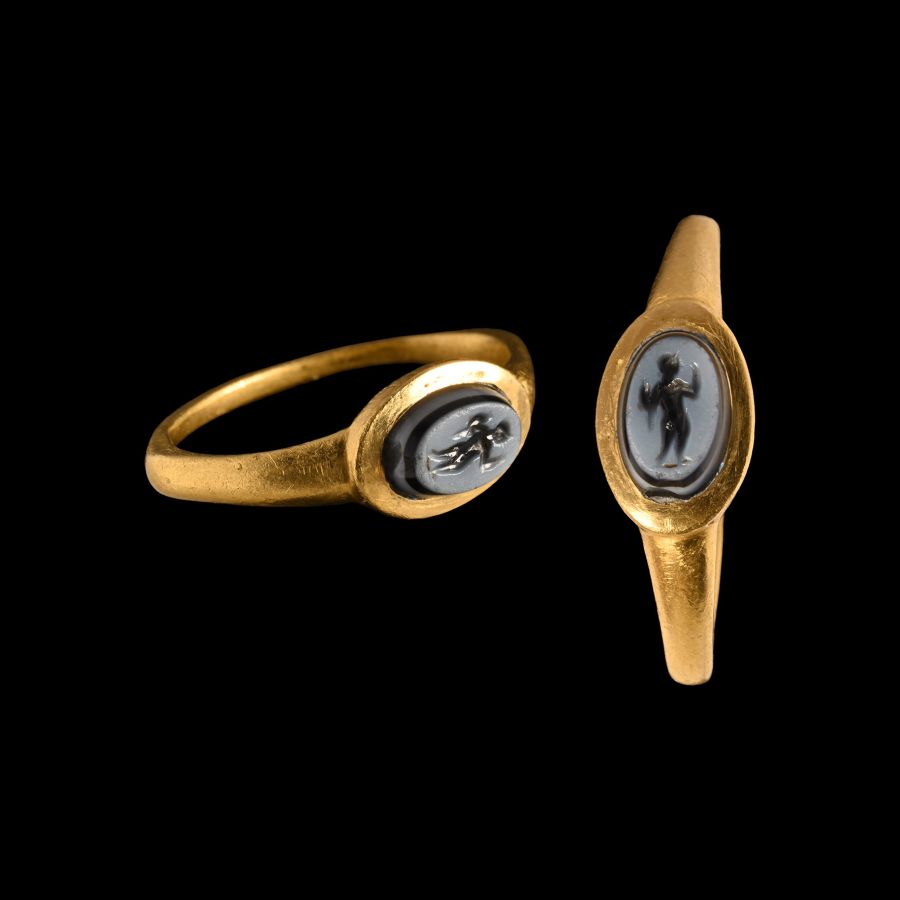
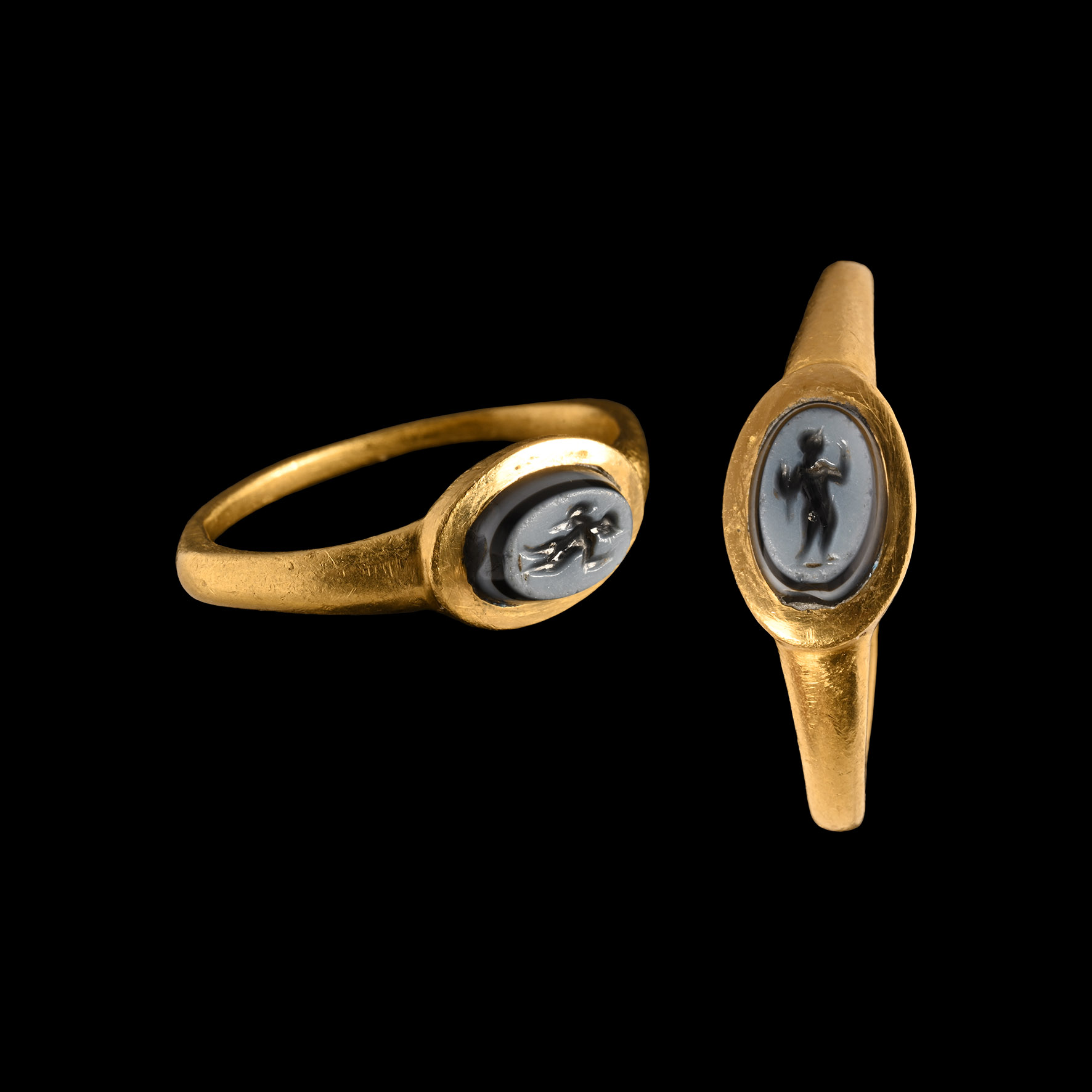
Roman Gold Ring with Apollo Gemstone
2ND-3RD CENTURY A.D.
1 in. (4.49 grams, 26.13 mm overall, 21.70 mm internal diameter (approximate size British L 1/2, USA 6, Europe 11.87, Japan 11)).
With a solid ellipsoid hoop expanding at the shoulders from the mid 3rd century, with oval bezel set with a blue nicolo gemstone engraved with the figure of standing crowned god Apollo, depicted nude and holding a staff (or lyre?) in his raised right hand, gazing towards his raised left hand.
ProvenanceFrom the private collection of the late A.B., London, UK; acquired before 1989.
Accompanied by an academic report by Dr Raffaele D’Amato.
This lot has been checked against the Interpol Database of stolen works of art and is accompanied by a search certificate number no.12005-213036.
See variant 1, type VII, and type III, variant 1, of the Ruseva-Slokoska classification, in Ruseva-Slokoska, L., Roman Jewellery, Sofia, 1991, pp.165-166 nos.182-183, 174, no.203; cf. similar specimens in the Koch collection, in Chadour, A.B., Rings. The Alice and Louis Koch Collection, volume I, Leeds, 1994, items 344-346; Kiernan, P. and Henz, K.P., ‘Rings from the Forbidden Forest. The function and meaning of Roman Trinket Rings’ in Journal of Roman Archaeology, Supplementary Materials, 2023, pp.1-19, fig.1, seven rings of the same shape with a nicolo gemstone.
FootnotesThe god’s body is depicted in three-quarter view, whereas the head is in full profile. The casual posture of the figure on the gemstone is taken from the common iconography of the god. Apollo is frequently portrayed in this fashion, although often leaning against a small column.
CONDITIONTimeLine Auctions follows a vetting process to ensure the authenticity and legality of all items, reinforcing our commitment to integrity and responsible trading. Each antiquity, antique, and coin lot undergoes thorough examination by a vetting committee of at least ten external specialists, professional trade association members, scientists, and archaeologists: Our Vetting Process
AUCTIONS:
TimeLine is a leading auction house specialising in antiquities, ancient art, collectables, natural history, coins, medals, and books. Our auctions offer museums, collectors, historians, and enthusiasts the opportunity to acquire unique and historically significant pieces.
LOT 0102
Roman Gold Ring with Apollo Gemstone
Estimate £2,000 - 3,000€2,320 - 3,480 (for guidance only)$2,700 - 4,050 (for guidance only)
-
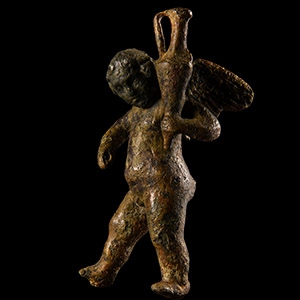
Roman Bronze Statuette of Eros
Circa 1st-2nd century A.D.Sold for (Inc. bp): £572
Eros modelled in the round, advancing, carrying an amphora on his left shoulder, wings spread to the rear, right hand open to accept a bow(?); mounted on a custom-made stand with brass nameplate. 160 grams total, 12.5 cm including stnad
Ex Phillips UK in 1998. From a collection acquired on the UK art market from various auction houses and collections mostly before 2000. From an important Cambridgeshire estate; thence by descent. -
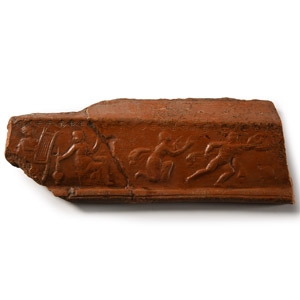
Roman Redware Pottery Sherd with Achilles and Thetis
4th-5th century A.D.Sold for (Inc. bp): £169
From the upper part of a vessel, displaying a frieze of profile images and figural scenes from Graeco-Roman mythology: a musician in late Roman garments playing a harp (Orpheus?), a seated woman weaving with a distaff in her hand (Penelope?), a kneeling naked woman imploring a naked warrior fighting with shield and spear (Achilles and Thetis?). 202 grams, 18 cm
Acquired 1960s-1990s. From the late Alison Barker collection, a retired London barrister.
This terra sigillata fragment appears to have been part of a large tray. Elements of dying paganism were still used to celebrate the deeds of the new imperial heroes. Note the detailed late Roman clothing of the harpist, with a chlamys-paludamentum on the right shoulder and the tunic decorated with clavi and orbiculi. -
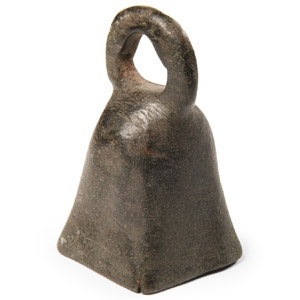
Roman Bronze Square-Shaped Bell
1st-3rd century A.D.Sold for (Inc. bp): £59
With flared, square-section body and thick suspension loop. 59 grams, 60 mm
Ex property of a gentleman from Vienna; from his private collection formed since 1970.
