
Loading, please wait...


LOT 0086
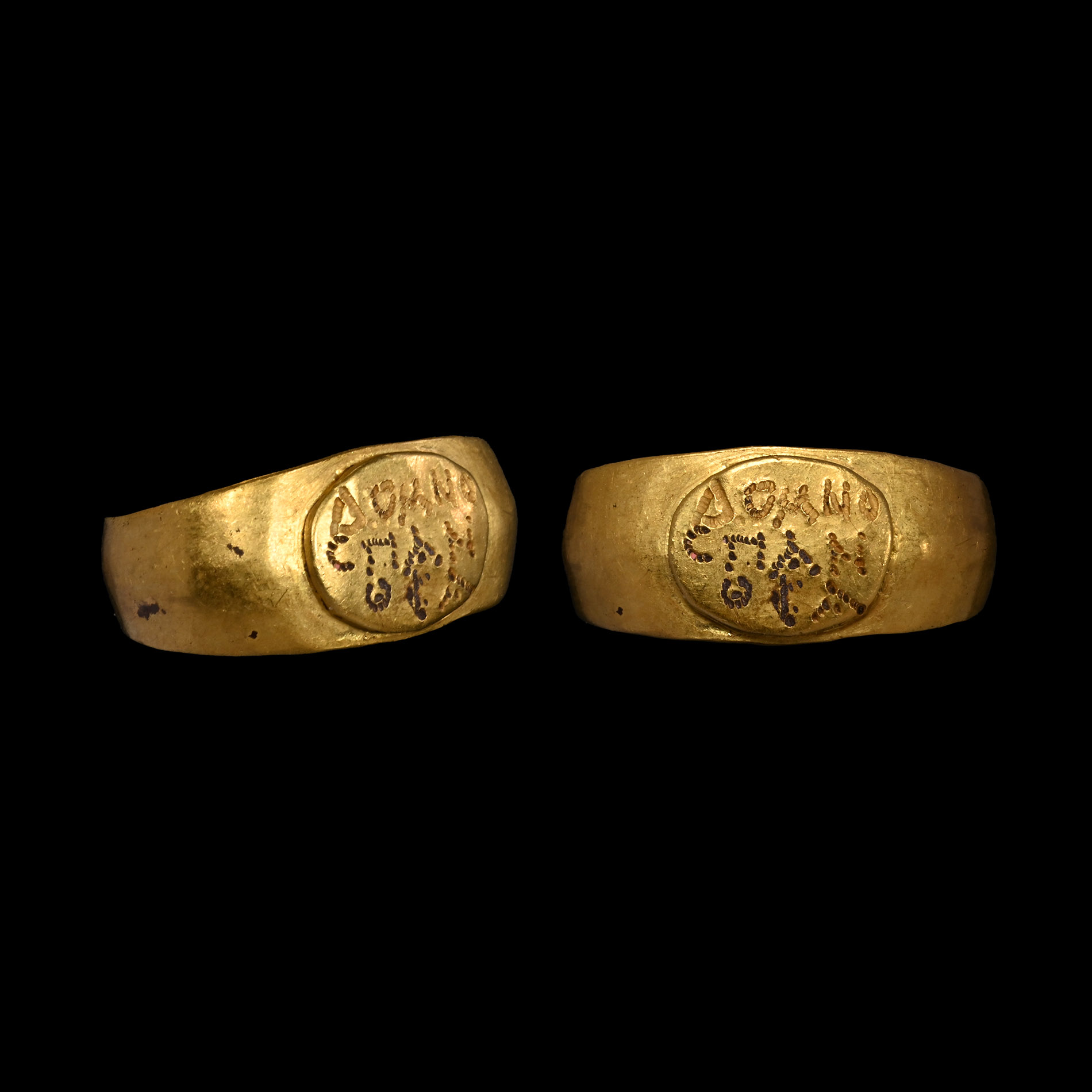
Roman Gold Ring of Domnos and Panthea
2ND CENTURY A.D.
3/4 in. (5.70 grams, 19.30 mm overall, 16.07 mm internal diameter (approximate size British G, USA 3 1/4, Europe 4.92, Japan 4)).
With flat shoulders and raised ellipsoid plaque, pointillé Greek inscription 'ΔΟΜΝο / CΠΑΝ / Θ[.]A' (Domnos Panthea).
ProvenanceAcquired in the mid 1980s-1990s.
Private collection, Switzerland, thence by descent.
Private collection, since the late 1990s.
Cf. Ruseva-Slokoska, L., Roman Jewellery, Sofia, 1991, item 228, for type.
FootnotesIt is likely that the inscription refers to a husband and wife, 'Domnos' being a known male name and 'Panthea' a female one.
CONDITIONTimeLine Auctions follows a vetting process to ensure the authenticity and legality of all items, reinforcing our commitment to integrity and responsible trading. Each antiquity, antique, and coin lot undergoes thorough examination by a vetting committee of at least ten external specialists, professional trade association members, scientists, and archaeologists: Our Vetting Process
AUCTIONS:
TimeLine is a leading auction house specialising in antiquities, ancient art, collectables, natural history, coins, medals, and books. Our auctions offer museums, collectors, historians, and enthusiasts the opportunity to acquire unique and historically significant pieces.
-
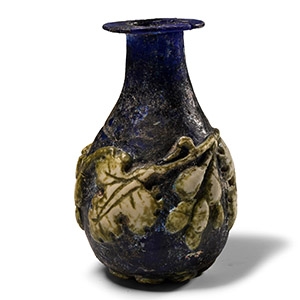
Roman Blue Glass Vessel with Vine Leaf Design
Early 1st century A.D. and laterSold for (Inc. bp): £585
Of piriform shape with iridescent surfaces, decorated with later applied fruiting vines in high-relief, a stylised rosette to the vessel's base; restored; rim chipped. 186 grams, 11.5 cm
London gentleman; acquired by his father in the 1970s; thence by descent. Private collection, England. -
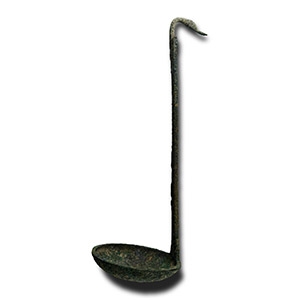
Roman Bronze Duck-Headed Ladle
1st-3rd century A.D.Sold for (Inc. bp): £520
With broad bowl and inturned rim, D-section handle, with one remaining hooked duck-head finial. 208 grams, 26.5 cm
Private collection of Mr S.A., Switzerland, 1990s, thence by descent. -
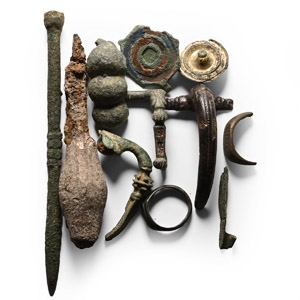
Roman Bronze Artefact Collection
1st-3rd century A.D.Sold for (Inc. bp): £46
Including a gilt tutulus brooch, section of a plumbata missile, dolphin brooch, enamelled disc brooch, surgical probe and other items. 176 grams total, 2-11.4 cm
Found various site in the UK. Ex N.Mills.
