
Loading, please wait...

LOT 0092
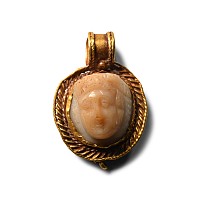
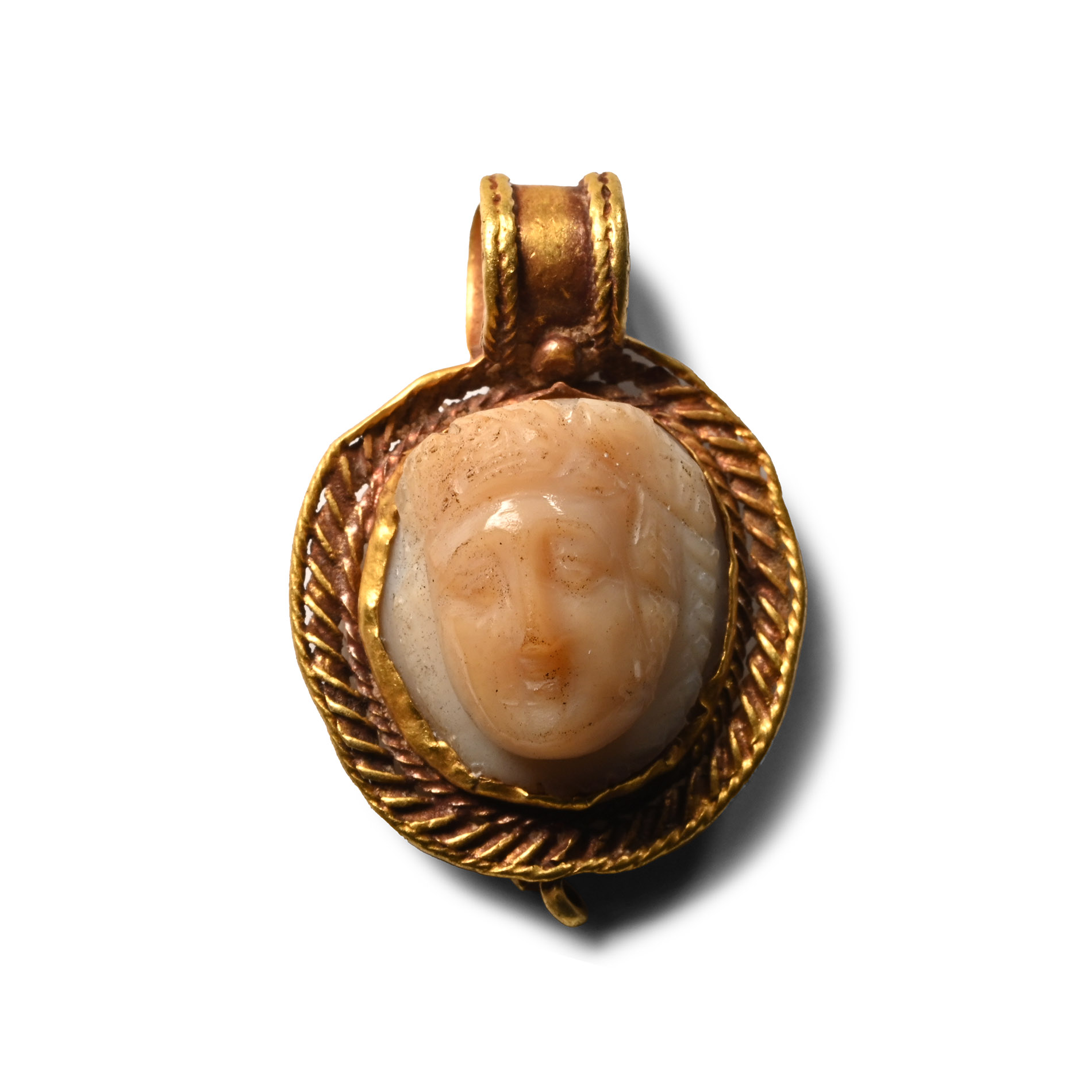
Roman Gold Pendant with Medusa Cameo
1ST-2ND CENTURY A.D.
1 1/4 in. (5.06 grams, 29 mm).
Discoid plaque with applied ropework wreath detailing, suspension loop with filigree borders and granule below, inset cameo gorgoneion; ring at bottom for attachment of a securing chain.
ProvenanceFrom the collection of a gentleman, acquired on the London art market in the 1990s.
LiteratureCf. similar in the collection of the British Museum, London, under accession no.1923,0401.1150.
CONDITIONTimeLine Auctions follows a vetting process to ensure the authenticity and legality of all items, reinforcing our commitment to integrity and responsible trading. Each antiquity, antique, and coin lot undergoes thorough examination by a vetting committee of at least ten external specialists, professional trade association members, scientists, and archaeologists: Our Vetting Process
AUCTIONS:
TimeLine is a leading auction house specialising in antiquities, ancient art, collectables, natural history, coins, medals, and books. Our auctions offer museums, collectors, historians, and enthusiasts the opportunity to acquire unique and historically significant pieces.
-
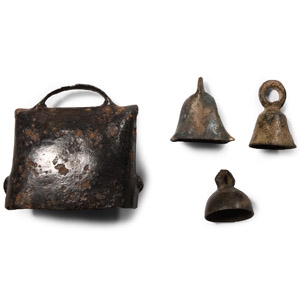
Roman to Post Medieval Bell Collection
1st-18th century A.D.Sold for (Inc. bp): £59
Including cow-bell, hemispherical, jingle and other types; many of these objects are published in the Detector Finds book series. 126 grams total, 23-67 mm
From the collection of the famous author, writer and speaker, Gordon Bailey, Essex, UK; formed since 1968. -
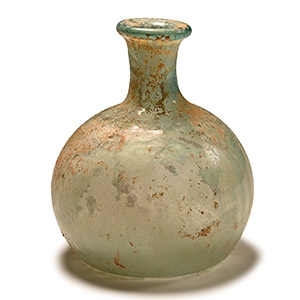
Roman Glass Toilet Bottle
1st century A.D.Sold for (Inc. bp): £195
With globular body, short everted rim and cylindrical neck, concave base. 73 grams, 10 cm
Ex London, UK, collection, 1980-1990s.
The bottle should be associated with Isings form 6 or Tommaso type 7. Small bottles of this typology are among the earliest known blown glass. The everted rim seems to distinguish examples made in Italy and the western Mediterranean provinces from those of the Eastern Mediterranean, on which the rim is usually folded in the form of a flange. -

Roman Bronze Venus Anadyomene Statuette
1st century A.D.Sold for (Inc. bp): £85
Modelled nude with left hand resting on her hip and right hand above her head, detailed hair cascading down her back, pellet breasts and dimpled navel; mounted on a custom-made stand. 37.6 grams total, 72 mm
From a collection acquired on the UK art market from various auction houses and collections mostly before 2000. From an important Cambridgeshire estate; thence by descent.
Venus Anadyomene (Greek: Ἀναδυόμενη "Rising from the Sea") is an iconic and much-repeated image of Venus (Aphrodite) which was popular in the ancient world and was revived in the Italian Renaissance, Baroque and Rococo periods. The goddess is shown emerging from the water and wringing out her long hair.
