Loading, please wait...

Roman Gold Pendant with Carnelian Intaglio of Goddess Venus Roman Gold Pendant with Carnelian Intaglio of Goddess Venus Roman Gold Pendant with Carnelian Intaglio of Goddess Venus
Use mousewheel to zoom in and out, click to enlarge
Details

LOT 0104

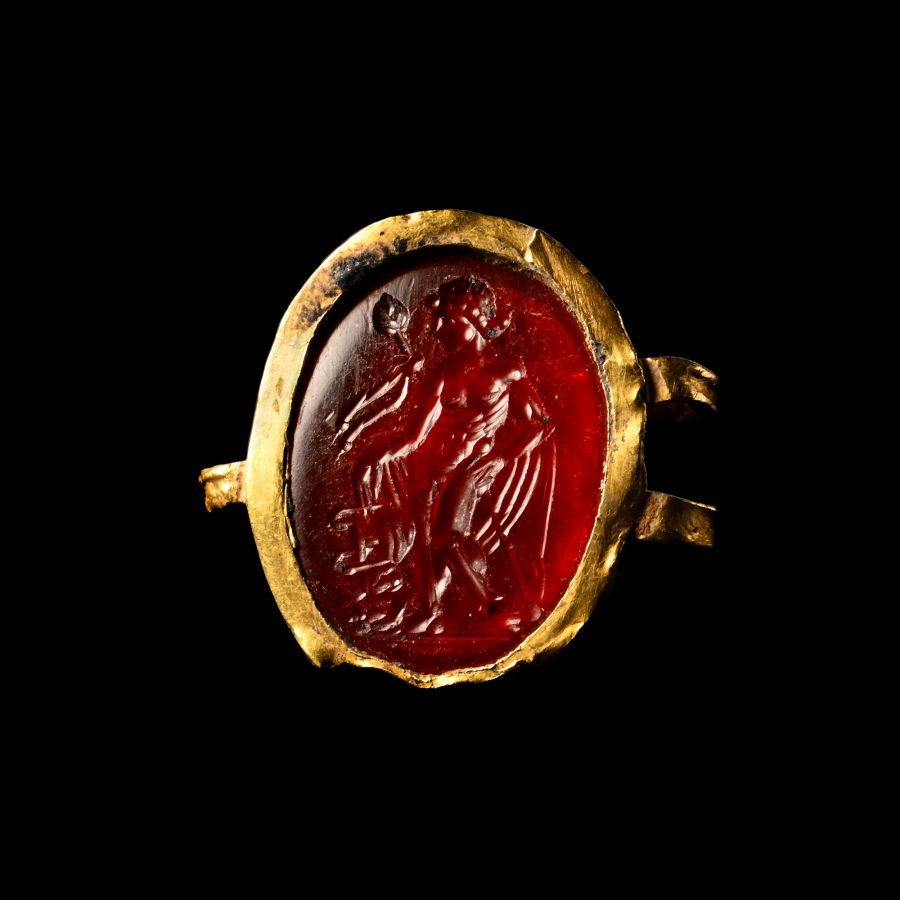
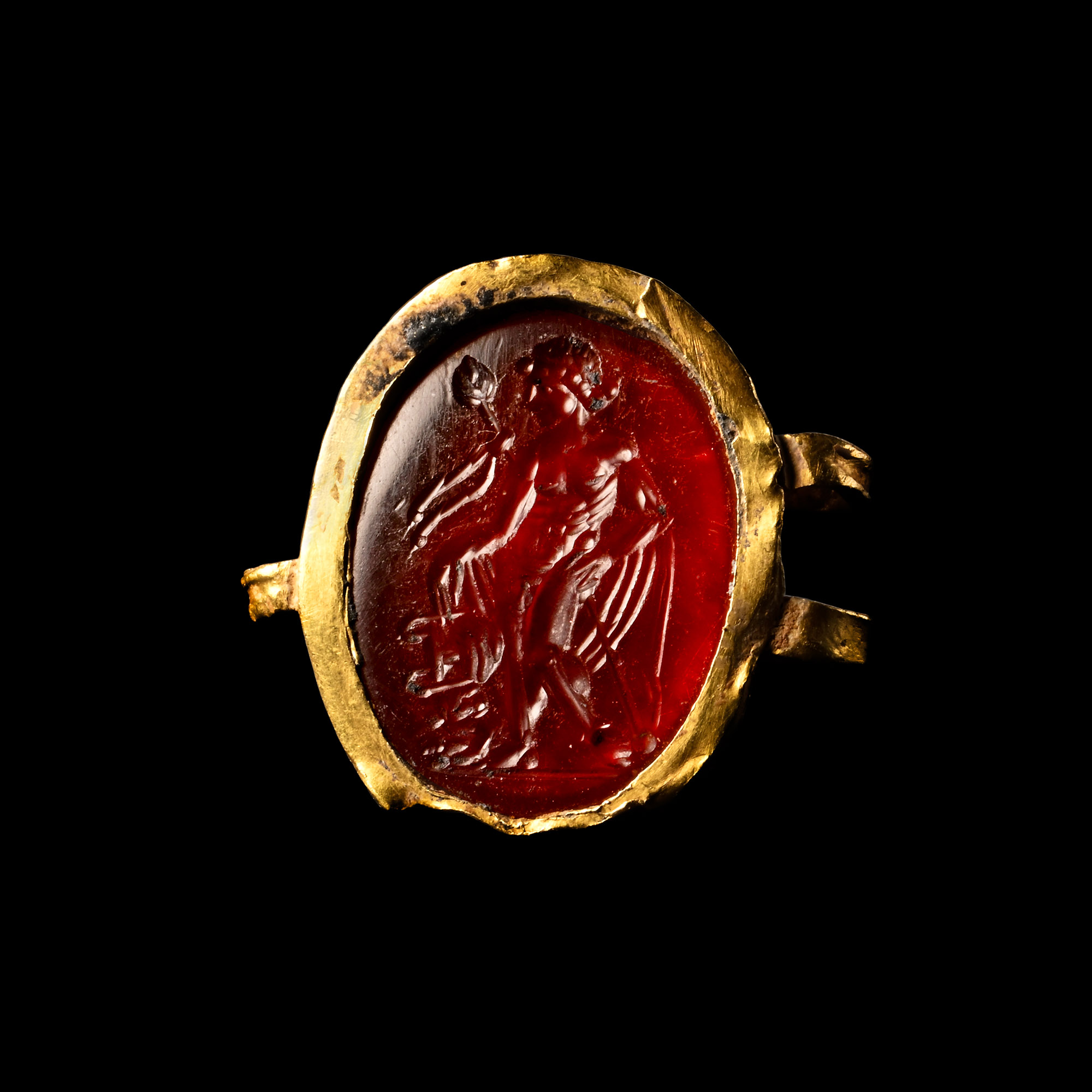
Roman Gold Pendant with Carnelian Intaglio of Goddess Venus

1ST-2ND CENTURY A.D.

7/8 in. (5.68 grams, 22 mm).

Gold cell with flange rim and three lateral loops; inset intaglio of a cloaked goddess (Venus) with a distaff and diadem, caressing a hare.

Provenance

From the collection of a deceased Lady collector, 1970s.

This lot has been checked against the Interpol Database of stolen works of art and is accompanied by search certificate number no.12957-243670.

Literature

Cf. Chadour, A.B., Rings. The Alice and Louis Koch Collection, volume I, Leeds, 1994, item 497, for a similar iconography of Venus.

Footnotes

Symbol of fertility and of good luck, the hare became a popular motif in the pre-Roman Era on the coins of Messina, Etruscan art and
coins and Calenian pottery. The hare was a sacred animal to Venus (Aphrodite), often depicted in her worship and associated with love and fertility.

CONDITION
VETTING:

TimeLine Auctions follows a vetting process to ensure the authenticity and legality of all items, reinforcing our commitment to integrity and responsible trading. Each antiquity, antique, and coin lot undergoes thorough examination by a vetting committee of at least ten external specialists, professional trade association members, scientists, and archaeologists: Our Vetting Process


AUCTIONS:

TimeLine is a leading auction house specialising in antiquities, ancient art, collectables, natural history, coins, medals, and books. Our auctions offer museums, collectors, historians, and enthusiasts the opportunity to acquire unique and historically significant pieces.

LOT 0104

Roman Gold Pendant with Carnelian Intaglio of Goddess Venus

Sold for (Inc. bp): £2,600

Print page

RELATED LOTS
  • Roman Orange Glass Bead Necklace String
    Roman Orange Glass Bead Necklace String
    1st-4th century A.D. and later

    Sold for (Inc. bp): £65

    Restrung designer necklace string of oblate and other types with irregular annular pendant centrepiece. 9.15 grams, 38.5 cm


    London, UK, collection, 2000s.

    Lot Details

  • Roman Silver Ladle with Beast Finial
    Roman Silver Ladle with Beast Finial
    1st-3rd century A.D.

    Estimate: £800 - 1,000 (‡+bp*)

    Opening Bid: £400

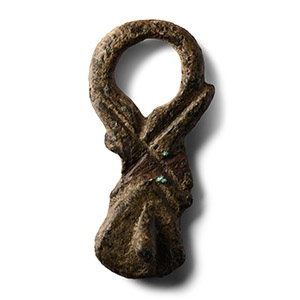
    With broad bowl and in-turned rim, square-section long handle looped at the end with a beast-head finial; repaired and mounted on a custom-made display stand. 70 grams, 22.5 cm (317 grams total, 25.5 cm including stand)


    Acquired in the mid 1980s-1990s. Private collection, Switzerland, thence by descent. Private collection, since the late 1990s.

    Lot Details

  • Romano-Scottish Legion XX Valeria Victrix Inchtuthil Fort Boxed Educational Iron Nail Hoard Set
    Romano-Scottish Legion XX Valeria Victrix 'Inchtuthil Fort' Boxed Educational Iron Nail Hoard Set
    Circa 83-87 A.D.

    Sold for (Inc. bp): £520

    Group of five iron clout-nails permanently mounted in a wooden display case with sloping sides and sliding glazed lid; with information panel 'Iron Nails / From / Roman Legionary Fortress / at / Inchtuthil, Perthshire, Scotland / A.D.83-87'; supplied with a printout on the subject of the Inchtuthil fortress. 713 grams total, 36 x 15.8 cm


    From excavations started by Richmond in Perthshire, Scotland, from the 1950s, and discovered in the summer of 1960. Selected and boxed by David Colville & Sons by 1963. Property of a Norwich, Norfolk, UK, gentleman.

    The fortress at Inchtuthil was a fortified headquarters and forward supply depot for the forces led by the Roman governor, Gnaeus Julius Agricola, when he undertook a lengthy campaign against the Caledonian tribes in the north of Britain. The campaign is mentioned in the biographical work written by his son-in-law, the historian Tacitus, which has been studied in order to understand the Roman plan for the subjugation of the island. The troops chosen for the campaign were drawn from the 20th Legion (Legio XX Valeria Victrix). While the construction of Inchtuthil and other strongholds took place, the troops lived in temporary encampments which were also fortified and formed a chain of defensive sites from which domination of the surrounding territory could be achieved. Subsequently once the site was abandoned late in the 1st century A.D., (around 86 A.D.) no further building took place there or in the area. Excavation in the 20th century by Sir Ian Richmond (begun in 1952) revealed a pristine site with its complete plan recoverable - unique in the Roman Empire. The defences were a broad ditch and turf wall with stone facing, with watchtowers and gatehouses. The site was thought to have been abandoned due to relocation of troops to counter an invasion from eastern Europe into the province of Dacia, although this is no longer certain. A huge quantity of iron nails (more than 875,000) was recovered from a pit in the fort as well as other ironware; the goods had been buried in order not to let them fall into the hands of the Caledonians. The excavated nails and other items were sorted and sold in small parcels, which was completed by 1963.The nails range in size from small nails between thirty-eight and seventy millimetres long, up to the massive spikes three hundred and seventy-two millimetres long. These kind of long nails were also used for crucifixions.

    Lot Details

Stay up-to-date with the latest from TimeLine Auctions by joining our mailing list