
Loading, please wait...
LOT 0899
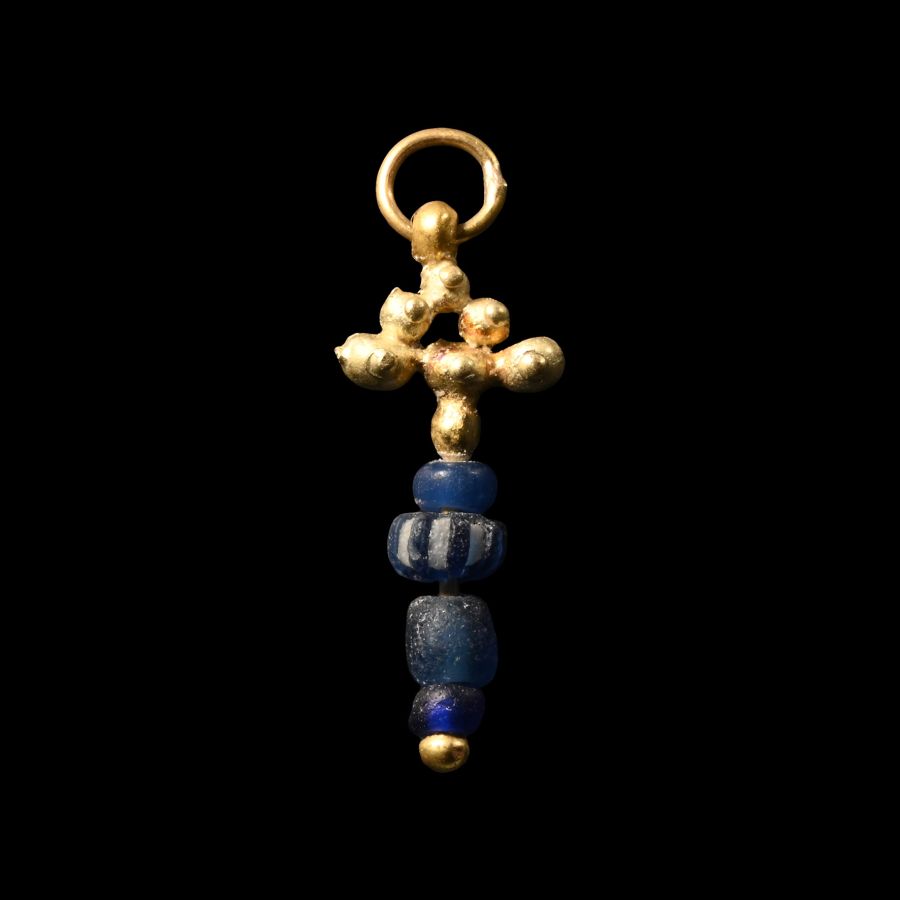
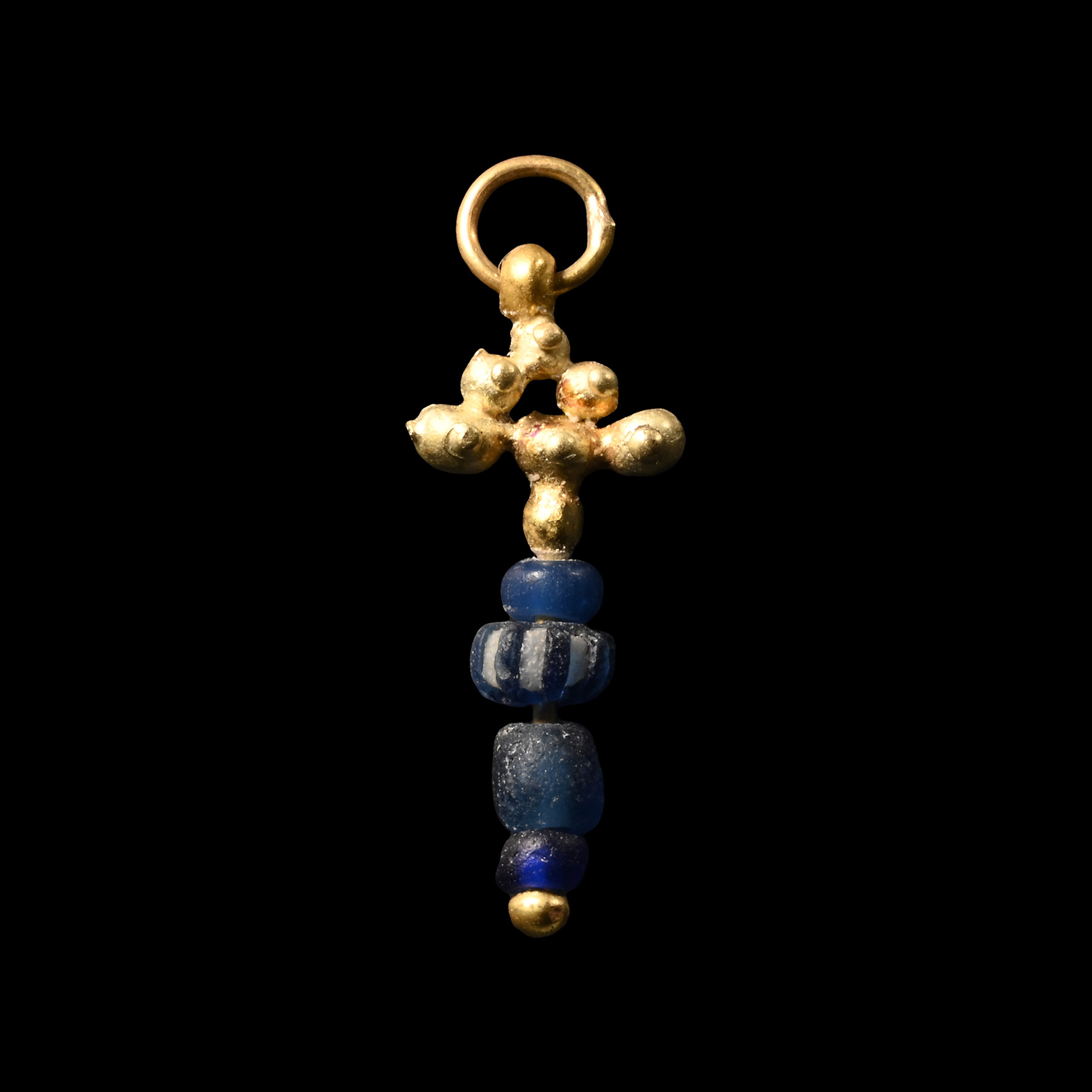
Roman Gold Pendant with Beads
1ST-4TH CENTURY A.D.
7/8 in. (0.83 grams, 22 mm).
Comprising a vertical shank with arc of granules above, ring and suspension loop; four glass beads to the shank, lobe finial.
ProvenanceFrom a late Japanese specialist collector, 1970-2000s.
CONDITIONTimeLine Auctions follows a vetting process to ensure the authenticity and legality of all items, reinforcing our commitment to integrity and responsible trading. Each antiquity, antique, and coin lot undergoes thorough examination by a vetting committee of at least ten external specialists, professional trade association members, scientists, and archaeologists: Our Vetting Process
AUCTIONS:
TimeLine is a leading auction house specialising in antiquities, ancient art, collectables, natural history, coins, medals, and books. Our auctions offer museums, collectors, historians, and enthusiasts the opportunity to acquire unique and historically significant pieces.
-
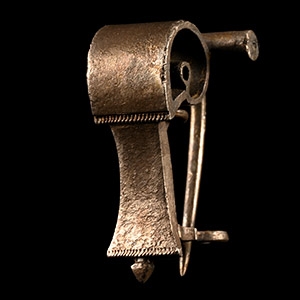
Roman Military Silver Knee Brooch
2nd century A.D.Sold for (Inc. bp): £325
Of 'knee type pattern' incorporating a 90 degree bend, the front plate with additional edge-notched decoration, complete with original pin. 16 grams, 34.7 mm
Ex Ancient Art, Eastpole Farm House, London, N14, early 2000s. From the private collection of Antony John Scammell (1937-2019). Accompanied by a copy of a certificate of authenticity from Ancient Art, London, UK. -
.jpg)
Large Roman Tinned Bronze Patera
1st century A.D.Estimate: £1,000 - 1,400 (‡+bp*)
Opening Bid: £500
With a deep bowl and flat-section handle with integral loop; shallow concentric grooves around the exterior of the neck, rolled rim, concentric rings to the underside; finished on a lathe; cracked and split. 903 grams, 33 cm wide
Acquired in Europe before 1993. Private collection, Europe. This lot has been checked against the Interpol Database of stolen works of art and is accompanied by search certificate number no.11788-206494.
In contrast to their elaborate counterparts, paterae such as this were likely carried as part of the standard kit of Roman soldiers, used as a general cooking and eating utensil. The regular heap up (sarcina) of the legionaries is well represented on the reliefs of Trajan's column. It was composed of a T stake (furca), to which a linen bag (sacculus) was hung, as well as the leather haversack for 15-20 days supplies (trinum nundinum) and personal effects, a pot (ollula), a cup (patera), and a basket for work on the fields. -
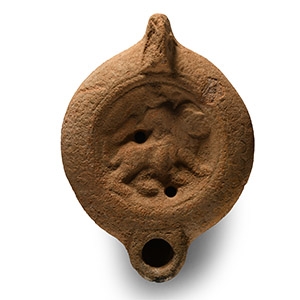
Roman Terracotta Oil Lamp with Cybele Riding a Lion
2nd-3rd century A.D.Sold for (Inc. bp): £312
Lug handle to the rear, shallow discus with filling holes and a low-relief image of goddess Cybele riding on her frequent companion, a lion. 172 grams, 12 cm
Acquired on the European art market, 1980s. English private collection.
This lamp belongs to the group of Provincial African lamps with a plain shoulder and a heart-shaped nozzle. The shoulder form of the lamps (irrespective of African, Italic, or eastern place of manufacture or origin) varies widely. Some of them had undecorated shoulders, like our example. Discus decors include mythology, amphitheatre, daily life, animals (our example), geometric patterns and plain discus.
