
Loading, please wait...
LOT 0666
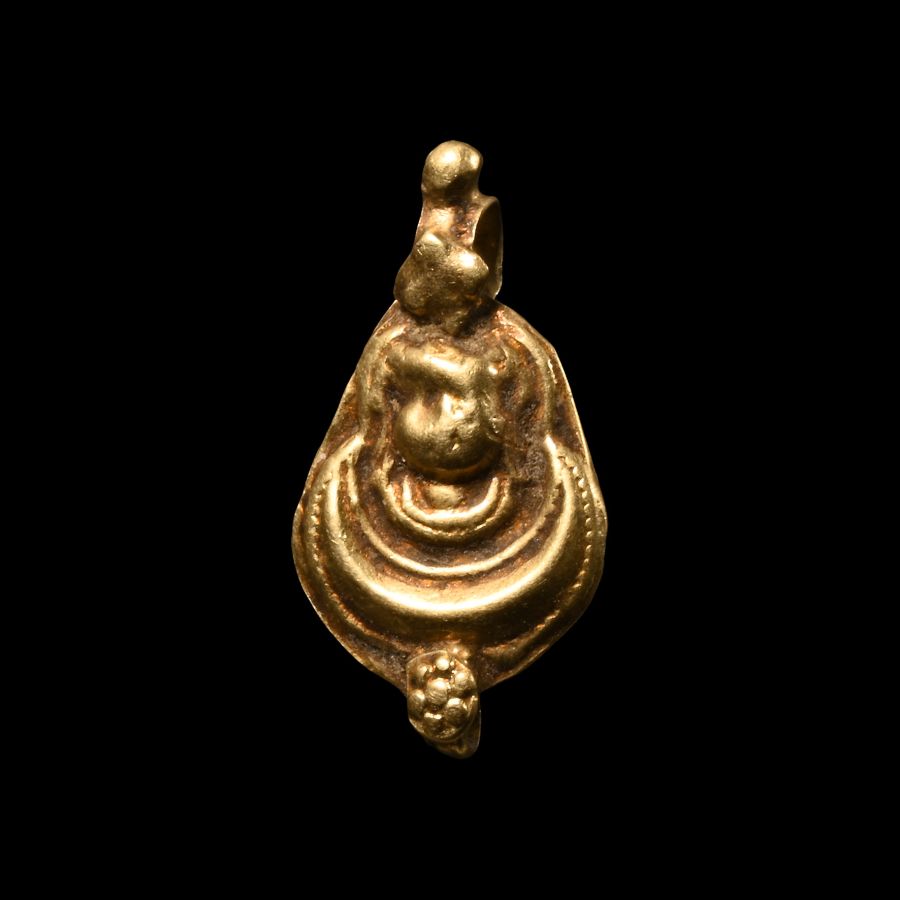
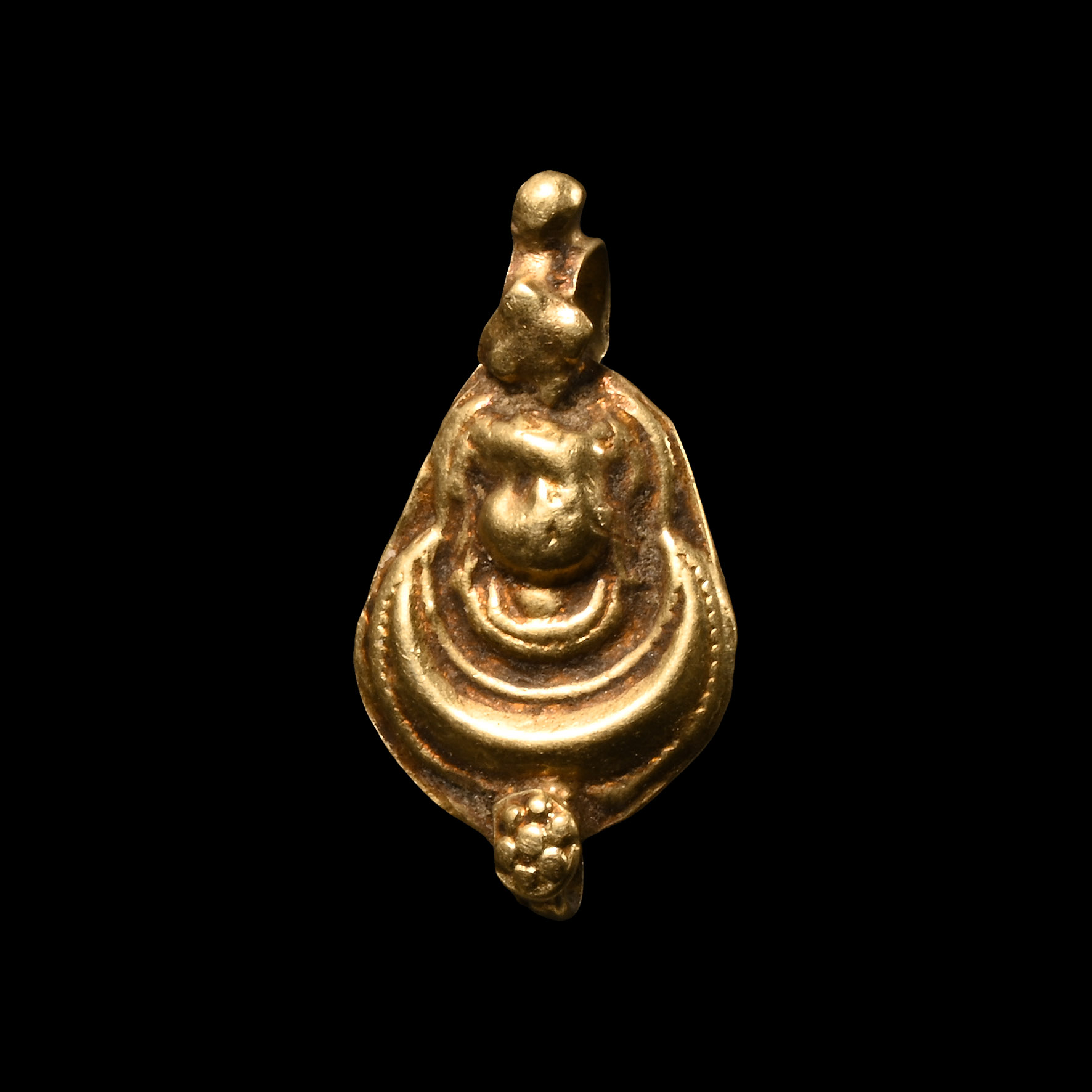
Roman Gold Lunar Pendant with Bust of Diana
1ST-4TH CENTURY A.D.
5/8 in. (0.37 grams, 15 mm).
Repoussé pendant with inverted crescent beneath a facing female mask, possibly Diana or Luna, loops above an below.
ProvenanceEx Abelita family collection.
From an old UK collection.
Ex London, UK, gallery, 2000s.
Accompanied by a previous catalogue information card.
TimeLine Auctions follows a vetting process to ensure the authenticity and legality of all items, reinforcing our commitment to integrity and responsible trading. Each antiquity, antique, and coin lot undergoes thorough examination by a vetting committee of at least ten external specialists, professional trade association members, scientists, and archaeologists: Our Vetting Process
AUCTIONS:
TimeLine is a leading auction house specialising in antiquities, ancient art, collectables, natural history, coins, medals, and books. Our auctions offer museums, collectors, historians, and enthusiasts the opportunity to acquire unique and historically significant pieces.
-
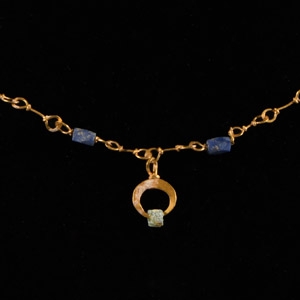
Roman Gold Necklace with Blue Glass Beads
3rd century A.D.Sold for (Inc. bp): £1,170
Comprising gold looped links with corner-less oblong and biconvex lapis lazuli beads, hook-and-eye closure, centrepiece a flat sheet gold hoop with iridescent turquoise-coloured glass bead. 4.66 grams, 39 cm long
Private collection of Mr S.A., Switzerland, 1994, thence by descent. -
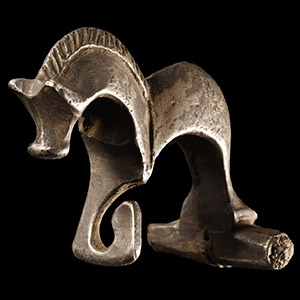
Roman Silver Horse Brooch
1st-2nd century A.D.Sold for (Inc. bp): £390
Zoomorphic bow brooch with hexagonal-section head and hinge for the pin, bow forming the horse's body and smaller bow for the neck with hatched mane; catch formed by the forelegs. 16.5 grams, 37 mm
Acquired on the London art market in the late 1980s-1990s. From the family collection of an East London, UK, gentleman. -
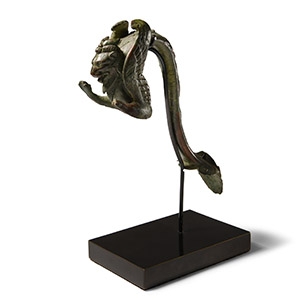
Roman Bronze Handle with Winged Lion and Mask
1st-2nd century A.D.Sold for (Inc. bp): £2,405
D-section swept-curve handle, the upper end developing to the foreparts of a winged lion with forelegs bent and paws resting on the vessel's rim, wings folded to the flanks; high-relief foliage detailing to the outer face of the handle; acanthus leaf to the lower end developing to a facing bearded mask of a satyr; mounted on a custom-made stand. 452 grams total, 13 cm high (17 cm high including stand)
Acquired between 1980-1983. From the 'Empire' collection, an important UK private collection of seals.
Usually this type of handles decorated ovoid-shaped oinochoai, a type of vase widespread in Southern Italy. Numerous specimens in the National Museum of Archaeology, Naples present panther or horse protomes, as do some provincial specimens from Gaul. Particular and unusual here is the lion-griffin, which refers to Greek-Egyptian motifs, perhaps connected to the cult of Isis-Serapis.
