
Loading, please wait...

LOT 0087
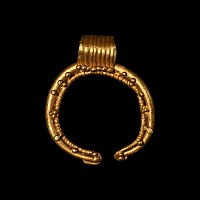
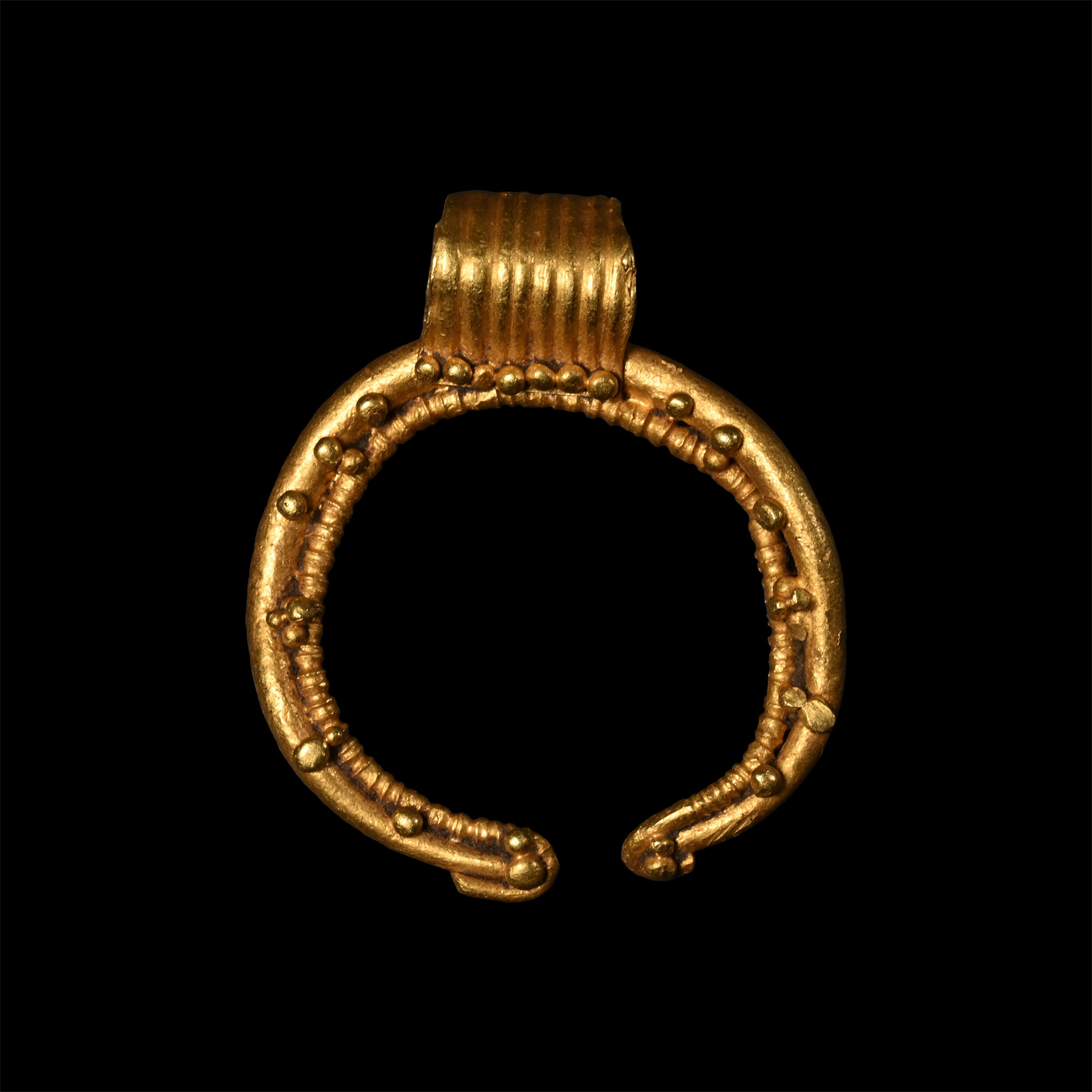
Roman Gold Luna Pendant
1ST-4TH CENTURY A.D.
3/4 in. (3.53 grams, 21 mm).
Crescentic gold wire shank with beaded wire to the inner face of the arc applied granules, ribbed suspension loop.
ProvenanceEx German art market, 2000s.
Acquired from an EU collector living in London.
From the collection of Surrey, UK, gentleman.
See British Museum, accession numbers 1850,0601.3 and 1850,0601.4, for similar.
FootnotesSuch lunar pendants were worn by girls in ancient Rome as amulets to protect them against evil forces. The equivalent pendant for boys was the bulla.
CONDITIONTimeLine Auctions follows a vetting process to ensure the authenticity and legality of all items, reinforcing our commitment to integrity and responsible trading. Each antiquity, antique, and coin lot undergoes thorough examination by a vetting committee of at least ten external specialists, professional trade association members, scientists, and archaeologists: Our Vetting Process
AUCTIONS:
TimeLine is a leading auction house specialising in antiquities, ancient art, collectables, natural history, coins, medals, and books. Our auctions offer museums, collectors, historians, and enthusiasts the opportunity to acquire unique and historically significant pieces.
-
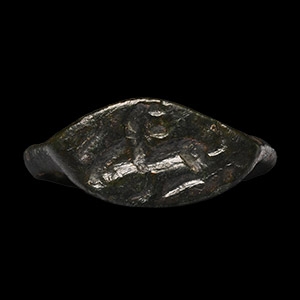
Roman Bronze Ring with Lion
1st century B.C.-1st century A.D.Sold for (Inc. bp): £111
With ellipsoid bezel, incuse lion attacking a goat. 3.11 grams, 24.39 mm overall, 20.02 mm internal diameter (approximate size British T, USA 9 1/2, Europe 21.26, Japan 20)
UK private collection before 2000. Acquired on the UK art market. Property of a London gentleman. -
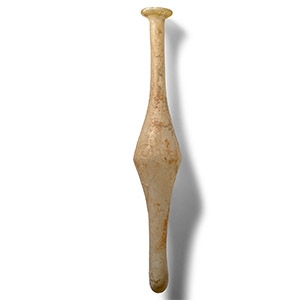
Large Roman Translucent Glass Flask
1st-4th century A.D.Sold for (Inc. bp): £78
Of fusiform type with a rolled lip and thick rounded bottom; repaired. 43 grams, 25.2 cm
From the collection of a late East Anglian teacher and antiquarian who retired to the Isle of Wight in Hampshire, UK. He amassed a large collection of objects between the 1960s-1980s. -
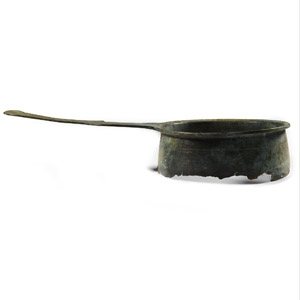
Large Roman Bronze Skillet
2nd-3rd century A.D.Sold for (Inc. bp): £247
With a deep bowl, everted rim with a rounded lip, flat-section handle with lateral spurs and oval finial. 352 grams, 35.8 cm
From a collection acquired on the UK art market from various auction houses and collections mostly before 2000. From an important Cambridgeshire estate; thence by descent.
