
Loading, please wait...
LOT 1033
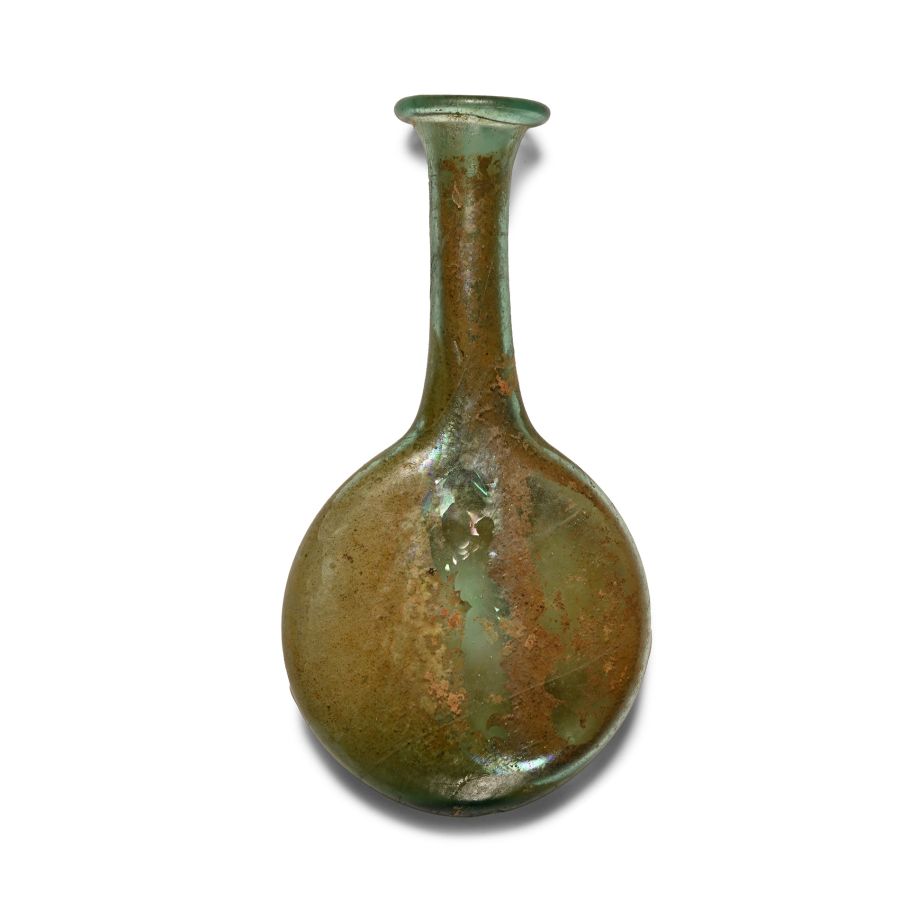
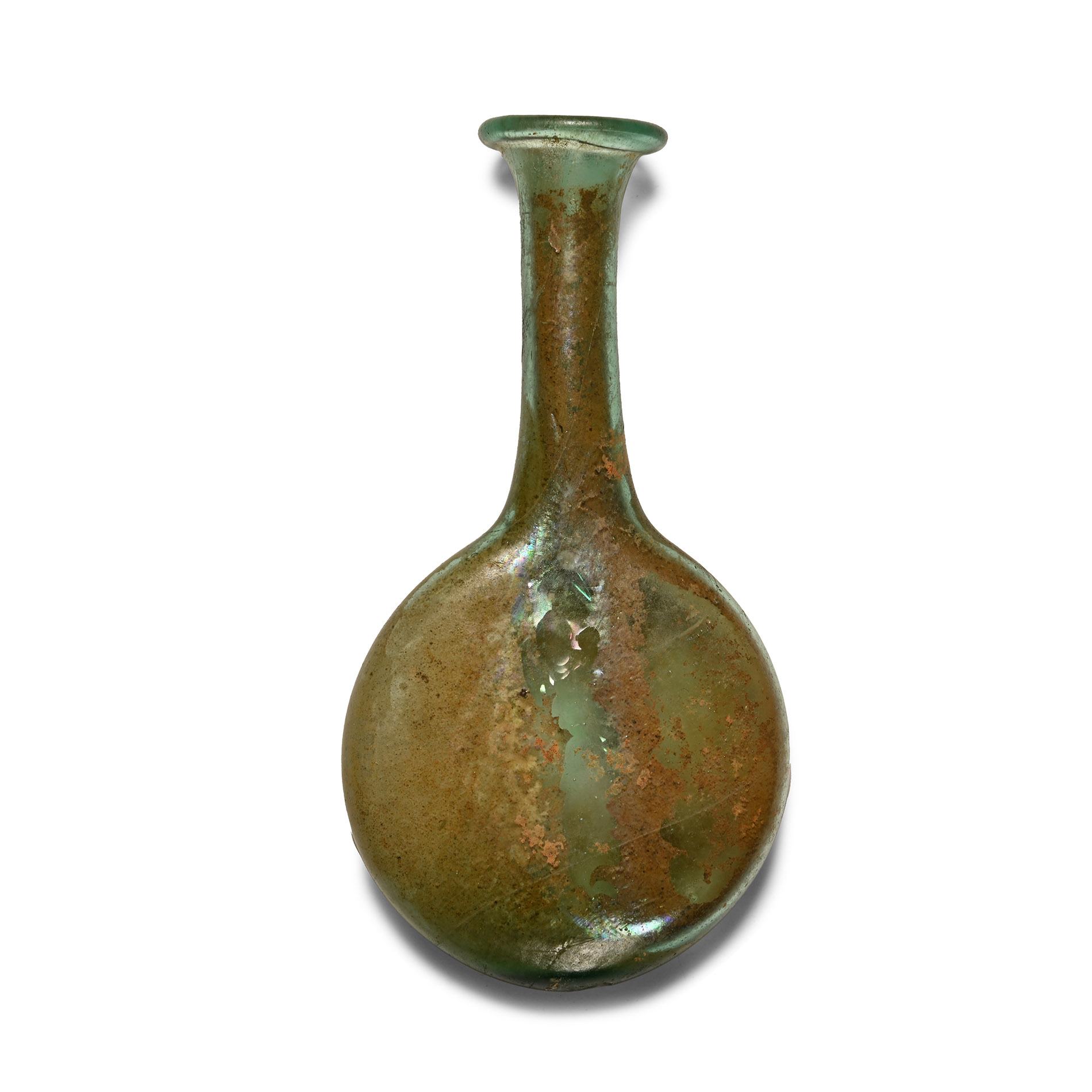
Roman Glass Vessel
2ND-3RD CENTURY A.D.
4 1/8 in. (20.5 grams, 10.6 cm).
With flattened discoid body and tall neck with flared mouth, applied rim.
ProvenanceFrom a London, UK, collection, 1990s.
This lot is accompanied by an illustrated lot declaration signed by the Head of the Antiquities Department, Dr Raffaele D’Amato.
Cf. for similar The Metropolitan Museum, New York, item 74.51.67, in Lightfoot, C. S., The Cesnola Collection of Cypriot Art: Ancient Glass, New York, 2017, p.290, no.430.
FootnotesGlass flasks, such as this example, were used as containers for ointments, powders, balms, and other expensive liquids such as perfumes. These flattened spherical vessels were often utilised by pilgrims to carry water on their travels. This particular form appears to be a predecessor to twin-handled pilgrim flasks, which became commonplace later in the 3rd and 4th centuries.
CONDITIONTimeLine Auctions follows a vetting process to ensure the authenticity and legality of all items, reinforcing our commitment to integrity and responsible trading. Each antiquity, antique, and coin lot undergoes thorough examination by a vetting committee of at least ten external specialists, professional trade association members, scientists, and archaeologists: Our Vetting Process
AUCTIONS:
TimeLine is a leading auction house specialising in antiquities, ancient art, collectables, natural history, coins, medals, and books. Our auctions offer museums, collectors, historians, and enthusiasts the opportunity to acquire unique and historically significant pieces.
-
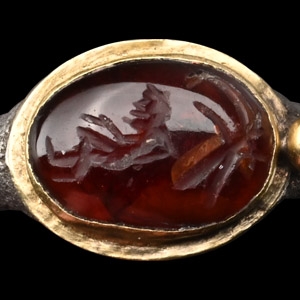
Roman Silver Ring with Crouching Figure Gemstone
3rd-4th century A.D.Sold for (Inc. bp): £156
With disc bezel, gold cell with orienting knop to one shoulder, inset cabochon garnet with intaglio crouching figure with symbol above; accompanied by a museum-quality impression. 4.79 grams, 20.32 mm overall, 14.11 mm internal diameter (approximate size British F 1/2, USA 3, Europe 4.3, Japan 4)
Property of a gentleman; acquired in the late 1960s-early 1970s. -
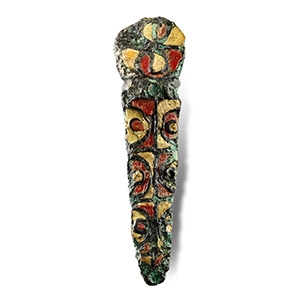
'The Thorpe Audlin' Romano-British Enamelled Bow Brooch
Circa 2nd century A.D.Sold for (Inc. bp): £468
Comprising: discoid head with raised rectangular neck, tongue-shaped bow with tapered end; the head decorated extensively with a raised triskele style pattern, with retained enamel in alternate yellow and red colours; the body with a raised longitudinal running linear border bisected by four latitudinal borders; within each sub-rectangular cell, a crescent border with central raised pellet; within each cell created by the raised borders, retained enamel in alternating red and yellow; the reverse undecorated with lug and chord, catchplate to lower end. 13.7 grams, 57 mm
Found by Mr Wayne Colbeck whilst searching with a metal detector in Thorpe Audlin, Wakefield, Yorkshire, UK, in 2014. Accompanied by a copy of the British Museum's Portable Antiquities Scheme (PAS) report no.YORYM-D5BBD5. Accompanied by the finder's original copy of the York Archaeological Trust's object entry form dated 31 October 2014 with reference no.E001019.
Sally Worrell, National Finds Advisor has been unable to locate any comparable examples of this form of brooch. It has been designated by the British Museum as a 'Find of Note' and of 'Regional Importance'. -
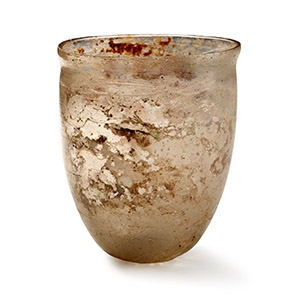
Roman Iridescent Glass Flask
1st-4th century A.D.Sold for (Inc. bp): £221
Aqua glass drum-shaped jar with everted rim and rounded base. 34.58 grams, 70 mm
Acquired Christie's, London, Antiquities, Works of Art and Important Renaissance Bronzes, Plaquettes and Limoges Enamels, 8 July 1981, no.617 (part). From a private Wiltshire, UK, collection. Accompanied by a copy of the relevant Christie's catalogue pages.
