
Loading, please wait...
LOT 0909
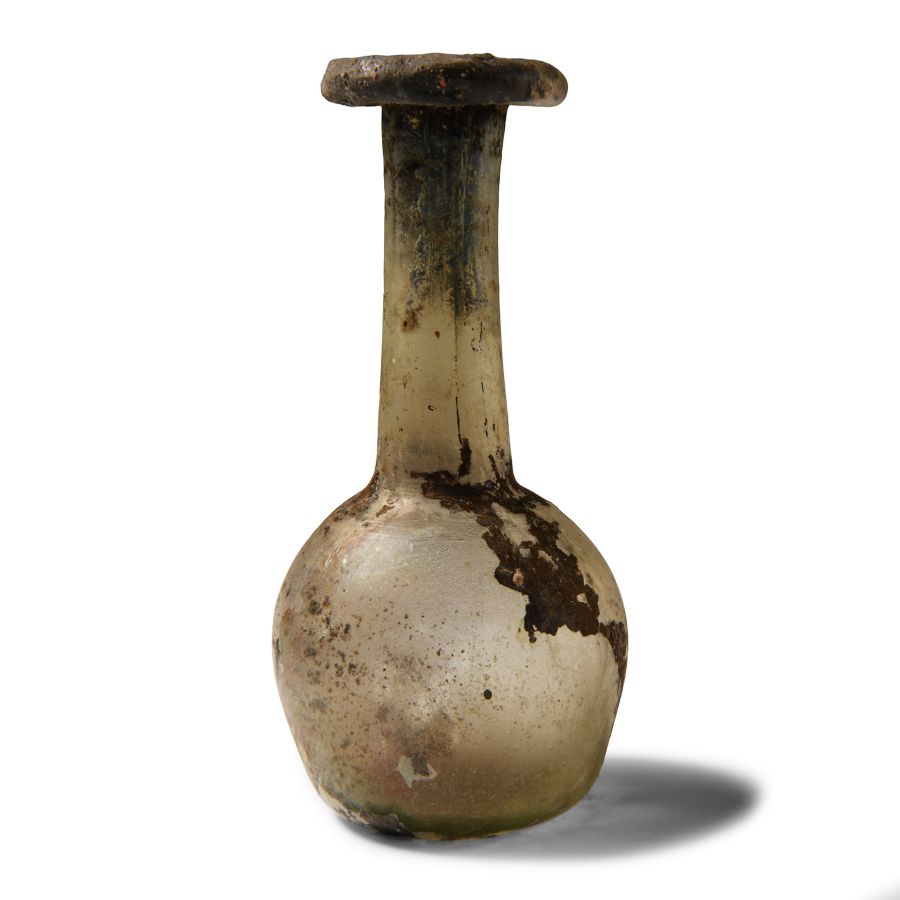
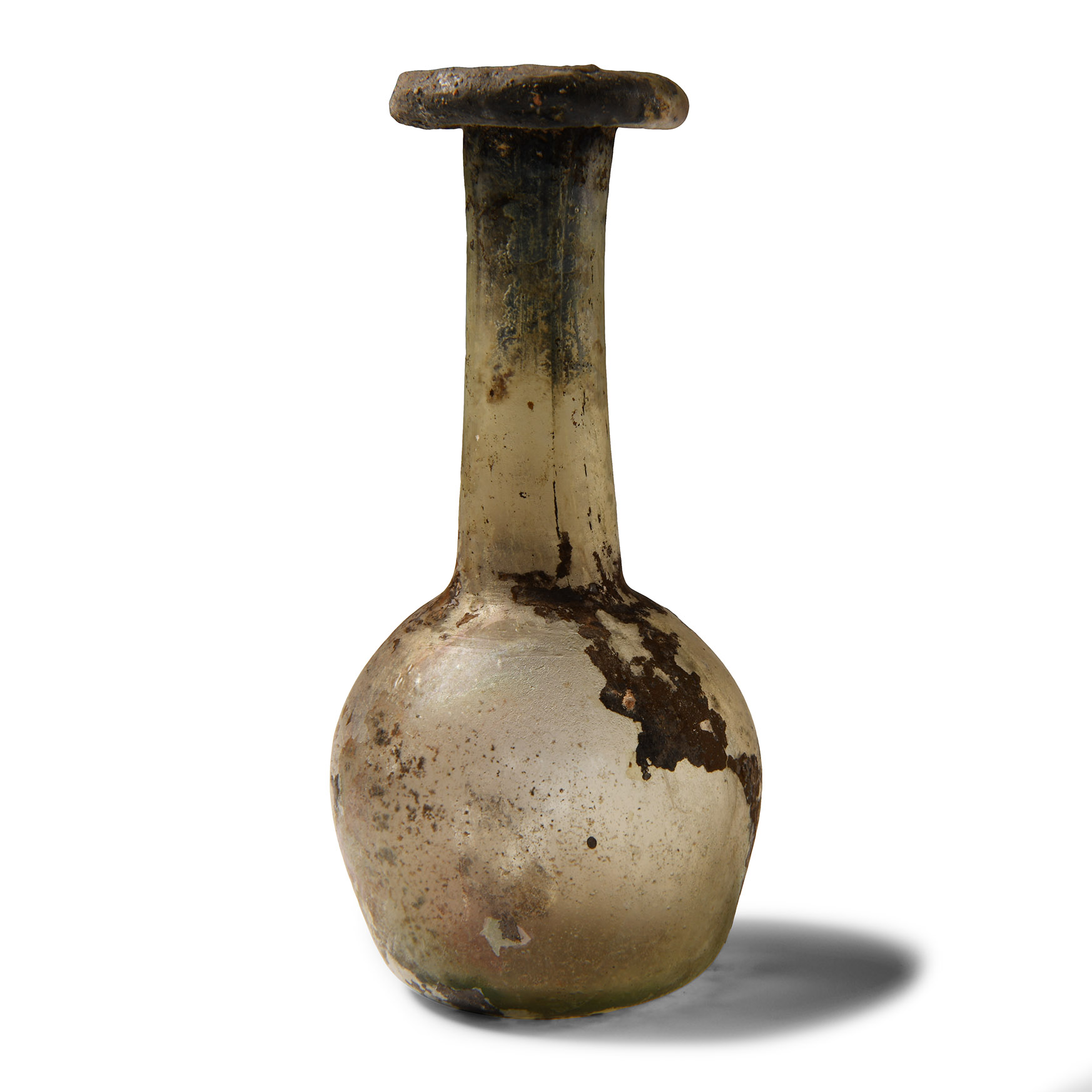
Roman Glass Unguentarium
1ST-3RD CENTURY A.D.
4 in. (27.5 grams, 10.1 cm).
Aqua-glass perfume bottle with applied rim to the mouth, bulbous lower body and pontil base.
ProvenanceAcquired 1980-2015.
Ex Abelita family collection.
TimeLine Auctions follows a vetting process to ensure the authenticity and legality of all items, reinforcing our commitment to integrity and responsible trading. Each antiquity, antique, and coin lot undergoes thorough examination by a vetting committee of at least ten external specialists, professional trade association members, scientists, and archaeologists: Our Vetting Process
AUCTIONS:
TimeLine is a leading auction house specialising in antiquities, ancient art, collectables, natural history, coins, medals, and books. Our auctions offer museums, collectors, historians, and enthusiasts the opportunity to acquire unique and historically significant pieces.
-
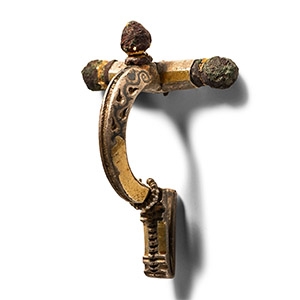
Roman Silver Crossbow Brooch
3rd-4th century A.D.Sold for (Inc. bp): £1,170
Parcel-gilt crossbow brooch with onion-shaped knops to the ends of the headplate and medially along the top edge; deep trapezoidal-section bow with median gusset; D-section footplate with chamfered sides open to one edge; upper part of one face of the bow with niello-filled running scroll design, lower part of the other face with running guilloche; beaded wire collar at the end. 14.6 grams, 46 mm
Ex N.C. collection. Acquired on the Swiss art market in 2000. European private collection.
Crossbow fibulae of this type were worn by high officers and, if in gold, even emperors, from Constantine to Justinian, as symbols of military rank. These fibulae are an important element in the graves, for the classification of the category of the dead, as belonging to the militia (armed or not); many of them were in gold, or gilded silver, and decorated with an inscription. -
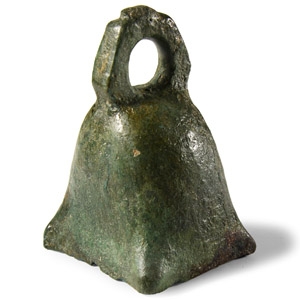
Roman Bronze Square-Shaped Bell
Circa 1st century A.D.Sold for (Inc. bp): £221
Of quadrilateral form, with a rectangular cross-section at base, tapering to a rounded dome with large integral suspension loop with five facets to the outer face; clanger absent. 162 grams, 82 mm
Acquired before 2000. From the collection of a European gentleman living in the UK.
The Romans used bells in ritual and secular contexts, when they could be suspended from the necks of animals, worn for talismanic protection or as anklets by servants. -
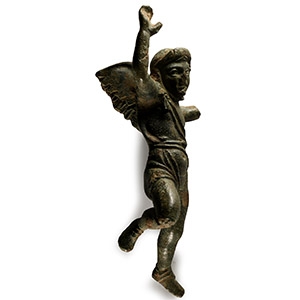
Large Gallo-Roman Bronze Statuette of Cupid
1st-3rd century A.D.Estimate: £4,000 - 6,000 (‡+bp*)
Opening Bid: £2,000
Modelled in the round leaping and winged, his right hand reaching above his head seemingly gesturing to retrieve arrows from a quiver once carried on his back, dressed in an exomis tunic leaving him naked below the torso, wearing a helmet or cap and ankle boots. 403 grams, 16 cm high
Acquired in Europe before 1994. Private collection, Europe. Accompanied by an academic report by Dr Raffaele D’Amato. This lot has been checked against the Interpol Database of stolen works of art and is accompanied by search certificate no.11808-206795.
Often the statues of puttos or amorini (small loves) depicting personifications of Eros were covered with gold leaf. This was a frequent practice and the figures, when represented with wings, were known as chrysopteroi, meaning 'with golden wings'.
