
Loading, please wait...
_900x900.jpg "Roman Glass Intaglio with Scenic Group")
_200x200.jpg "Roman Glass Intaglio with Scenic Group")


.jpg "Roman Glass Intaglio with Scenic Group")

LOT 0095
Roman Glass Intaglio with Scenic Group
2ND-3RD CENTURY A.D.
1 5/8 in. (10.5 grams, 41 mm).
Ellipsoid in plan with bevelled edge, intaglio frieze depicting an altar with aedus and flames arising; robed human worshipper with votive offering above the flames; flanked by two priapic fauns with hands raised.
ProvenanceCollected from 1970-1999.
From the collection of the late Mr S.M., London, UK.
TimeLine Auctions follows a vetting process to ensure the authenticity and legality of all items, reinforcing our commitment to integrity and responsible trading. Each antiquity, antique, and coin lot undergoes thorough examination by a vetting committee of at least ten external specialists, professional trade association members, scientists, and archaeologists: Our Vetting Process
AUCTIONS:
TimeLine is a leading auction house specialising in antiquities, ancient art, collectables, natural history, coins, medals, and books. Our auctions offer museums, collectors, historians, and enthusiasts the opportunity to acquire unique and historically significant pieces.
LOT 0095
Roman Glass Intaglio with Scenic Group
Estimate £800 - 1,000€930 - 1,160 (for guidance only)$1,080 - 1,350 (for guidance only)
-
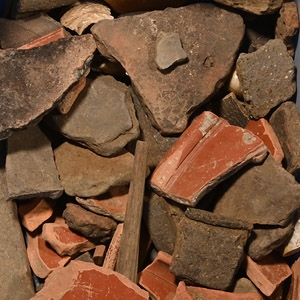
Roman Pottery Sherd Collection
1st-4th century A.D.Sold for (Inc. bp): £33
Mixed group of ceramic fragments including rooftiles, rim-sherds and other items. 2.3 kg total, 1.6-12.4 cm
Found on various UK sites since 1974. Property of an Essex collector. -
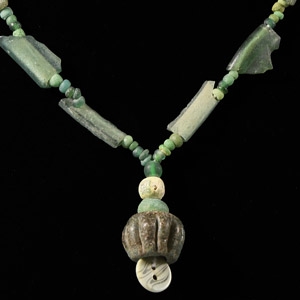
Roman Green Glass Bead Necklace String
1st-4th century A.D. and laterSold for (Inc. bp): £39
Restrung group of beads including tubular types, large melon bead centrepiece. 20.8 grams, 33.5 cm
Acquired 1980-2015. Ex Abelita family collection. -
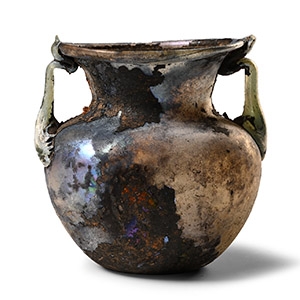
Roman Glass Double-Handled Iridescent Flask
4th century A.D.Estimate: £800 - 1,000 (+bp*)
Opening Bid: £400
With squat bulbous body, dimple base, flared trumpet neck; applied trails to the shoulder, applied strap handles to the shoulders. 47 grams, 72 mm
From an important London, UK, collection, 1970-1990s.
