
Loading, please wait...
LOT 0720
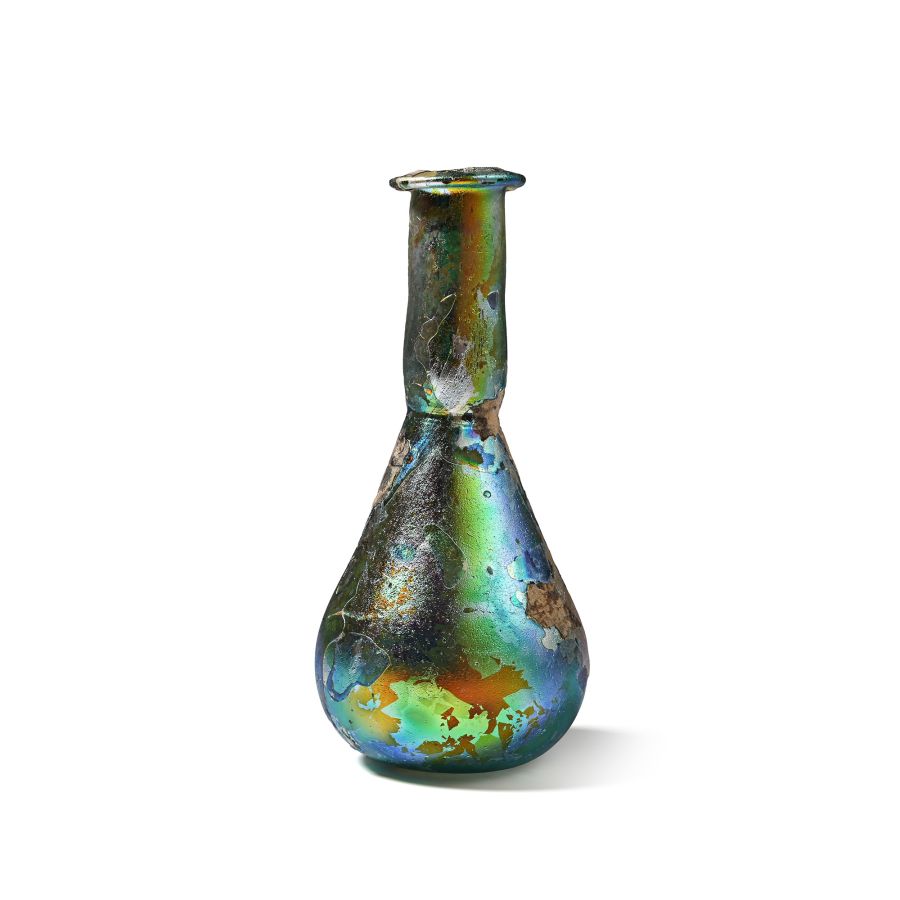
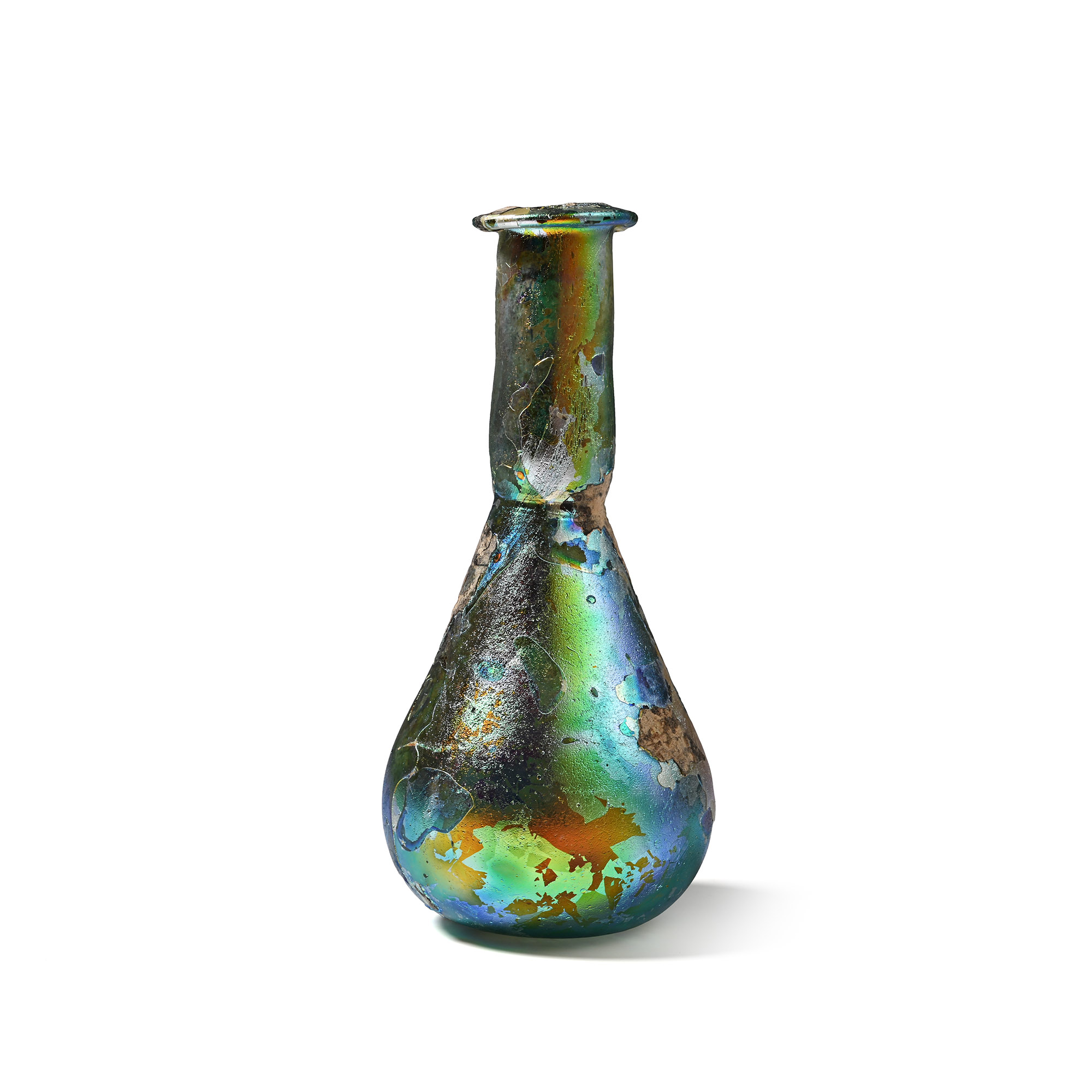
Roman Glass Flask with Iridescence
1ST CENTURY A.D.
5 7/8 in. (118 grams, 15 cm).
An iridescent glass unguentarium with piriform body, tubular neck with everted rolled rim.
ProvenanceFrom an important London collection of glass, 1990s.
This lot is accompanied by an illustrated lot declaration signed by the Head of the Antiquities Department, Dr Raffaele D'Amato.
Cf. Whitehouse, D., Roman Glass in the Corning Museum of Glass, vol.1, New York, 1997, item 268, for type.
CONDITIONTimeLine Auctions follows a vetting process to ensure the authenticity and legality of all items, reinforcing our commitment to integrity and responsible trading. Each antiquity, antique, and coin lot undergoes thorough examination by a vetting committee of at least ten external specialists, professional trade association members, scientists, and archaeologists: Our Vetting Process
AUCTIONS:
TimeLine is a leading auction house specialising in antiquities, ancient art, collectables, natural history, coins, medals, and books. Our auctions offer museums, collectors, historians, and enthusiasts the opportunity to acquire unique and historically significant pieces.
-
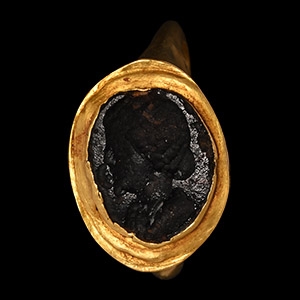
Roman Gold Ring with Glass Bezel
2nd-1st century B.C.Estimate: £800 - 1,000 (‡+bp*)
Opening Bid: £400
With a hollow-form D-section hoop and tall oval bezel set with a glass intaglio bearing a profile bust of a lady, her hair pulled back to a chignon at the nape of the neck. 3.07 grams, 25.34 mm overall, 16.74 mm internal diameter (approximate size British M, USA 6, Europe 12.46, Japan 12)
Acquired in the mid 1980s-1990s. Private collection, Switzerland, thence by descent. Private collection, since the late 1990s. This lot is accompanied by an illustrated lot declaration signed by the Head of the Antiquities Department, Dr Raffaele D'Amato. -
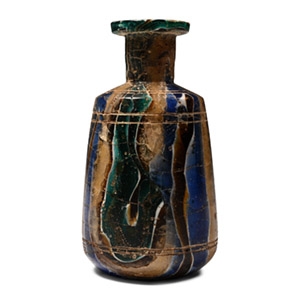
Roman Marbled Gold in Glass Bottle
Early 1st century A.D.Sold for (Inc. bp): £19,500
Cylindrical polychrome body tapering towards the angled shoulder, tubular neck and flat rim; circumferential lathe-cut lines to the body, base and rim. 85 grams, 89 mm
Acquired in the mid 1980s-1990s. Private collection, Switzerland, thence by descent. Private collection, since the late 1990s. Accompanied by an academic report by Dr Raffaele D’Amato. This lot has been checked against the Interpol Database of stolen works of art and is accompanied by a search certificate number no.12613-234626. This lot has been cleared against the Art Loss Register database, and is accompanied by an illustrated lot declaration signed by the Head of the Antiquities Department, Dr Raffaele D'Amato.
Small bottles, lidded pyxides (boxes) of this type and luxury gold-band glass were made during the Julio-Claudian period. The production and widespread use of tableware in marbled glass in the Western empire took place between the end of the age of Augustus and the beginning of the age of Tiberius (circa 10-16 A.D.), reaching its peak in the period of Nero (54-68 A.D.). -
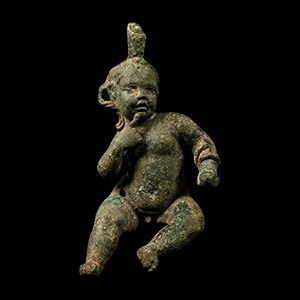
Roman Bronze Figure of Seated Harpocrates
1st century A.D.Estimate: £3,000 - 4,000 (‡+bp*)
Opening Bid: £1,350
Modelled in the round sitting with miniature double-crown, serpent arm-ring on left wrist, sidelock; fixing socket to right thigh. 145 grams, 72 mm
Private collection, Me. A., Florida, USA, early 1990s. European private collection, acquired in Germany, September 2000. This lot has been checked against the Interpol Database of stolen works of art and is accompanied by a search certificate number no.12683-234609. This lot has been cleared against the Art Loss Register database, and is accompanied by an illustrated lot declaration signed by the Head of the Antiquities Department, Dr Raffaele D'Amato.
