
Loading, please wait...


LOT 0160
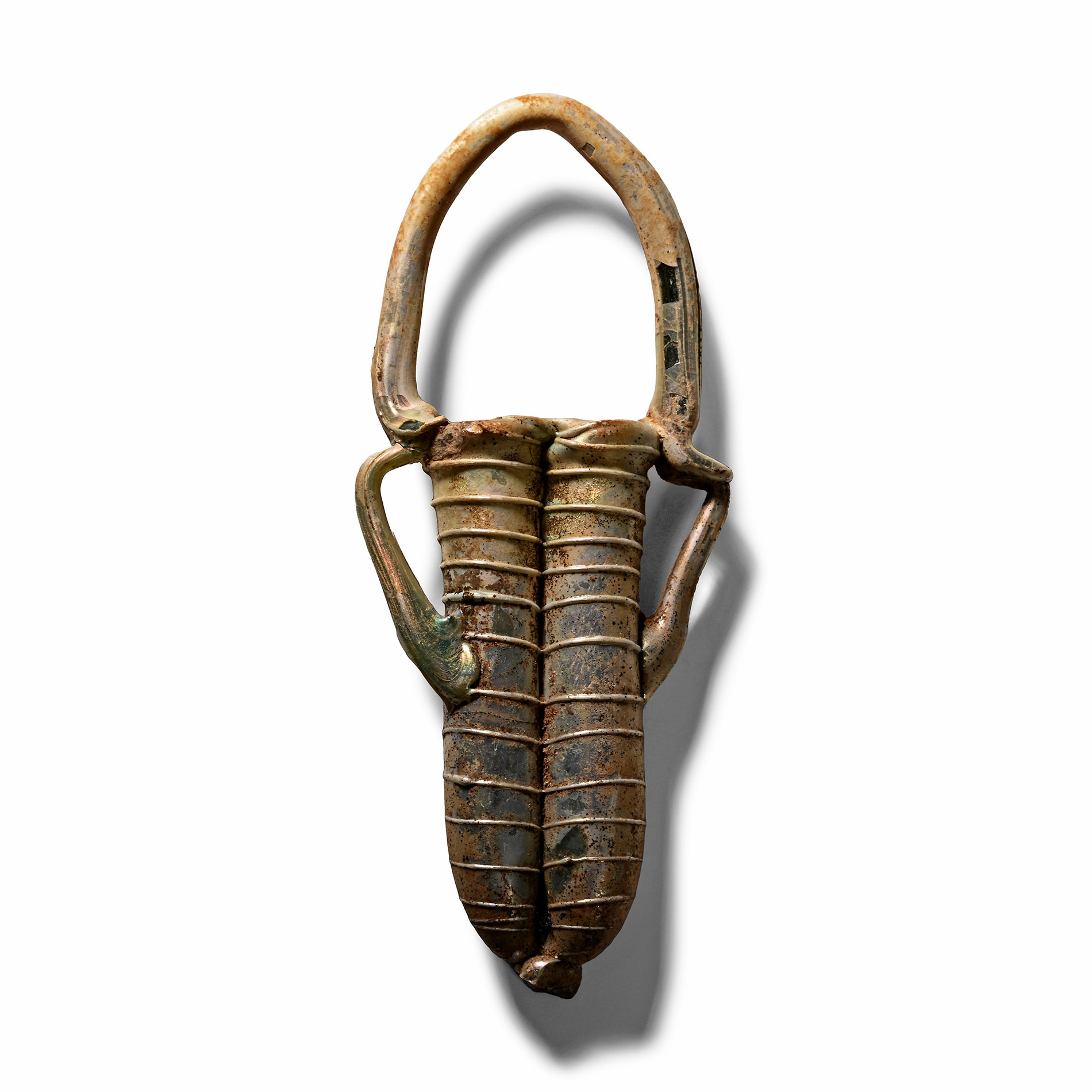
Roman Glass Double Unguentarium
2ND-3RD CENTURY A.D.
6 3/4 in. (59 grams, 17 cm).
With rolled rim to each tapering tube, applied trail detailing to the body, lateral angled handles and large applied loop handle above; iridescent surface.
ProvenanceAcquired in the mid 1980s-1990s.
Private collection, Switzerland, thence by descent.
Private collection, since the late 1990s.
This lot has been checked against the Interpol Database of stolen works of art and is accompanied by search certificate number no.12237-222167.
Cf. Lightfoot, C.S., Ancient Glass in National Museums Scotland, Edinburgh, 2007, item 460.
CONDITIONTimeLine Auctions follows a vetting process to ensure the authenticity and legality of all items, reinforcing our commitment to integrity and responsible trading. Each antiquity, antique, and coin lot undergoes thorough examination by a vetting committee of at least ten external specialists, professional trade association members, scientists, and archaeologists: Our Vetting Process
AUCTIONS:
TimeLine is a leading auction house specialising in antiquities, ancient art, collectables, natural history, coins, medals, and books. Our auctions offer museums, collectors, historians, and enthusiasts the opportunity to acquire unique and historically significant pieces.
LOT 0160
Roman Glass Double Unguentarium
Estimate £1,800 - 2,400€2,090 - 2,780 (for guidance only)$2,430 - 3,240 (for guidance only)
-
Redware Fragment with Amphibians
Roman, circa 2nd century A.D. or laterSold for (Inc. bp): £46
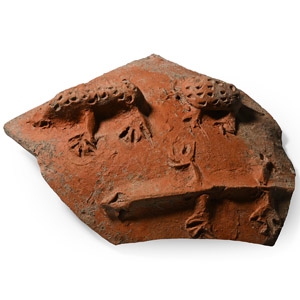
With curving profile, applied raised figures of a lizard, a frog and a turtle to the upper surface with incised detailing. 155 grams, 13 cm
Ex German art market, 2000s. Acquired from an EU collector living in London. From the collection of Surrey, UK, gentleman. -

Roman Bronze Military Knee Brooch Collection
2nd-3rd centuries A.D.Sold for (Inc. bp): £124
Comprising examples with sprung pins or hinged pins and catch plates to reverses. 66 grams total, 29-39 mm
Ex property of an Austrian private collector since the 1970s.
The knee brooches, especially in Britain, are connected to military sites, like the Hadrian’s Wall. The British types evolved after the continental versions appeared in Britannia, possibly having been imported by Noricum’s soldiers. -
Roman Sheet Gold Phalera Cover Pair with Pelta Shields
4th-6th century A.D.Sold for (Inc. bp): £247
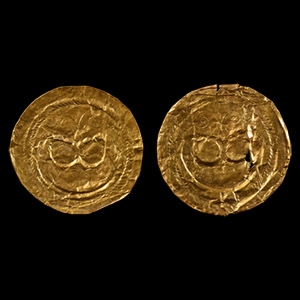
Comprising two discoid ornamental appliqués with beaded rims, each with repoussé pelta-shaped panel terminating in opposed bird-heads, surmounted by scrolled tendrils and a kantharos enclosed in a laurel crown. 7.28 grams total, 64-65 mm
Acquired in the early 1990s. From the collection of a London antiquarian. Accompanied by an academic report by Dr Raffaele D'Amato.
The subject represented on these two bracteae is a military shield in the form of a crescent, the so-called pelta, associated in the Late Roman iconography with the Amazon female warriors. This was not necessarily only an iconographic motif, considering that many shields of this typology were represented on the pedestal of the Column of Arcadius in Constantinople (circa 400 A.D.) and they seemed to be associated with the heavy cavalry of the Imperial guard (D’Amato-Negin, 2017, p.252). This could suggest that these gold sheets were applied upon phalerae or military decorations.
