
Loading, please wait...
LOT 0845
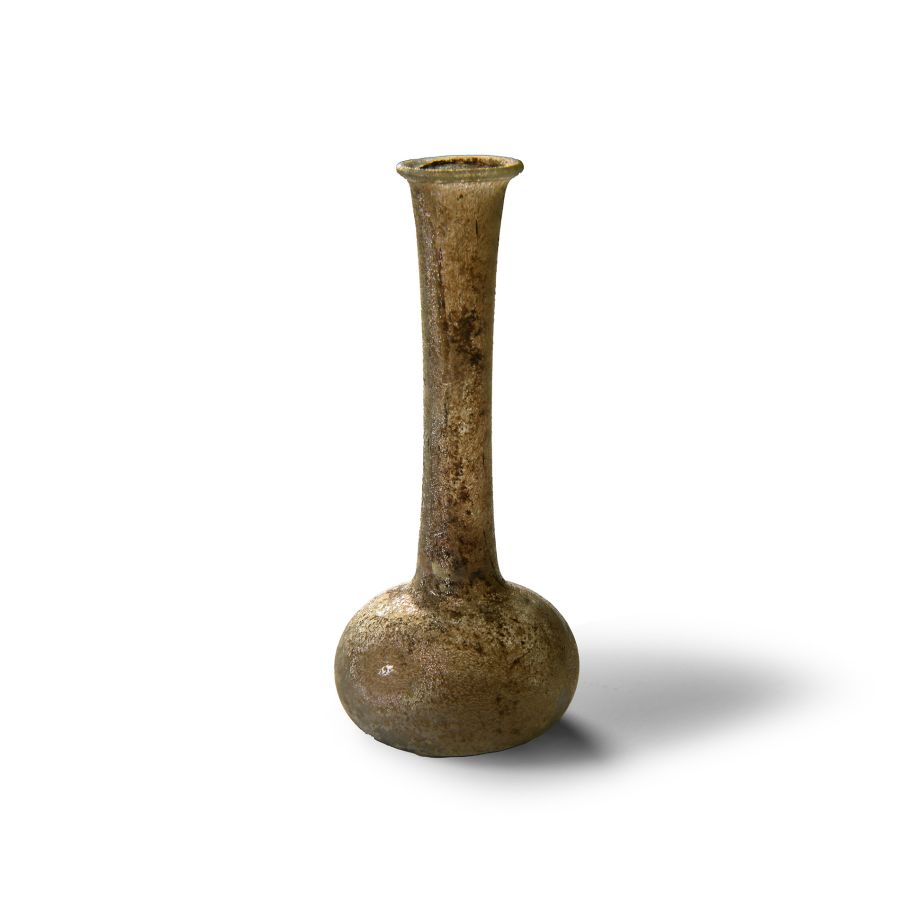
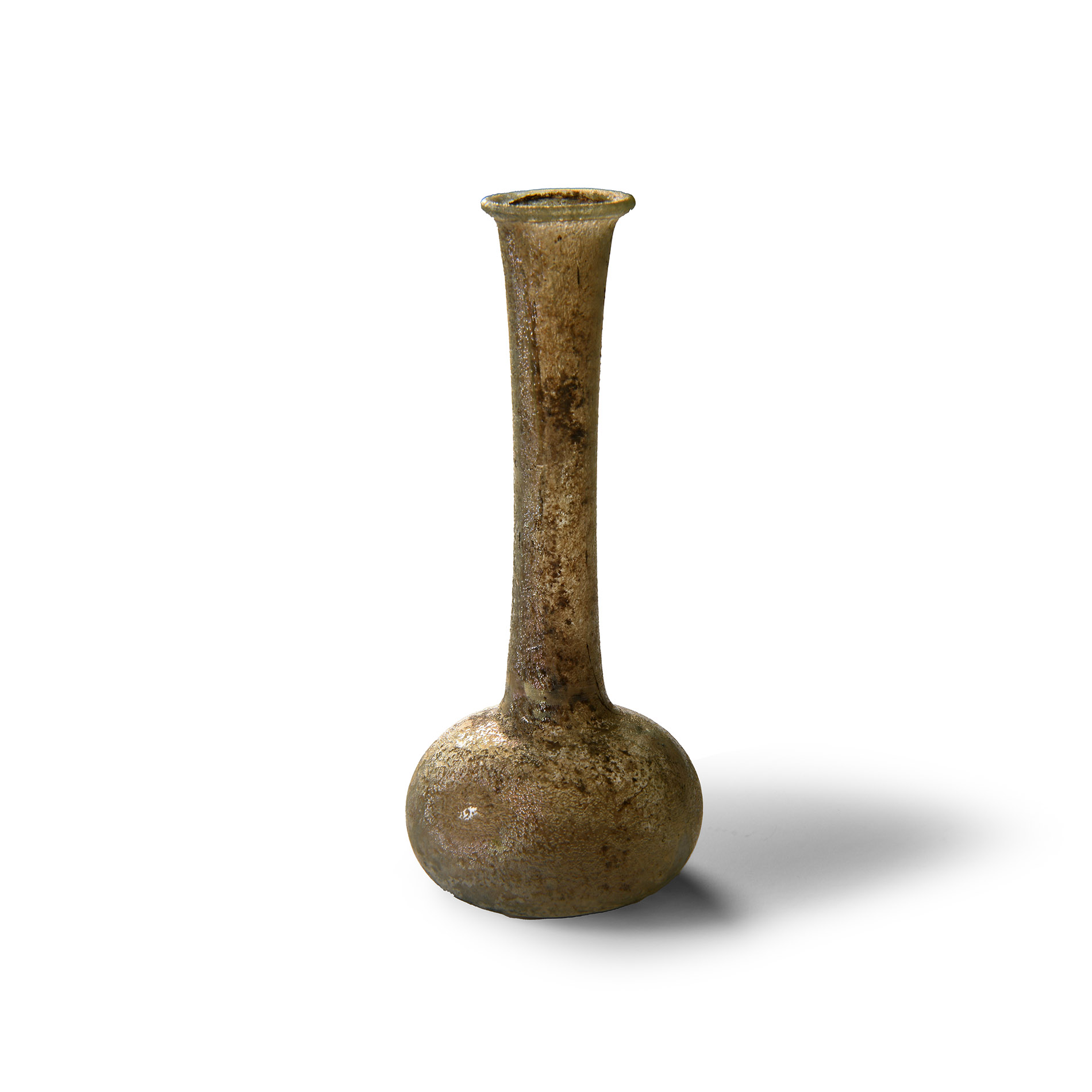
Roman Glass Candlestick Unguentarium
2ND-3RD CENTURY A.D.
4 1/8 in. (201 grams, 10.5 cm).
Bulbous body with flat bottom, tall tapering neck with everted rim.
ProvenanceAcquired 1980-2015.
Ex Abelita family collection.
Cf. Whitehouse, D., Roman Glass in the Corning Museum of Glass, vol.1, New York, 1997, item 259.
CONDITIONTimeLine Auctions follows a vetting process to ensure the authenticity and legality of all items, reinforcing our commitment to integrity and responsible trading. Each antiquity, antique, and coin lot undergoes thorough examination by a vetting committee of at least ten external specialists, professional trade association members, scientists, and archaeologists: Our Vetting Process
AUCTIONS:
TimeLine is a leading auction house specialising in antiquities, ancient art, collectables, natural history, coins, medals, and books. Our auctions offer museums, collectors, historians, and enthusiasts the opportunity to acquire unique and historically significant pieces.
-
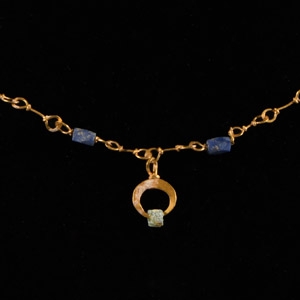
Roman Gold Necklace with Blue Glass Beads
3rd century A.D.Sold for (Inc. bp): £1,170
Comprising gold looped links with corner-less oblong and biconvex lapis lazuli beads, hook-and-eye closure, centrepiece a flat sheet gold hoop with iridescent turquoise-coloured glass bead. 4.66 grams, 39 cm long
Private collection of Mr S.A., Switzerland, 1994, thence by descent. -
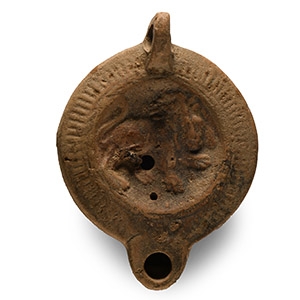
Roman Terracotta Oil Lamp with Lion
2nd-3rd century A.D.Sold for (Inc. bp): £208
Loop handle to the rear, low discus with an advancing lion with its head turned to the right, hatched decoration on the shoulder; concentric circles to the base. 108 grams, 11.2 cm
Acquired on the European art market, 1980s. English private collection.
This lamp belongs to the group of Provincial African lamps with a plain shoulder and a heart-shaped nozzle. Usually they are classified as D IX, but Italic and African variants of D X are very similar and have the shoulders with closely spaced outward-slanted rays, separated from discus by two circular grooves, here hardly visible. -
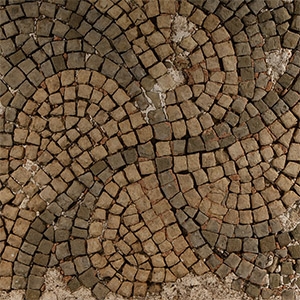
Roman 'Gloucestershire' Mosaic Panel
Circa 2nd-3rd century A.D.Sold for (Inc. bp): £1,105
Irregular mosaic fragment of beige, cream and grey tesserae with radiating trumpet-shaped swirls; mounted in a modern rectangular matrix. 33 kg, 76 cm high
Found Gloucestershire, UK. From a collection acquired on the UK art market from various auction houses and collections mostly before 2000. From an important Cambridgeshire estate; thence by descent.
A mosaic found in Cirenchester (insula IX, Chester Street) shows panels defined by a dark blue-grey single fillet with an additional double fillet parallel to it on a longer axis, having an overall scheme of running pelta-pattern. Each pelta is outlined in dark-blue grey and infilled with red, white and dark blue grey at the centre.
