
Loading, please wait...

LOT 0159
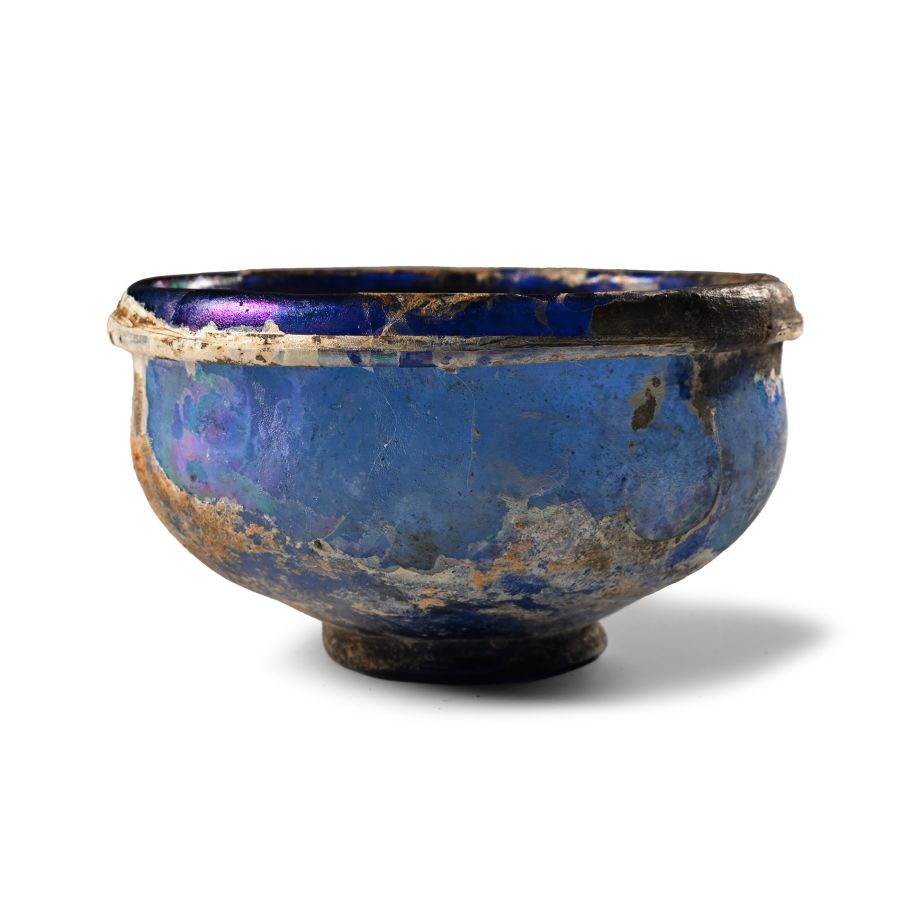
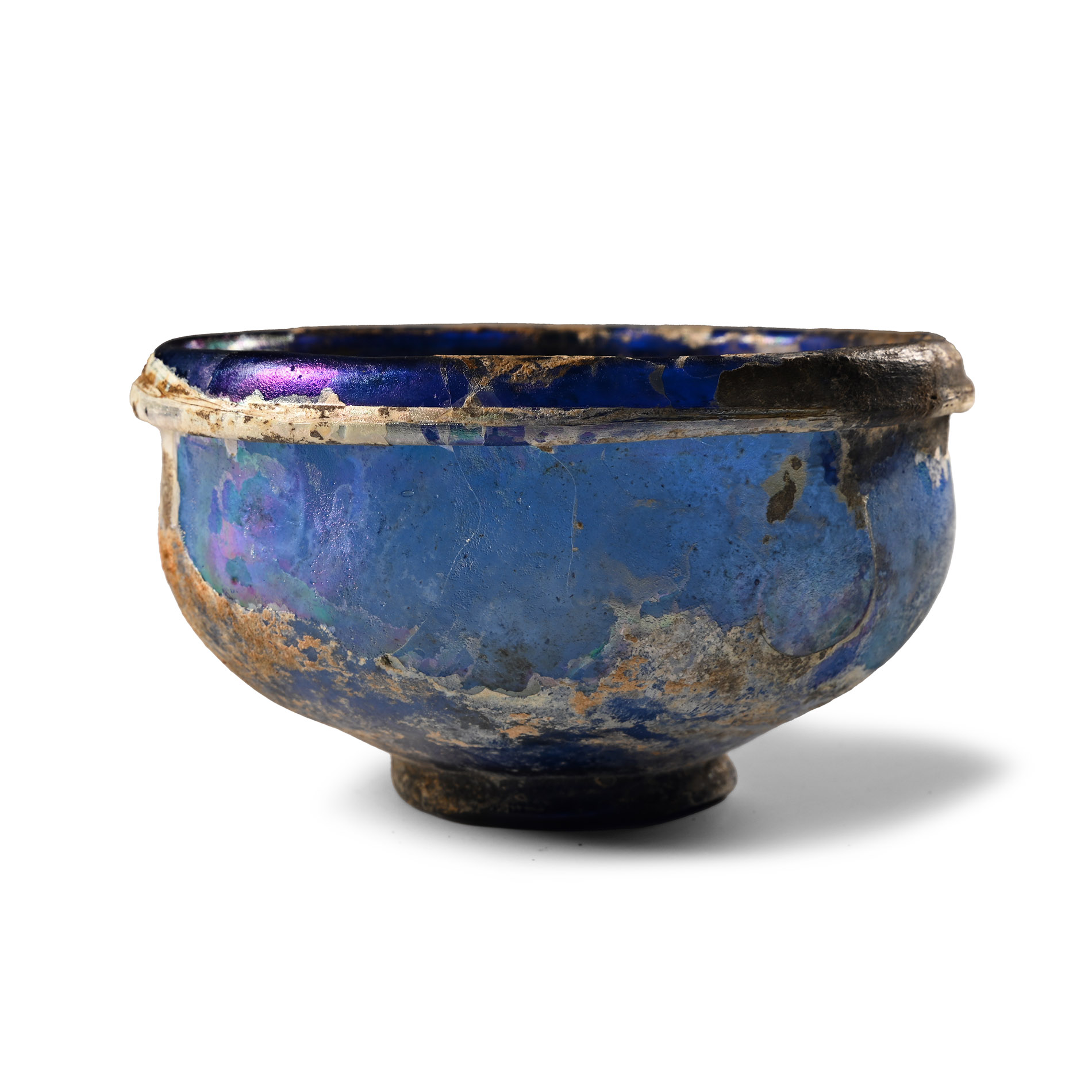
Roman Glass Bowl with Iridescence
1ST-2ND CENTURY A.D.
3 3/8 in. (45.5 grams, 84 mm wide).
Shallow in profile with basal ring, iridescent surface, applied collar below the rim; old collector's label '4231 TO' to base.
ProvenanceFrom the private collection of a French Count in the 19th century.
Ex Thierry de Maigret, April 2010.
Ex Sheikh Al Thani collection.
Cf. Whitehouse, D., Roman Glass in the Corning Museum of Glass, vol.2, New York, 2001, item 759, for type.
CONDITIONTimeLine Auctions follows a vetting process to ensure the authenticity and legality of all items, reinforcing our commitment to integrity and responsible trading. Each antiquity, antique, and coin lot undergoes thorough examination by a vetting committee of at least ten external specialists, professional trade association members, scientists, and archaeologists: Our Vetting Process
AUCTIONS:
TimeLine is a leading auction house specialising in antiquities, ancient art, collectables, natural history, coins, medals, and books. Our auctions offer museums, collectors, historians, and enthusiasts the opportunity to acquire unique and historically significant pieces.
LOT 0159
Roman Glass Bowl with Iridescence
Estimate £800 - 1,000€930 - 1,160 (for guidance only)$1,080 - 1,350 (for guidance only)
-

Roman Bronze Statuette Hand Holding Victory Wreath
1st century A.D.Sold for (Inc. bp): £59
Modelled in the round, right hand clutching a wreath of laurel leaves. 19.6 grams, 23 mm
From a collection acquired on the UK art market from various auction houses and collections mostly before 2000. From an important Cambridgeshire estate; thence by descent.
The hand raising the laurel wreath, symbol of Roman victory, could belong to a statuette representing the winged Victory, Nike. However, an important statuette of Flora, goddess of flowering and cereals, found in Witcombe Villa, represents her with raised hand holding a similar wreath, which does not necessarily correspond to a laurel wreath, but to an intertwined wreath of flowers , symbol of prosperity and spring. -

Roman Bronze Young Hercules Statuette
Circa 3rd century A.D.Sold for (Inc. bp): £130
Modelled in the round with kilt and lionskin mantle, standing with club resting on his shoulder, left hand concealed behind the body; mounted on a custom-made stand. 87 grams total, 55 mm including stand
From a collection acquired on the UK art market from various auction houses and collections mostly before 2000. From an important Cambridgeshire estate; thence by descent. -

Roman Marble Head of a Satyr
Late 1st-early 2nd century A.D.Estimate: £40,000 - 60,000 (‡+bp*)
Opening Bid: £20,000
Finely carved head of a young satyr with arched brows, pointed ears and tousled curly hair, his short rounded horns projecting from the hairline, lips drawn back in a mischievous smile with the tip of his tongue protruding to his right; head turned to his right, eyes slightly downcast; traces of wattles to each side of the jaw, tip of nose abraded, forelock chipped; mounted on a custom-made display stand. 18.2 kg total, 40 cm including stand
Christoph Bernoulli (1897-1981), Basel, possibly acquired from Münzen & Medaillen AG, Basel; thence by descent. Accompanied by an academic report by Dr Raffaele D’Amato. This lot has been checked against the Interpol Database of stolen works of art and is accompanied by search certificate no.12188-222442.
The head seems a work of the 2nd century A.D., derived from Hellenistic prototypes, likely based on a Greek original of the 4th or 3rd century B.C. traditionally associated with the work of Praxiteles, Skopas or Lysippos, depicting a standing Pan playing the flute with his legs crossed. However, both the present head and the Princeton example, always after Hellenistic prototypes of the mid-2nd century B.C., are close to the statue of the so-called Young Centaur signed by Aristeas and Papias, in bigio morato, which was found at Tivoli in Hadrian’s Villa and is now in the collection of the Capitoline Museum (inv. No. MC0656).
