
Loading, please wait...
LOT 0851
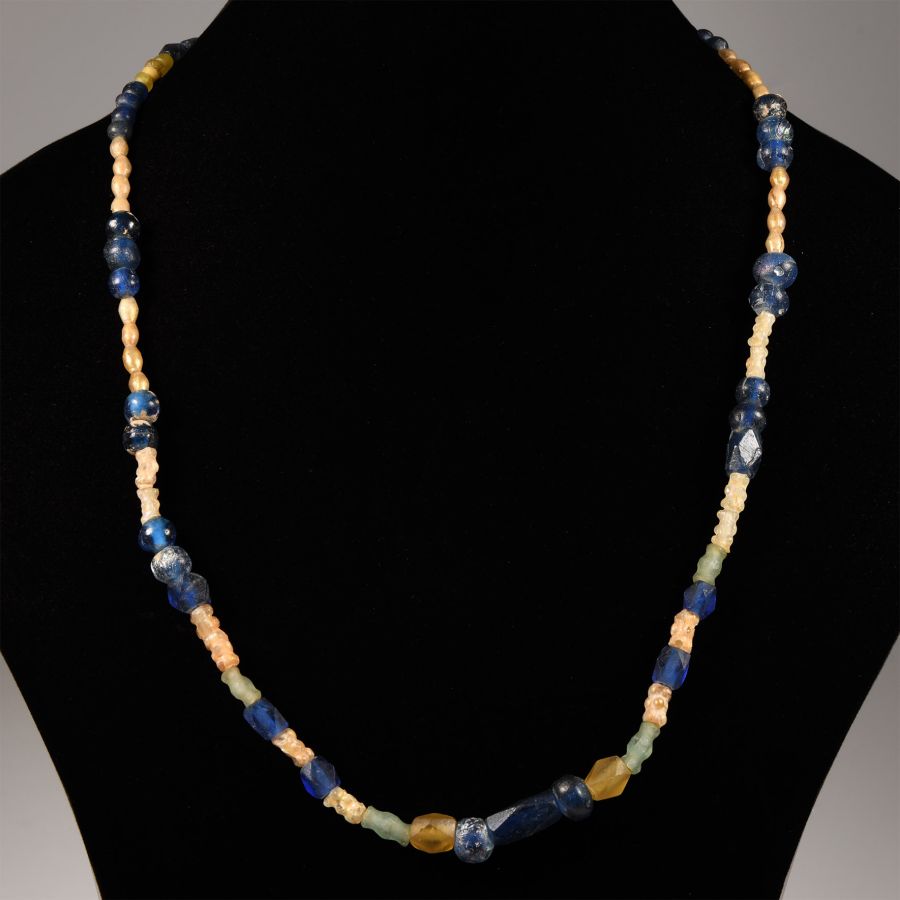
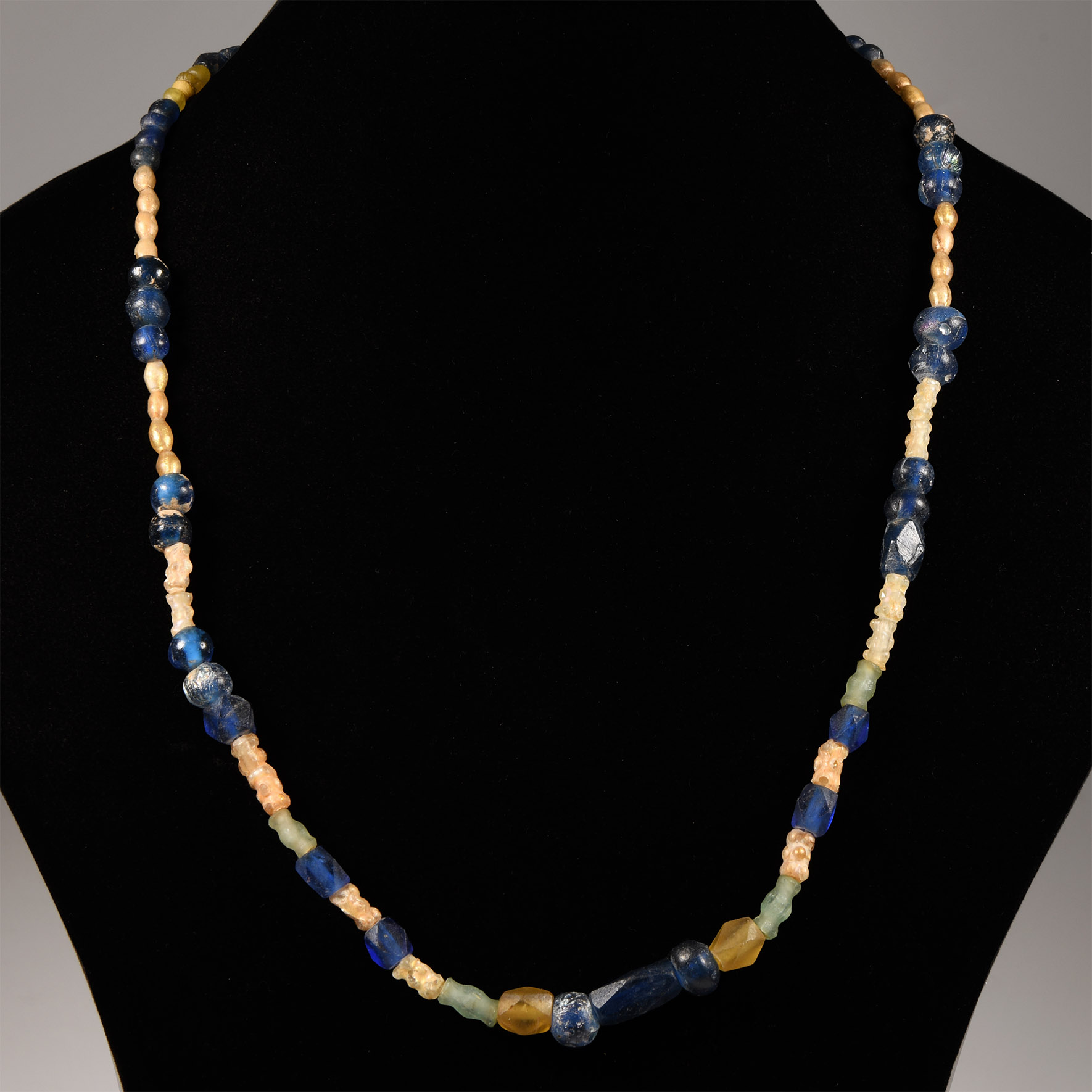
Roman Glass Bead Necklace
1ST-4TH CENTURY A.D.
27 1/8 in. (42 grams, 69 cm long).
Restrung group of bicones, faceted glass, oblates and rounded glass beads in various colours some with frosted surfaces.
Provenancewith a London, UK gallery 1971.
CONDITIONTimeLine Auctions follows a vetting process to ensure the authenticity and legality of all items, reinforcing our commitment to integrity and responsible trading. Each antiquity, antique, and coin lot undergoes thorough examination by a vetting committee of at least ten external specialists, professional trade association members, scientists, and archaeologists: Our Vetting Process
AUCTIONS:
TimeLine is a leading auction house specialising in antiquities, ancient art, collectables, natural history, coins, medals, and books. Our auctions offer museums, collectors, historians, and enthusiasts the opportunity to acquire unique and historically significant pieces.
-
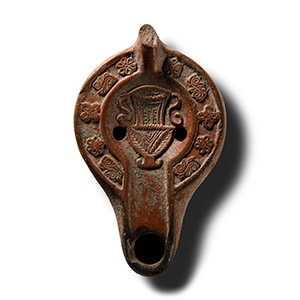
Roman Redware Oil Lamp with Amphora
North Africa, 5th century A.D.Sold for (Inc. bp): £286
With a lug handle and oval elongated body, two central filling-holes flanking the image of a kantharos, enclosed within a decorative shallow border on the shoulders with alternating floral S’s, concentric circles and quatrefoils; two thin concentric circles on the base with letter B in the middle, possibly the potter’s mark. 226 grams, 14.5 cm
From a collection acquired on the UK art market from various auction houses and collections mostly before 2000. From an important Cambridgeshire estate; thence by descent.
The lamp belongs to the type Atlante X or Hayes II A. The so-called Christian lamps in Terra Sigillata Africana have been classified by Hayes into two major types, I and II. He has distinguished two classes in his type II, according to geographic place of manufacture or origin. Subtype II A group lamps from central Tunisia are characterised by a fine clay, glossy light orange slip, and carefully executed decoration using a great number of neatly drawn shoulder motifs. The kantharos is a fairly common motif in Early Christian imagery, as a container of life giving water. -
.jpg)
Roman 'Published' Terracotta Oil Lamp with Fighting Gladiators
Early 1st century A.D.Sold for (Inc. bp): £2,340
Grey fabric, broad discus with concentric rings and chamfered shoulder, short nozzle flanked by volute scrolls; scene of two murmillo gladiators in combat, one having fallen to the ground; maker's stamp to the underside 'MAR[..]S'; mounted on a custom-made stand. 66 grams, 95 mm (137 grams total, 14.6 cm high including stand)
Ex Axel Guttmann collection of ancient arms and armour, Germany (1944-2001). with Christie's, Axel Guttmann collection of Ancient Arms and Armour, part 2, London, 28 April 2004, no.178 (part). European private collection. Exhibited at Harwich Museum, Harwich, Essex, UK, 3rd February-9th March 2024; accompanied by a copy of a photograph of the artefact on display. Accompanied by a copy of the Christie's online catalogue listing. Accompanied by copies of the relevant Das Spiel mit dem Tod, book pages. This lot has been checked against the Interpol Database of stolen works of art and is accompanied by search certificate no.12049-211932. -
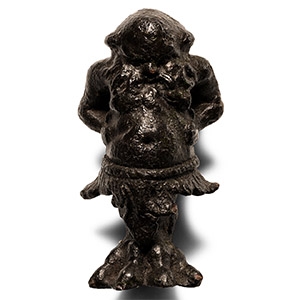
Roman Bronze Silenus Statuette Casket Fitting
2nd century B.C.-1st century A.D.Sold for (Inc. bp): £338
Standing wearing a hide skirt held up with rope, lion's claw foot below. arched bracket to rear. 124 grams, 63 mm
From a collection acquired on the UK art market from various auction houses and collections mostly before 2000. From an important Cambridgeshire estate; thence by descent.
