
Loading, please wait...
LOT 0694
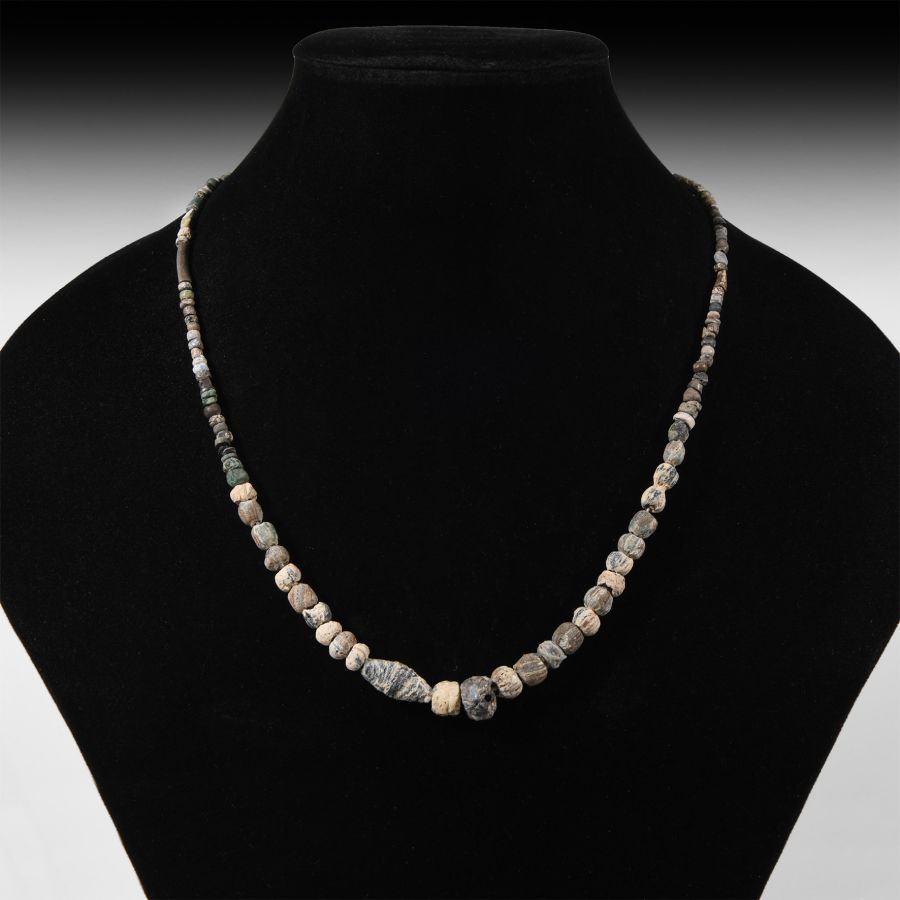
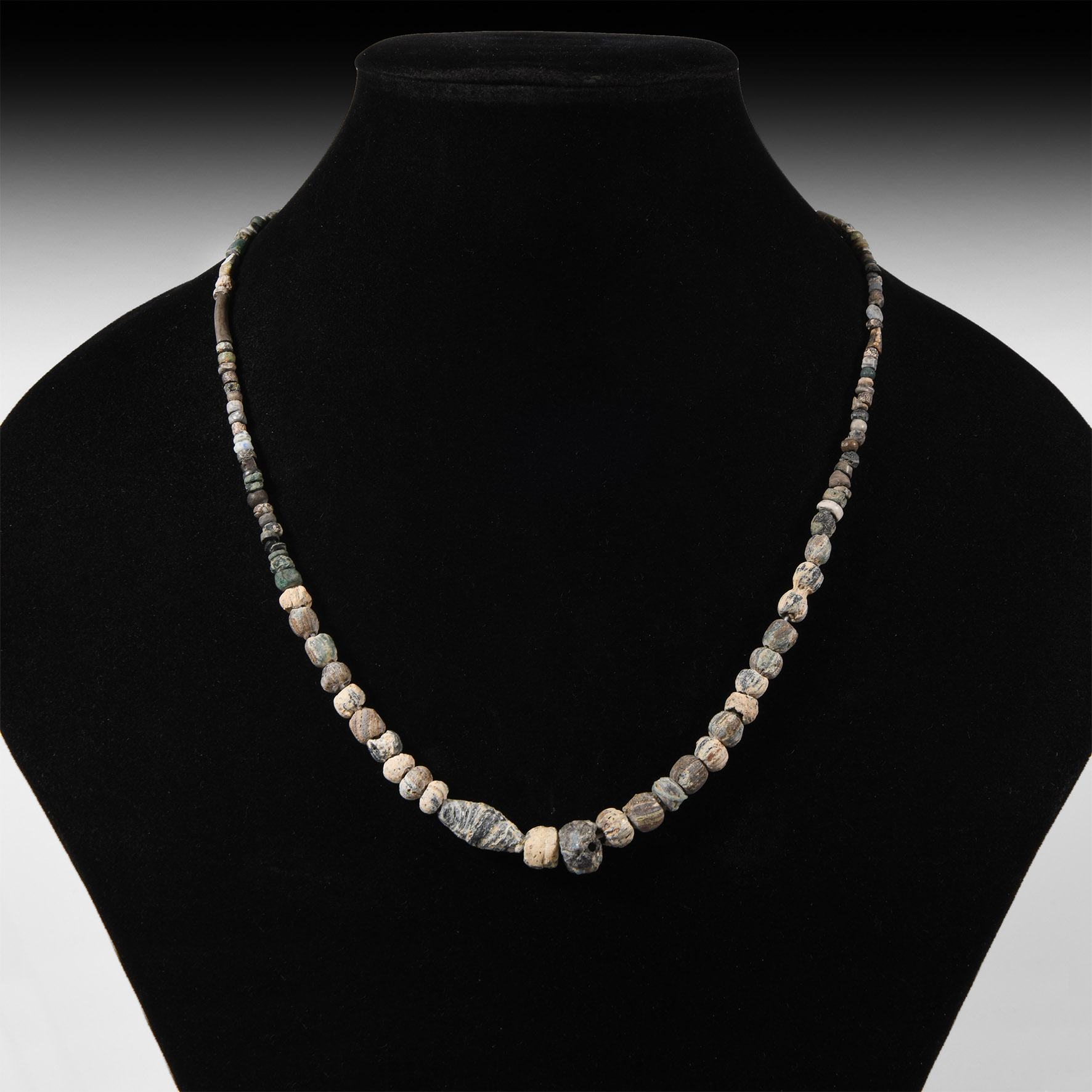
Roman Glass Bead Necklace
2ND-5TH CENTURY A.D.
30 1/4 in. (20.5 grams, 77 cm long).
Composed mainly of opaque glass beads of various colours, together with a number of stone beads, and incorporating beads of various types; restrung. [No Reserve]
ProvenanceEx W.J. collection, 1990s.
CONDITIONTimeLine Auctions follows a vetting process to ensure the authenticity and legality of all items, reinforcing our commitment to integrity and responsible trading. Each antiquity, antique, and coin lot undergoes thorough examination by a vetting committee of at least ten external specialists, professional trade association members, scientists, and archaeologists: Our Vetting Process
AUCTIONS:
TimeLine is a leading auction house specialising in antiquities, ancient art, collectables, natural history, coins, medals, and books. Our auctions offer museums, collectors, historians, and enthusiasts the opportunity to acquire unique and historically significant pieces.
-
Roman Bronze Phallic Pendant
1st-3rd century A.D.Sold for (Inc. bp): £59
With large suspension loop, curved shank and leaf-shaped finial. 8.61 grams, 35 mm
Acquired on the German art market around 2000. From the collection of a Surrey, UK, gentleman. -
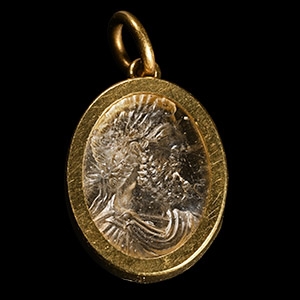
Yellow Sapphire Gemstone of Commodus in Later Gold Mount
Roman, 2nd century A.D. or laterSold for (Inc. bp): £1,430
The naturalistic pale yellow sapphire engraved with the bust of the emperor in profile right. 4.93 grams, 24 mm
Acquired in the 1980s. Ex European collection. Private collection of a London antiquarian.
The reign of Commodus (177-192 A.D.) is typically associated with the end of the period in Roman history, the golden era of peace. He initially reigned jointly with his father Marcus Aurelius (177-180 A.D.), and later alone. Commodus cultivated a personality cult which culminated in his performance as a gladiator in the Colosseum. He was eventually assassinated by a wrestler in the baths, marking the end of the Nerva-Antonine Dynasty. He was succeeded by Pertinax. -
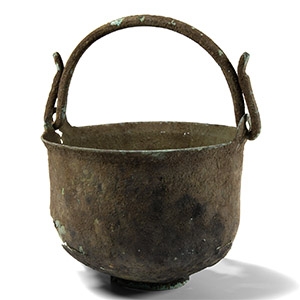
Roman Bronze Situla
1st century B.C.-1st century A.D.Sold for (Inc. bp): £182
Comprising a bell-shaped bowl, everted rim, shallow foot and round-section articulate handle; split, base absent. 560 grams, 20 cm wide
Acquired 1990s-early 2000s. East Anglian private collection.
Situla (plural situlae), from the Latin word for bucket or pail, is the term in archaeology and art history for a variety of elaborate bucket-shaped vessels from the Iron Age to the Middle Ages, usually with a handle at the top. Roman styles favoured a simple shape curving from the base, becoming vertical at the top, with a wide mouth and no shoulder, but sometimes with a projecting rim. These had a variety of uses, including aiding with washing and bathing.
