
Loading, please wait...
_900x900.jpg "Roman Glass and Other Mixed Bead Group")
_200x200.jpg "Roman Glass and Other Mixed Bead Group")
.jpg "Roman Glass and Other Mixed Bead Group")
LOT 0674
Roman Glass and Other Mixed Bead Group
CIRCA 1ST CENTURY A.D. OR LATER
22 in. (30.5 grams, 56 cm long).
A restrung group of glass beads of various types and colours, including reds, greens, blues and yellows. [No Reserve]
ProvenanceAcquired 1980-2015.
Ex Abelita family collection.
TimeLine Auctions follows a vetting process to ensure the authenticity and legality of all items, reinforcing our commitment to integrity and responsible trading. Each antiquity, antique, and coin lot undergoes thorough examination by a vetting committee of at least ten external specialists, professional trade association members, scientists, and archaeologists: Our Vetting Process
AUCTIONS:
TimeLine is a leading auction house specialising in antiquities, ancient art, collectables, natural history, coins, medals, and books. Our auctions offer museums, collectors, historians, and enthusiasts the opportunity to acquire unique and historically significant pieces.
-
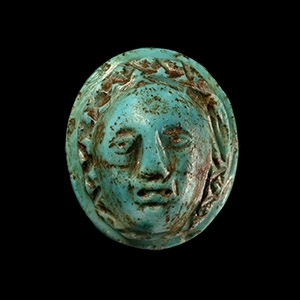
Roman Turquoise Cameo with Head of Medusa
1st-2nd century A.D.Sold for (Inc. bp): £845
Carved in relief in oval form, with stylised features. 0.89 grams, 11 mm
Ex private collection, 1980s. Acquired on the UK art market in the 1990s.
Turquoise is a very rare material for Roman cameos. -
.jpg)
Roman Gemstone with Winged Deities
Circa 1st-2nd century A.D.Sold for (Inc. bp): £494
Comprising a rock crystal cloison with intaglio scene of a winged kneeling male with outstretched arms receiving a winged baby from a seated winged female; accompanied by a museum-quality impression. 3.42 grams, 21 mm
Ex property of a London gentleman; acquired by his father in the 1970s; thence by descent. -
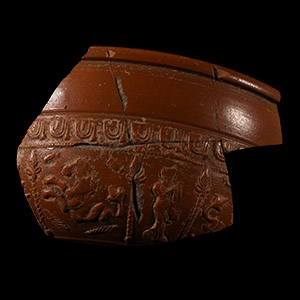
Roman Redware Bowl Fragment with Hippocampus and Standing Nereid
1st-2nd century A.D.Sold for (Inc. bp): £104
From the upper part of a vessel with two hippocampi (one partial) and a standing figure of a Nereid, floral and foliage decoration to the field, ornamental upper border; repaired. 77 grams, 12 cm
Acquired 1960s-1990s. From the late Alison Barker collection, a retired London barrister
The complete vessel probably represented scenes linked with the cult of Poseidon and Amphitrite. The riches of the sea and the dangers of navigation were merged by the ancients into a myth of great fame known as the wedding procession between Poseidon - brother of Zeus and Hades, god of the sea and the Nereid Amphitrite. The Nereids were the divinities of the sea, grandchildren of the ocean. Like the nymphs, all the Nereids were beautiful young women who spent their time singing or weaving. Also involved in the procession were the tritons and hippocampi, who provocatively played shells or were ridden by Nereids.
