
Loading, please wait...
LOT 0659
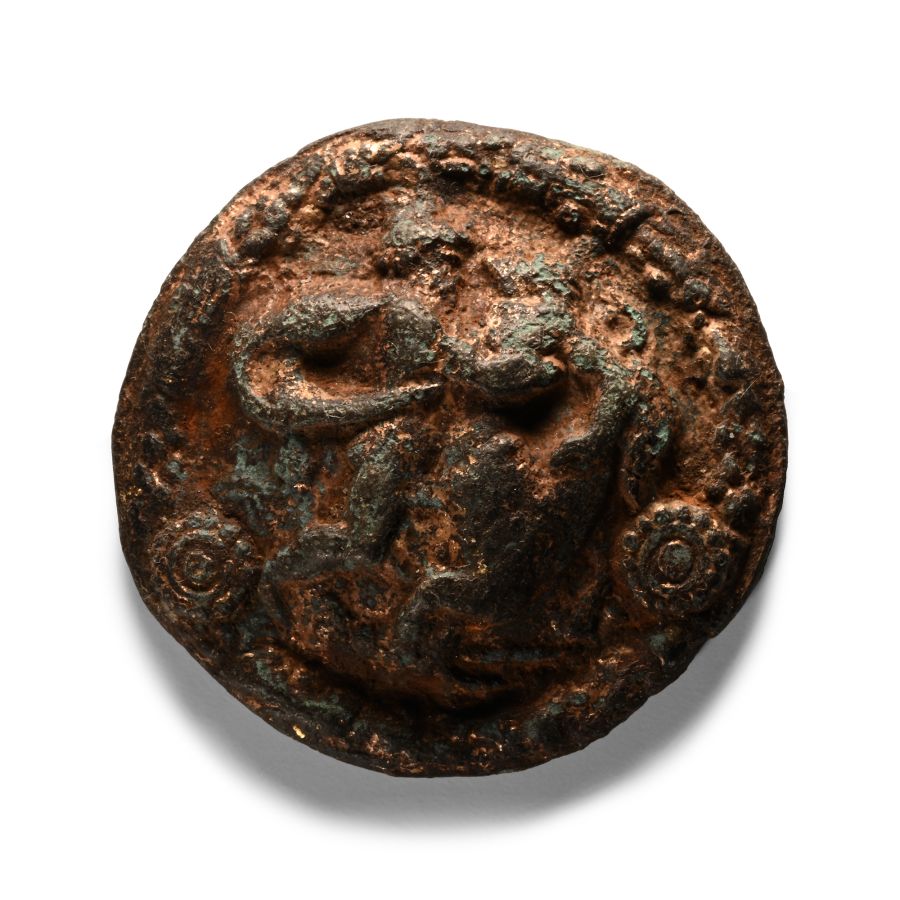
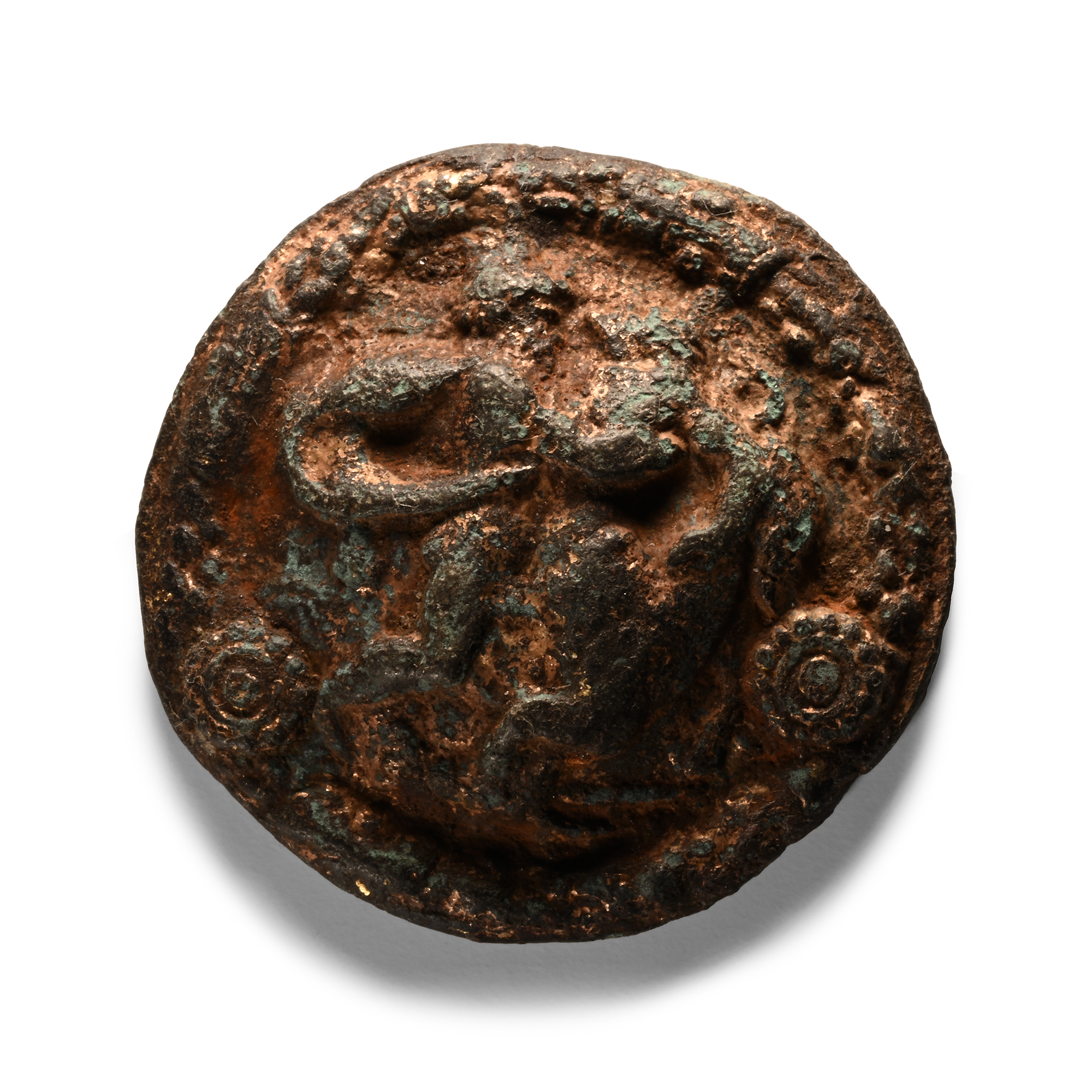
Roman Gilt Bronze Phalera with Theseus and the Minotaur
2ND CENTURY B.C.- 2ND CENTURY A.D.
2 in. (32 grams, 49 mm).
Domed roundel with high-relief design of combat between a bearded hero and a monster, wreath and rosettes to the rim.
ProvenanceFound near Sedgeford, Norfolk, UK, in the 1980s.
Acquired in the late 1990s.
Property of a Norfolk, UK, collector.
Cf. for surviving examples of this type of medallions or phalerae, often with an animal, compare various examples in the Staatliche Museen zu Berlin, inv. nos. 31630 and Fr. 1552 g 6-8; Babelon, E., and Blanchet, J.-A., Catalogue des bronzes antiques de la Bibliothéque Nationale, Paris, 1895, nos.12-13, 55, 65-66, 110, 132, 178, 193, 214, 264, 316-17, 359-60, 369, and 445; nos. 25, 28, 120, 143-44, 253, 301, 400, 434, 491, 622, 712, 715, 827, 844, and 1022.
FootnotesAccording to the legend, Theseus, prince of Athens, went to the island of Crete to kill a monster who was the son of queen Pasifae and a wild bull, although officially he was the son of Minos and Pasiphae. Theseus chased him into the labyrinth, killed him and found his way out with the help of the comb of Ariadne, daughter of King Minos. The myth has its representation in the Archaic, Classical and Hellenistic period, and was widely depicted in the Graeco-Roman world. The present repoussé appliqué was probably used as a furniture or horse harness ornament.
CONDITIONTimeLine Auctions follows a vetting process to ensure the authenticity and legality of all items, reinforcing our commitment to integrity and responsible trading. Each antiquity, antique, and coin lot undergoes thorough examination by a vetting committee of at least ten external specialists, professional trade association members, scientists, and archaeologists: Our Vetting Process
AUCTIONS:
TimeLine is a leading auction house specialising in antiquities, ancient art, collectables, natural history, coins, medals, and books. Our auctions offer museums, collectors, historians, and enthusiasts the opportunity to acquire unique and historically significant pieces.
LOT 0659
Roman Gilt Bronze Phalera with Theseus and the Minotaur
Estimate £200 - 300€230 - 350 (for guidance only)$270 - 410 (for guidance only)
-
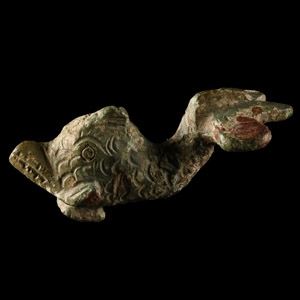
Roman Bronze Dolphin Statuette
Circa 2nd-3rd century A.D.Sold for (Inc. bp): £98
Modelled in the round with scale detailing, pellet eyes, rectangular mounting lug. 25.4 grams, 44 mm
Property of the vendor's grandfather, thence by family descent, circa 1985. From the private collection of a New York, USA gentleman. -
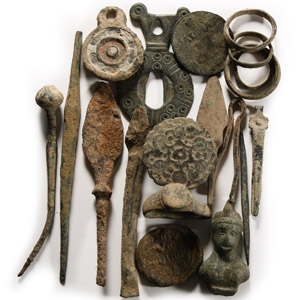
Roman and Later Bronze Artefact Collection
Mainly 1st-3rd century A.D.Sold for (Inc. bp): £104
Including bust of Victory pendant, tanged arrowhead, rosette belt slider, finger rings and other items. 145 grams total, 17-99 mm
Ex Nigel Mills, London, UK. -
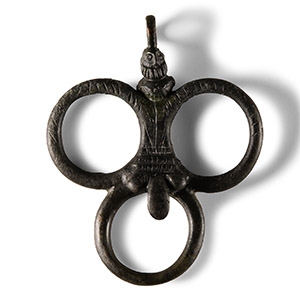
Roman Bronze Looped Figural Pendant with Phallus
Circa 1st century A.D.Sold for (Inc. bp): £286
Composed of three concentric circles surmounted by a bearded figure to which is attached a suspension ring, the body of the figure engraved and ending with phallic attributes. 53 grams, 83 mm
Acquired before 2000. From the collection of a European gentleman living in the UK.
Roman military harness included pendants of various typology, ranging from lunules to other decorative elements, often phallic, with the possible intention of protecting the animal. This particular pendant could be connected to the bearded image of the god Priapus.
