
Loading, please wait...
_900x900.jpg "Roman Gemstone with Victory Scene")
_200x200.jpg "Roman Gemstone with Victory Scene")
.jpg "Roman Gemstone with Victory Scene")
LOT 0813
Roman Gemstone with Victory Scene
2ND-3RD CENTURY A.D.
3/4 in. (2.73 grams, 20 mm).
Ellipsoid intaglio insert with seated female figure beside an altar and holding a staff or spear, to her rear standing figure of Victory, winged and holding a wreath over the head of the seated figure.
ProvenanceFrom the collection of a gentleman, acquired on the London art market in the 1990s.
This lot is accompanied by an illustrated lot declaration signed by the Head of the Antiquities Department, Dr Raffaele D'Amato.
TimeLine Auctions follows a vetting process to ensure the authenticity and legality of all items, reinforcing our commitment to integrity and responsible trading. Each antiquity, antique, and coin lot undergoes thorough examination by a vetting committee of at least ten external specialists, professional trade association members, scientists, and archaeologists: Our Vetting Process
AUCTIONS:
TimeLine is a leading auction house specialising in antiquities, ancient art, collectables, natural history, coins, medals, and books. Our auctions offer museums, collectors, historians, and enthusiasts the opportunity to acquire unique and historically significant pieces.
LOT 0813
Roman Gemstone with Victory Scene
Estimate £500 - 700€580 - 810 (for guidance only)$680 - 950 (for guidance only)
-

Roman Green Glass Bead Necklace String
1st-4th century A.D. and laterSold for (Inc. bp): £46
Restrung group of oblate and other beads. 9.67 grams, 39 cm
Ex London, UK, collection, 1990s. This lot is accompanied by an illustrated lot declaration signed by the Head of the Antiquities Department, Dr Raffaele D'Amato. -
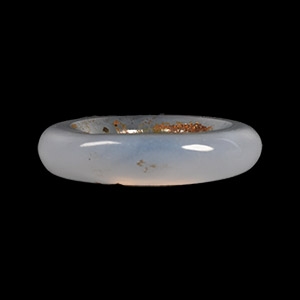
Roman Chalcedony Ring
1st century B.C.-1st century A.D. or laterSold for (Inc. bp): £104
Ellipsoid-shaped with carinated hoop on both inner and outer side. 3.56 grams, 25.90 mm overall, 14.47 mm internal diameter (approximate size British F 1/2, USA 3, Europe 4.3, Japan 4)
with H.A.C.A.G., Basel, prior 1999. This lot is accompanied by an illustrated lot declaration signed by the Head of the Antiquities Department, Dr Raffaele D’Amato. This lot is accompanied by an illustrated lot declaration signed by the Head of the Antiquities Department, Dr Raffaele D'Amato.
This ring, with a flat ellipsoid-shaped bezel, is related to type 2i of the Roman rings in Gallia, and they were usually considered as grave goods. Similar rings have often been found in Illyricum, Salonae, Zadar, Nin or Asseria. -
.jpg)
Late Roman Gold Earrings with Pearl Drops
4th-6th century A.D.Sold for (Inc. bp): £819
Matched pair, each a crescent hoop with four gold chain dangles with pearl finials. 13.44 grams total, 56 mm each
Ex Gorny & Mosch, Munich, Germany, December 2010. From the collection of a London, UK, gentleman. This lot is accompanied by an illustrated lot declaration signed by the Head of the Antiquities Department, Dr Raffaele D'Amato.
