
Loading, please wait...
LOT 0722
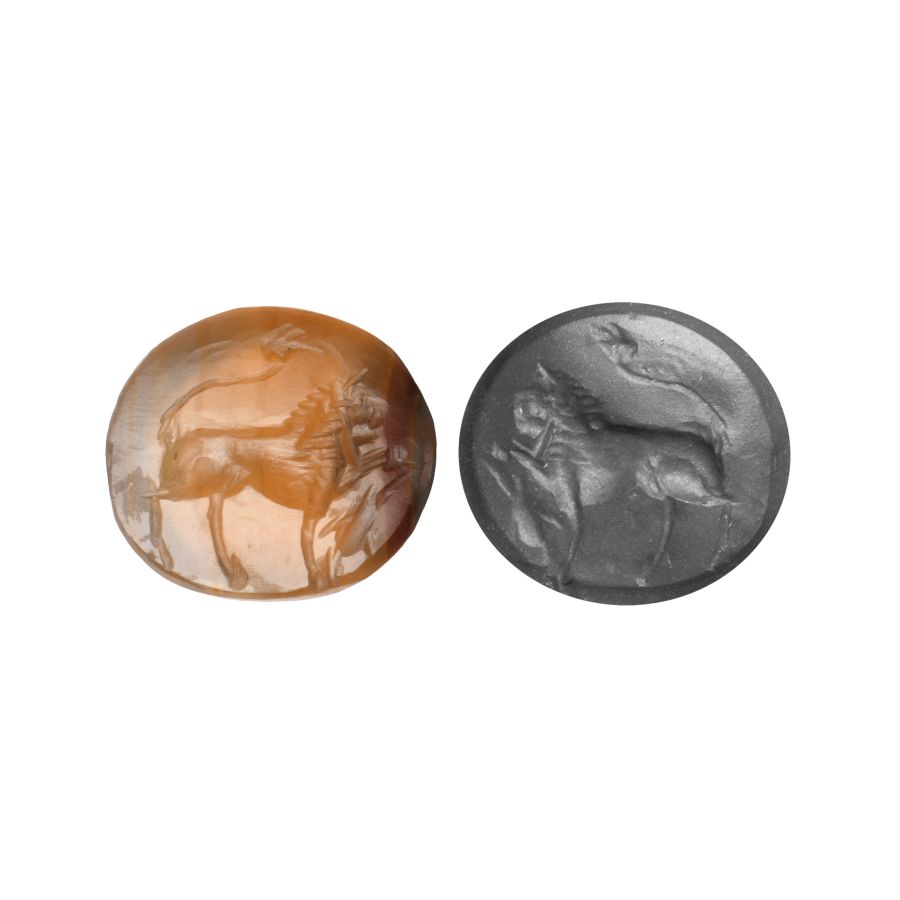
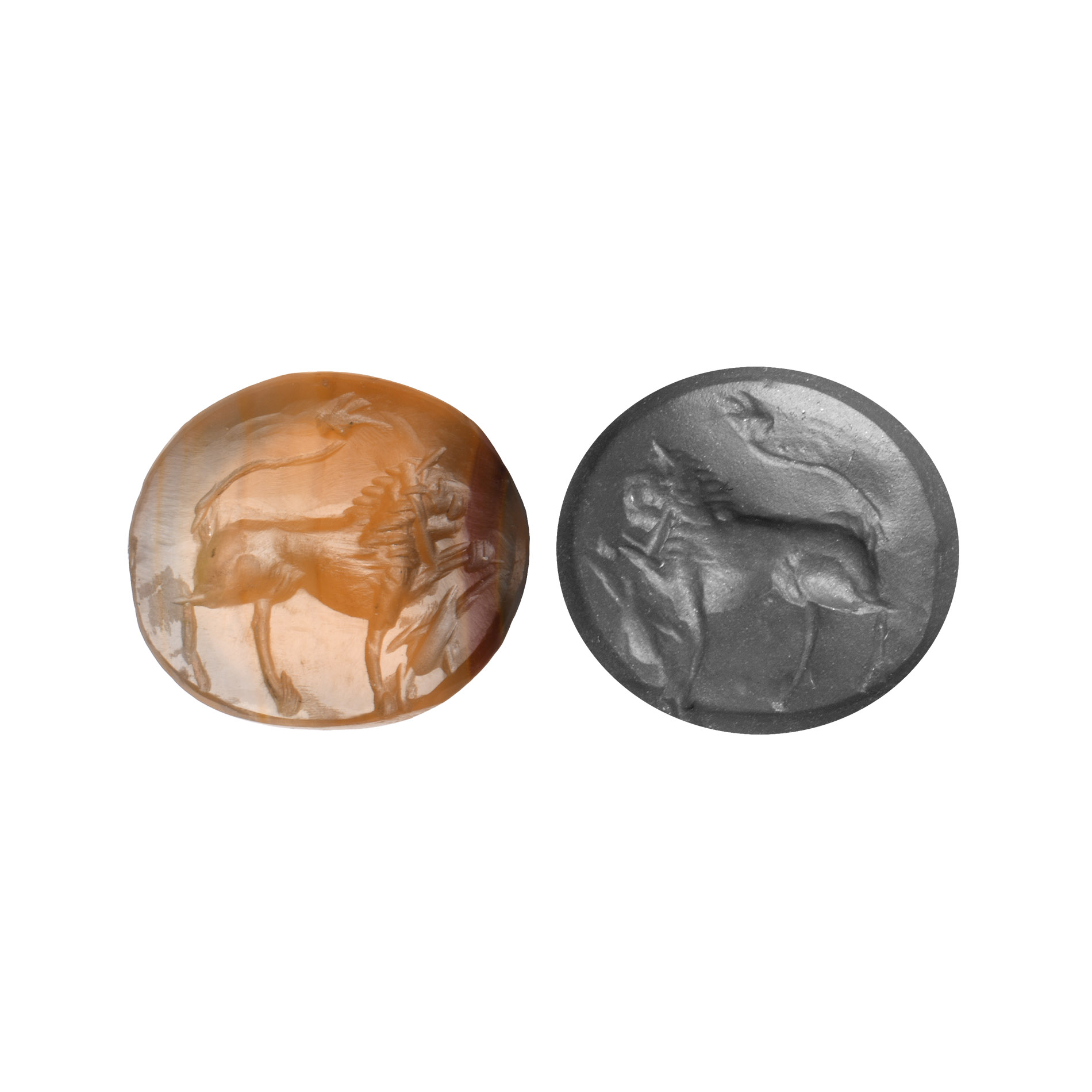
Roman Gemstone with Lion
CIRCA 2ND-3RD CENTURY A.D.
1/2 in. (1.79 grams, 14 mm).
Of truncated conical form, the agate stone engraved with a prancing male lion facing right, one front leg and tail raised; accompanied by a museum-quality impression.
ProvenanceAcquired on the European art market in the late 1960s-early 1970s.
CONDITIONTimeLine Auctions follows a vetting process to ensure the authenticity and legality of all items, reinforcing our commitment to integrity and responsible trading. Each antiquity, antique, and coin lot undergoes thorough examination by a vetting committee of at least ten external specialists, professional trade association members, scientists, and archaeologists: Our Vetting Process
AUCTIONS:
TimeLine is a leading auction house specialising in antiquities, ancient art, collectables, natural history, coins, medals, and books. Our auctions offer museums, collectors, historians, and enthusiasts the opportunity to acquire unique and historically significant pieces.
LOT 0722
Roman Gemstone with Lion
Estimate £300 - 400€350 - 460 (for guidance only)$410 - 540 (for guidance only)
-
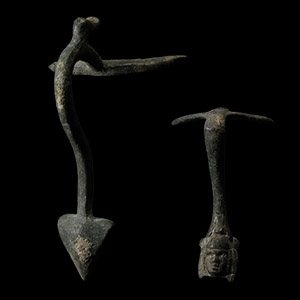
Roman Bronze Tankard Handle Group
Circa 1st-4th century A.D.Estimate: £100 - 140 (+bp*)
Opening Bid: £40
Comprising two differently sized handles, one featuring a female mask, the other with a leaf-shaped terminal and stylised duck's head to the apex of the bow. 411 grams total, 11.4-18 cm
Acquired 1990s-early 2000s. East Anglian private collection. -
.jpg)
Roman Gold Ring with Carnelian Cameo of Eros
Early 3rd century A.D.Estimate: £1,200 - 1,700 (+bp*)
Opening Bid: £480
Composed of a convex hoop with expanding angled shoulders, oval bezel set with carnelian cameo gemstone carved with the head and face of Eros with pinched features and centrally-parted hair; a marriage. 7.09 grams, 21.79 mm overall, 17.87 mm internal diameter (approximate size British H 1/2, USA 4, Europe 6.81, Japan 6)
Acquired 1990s-early 2000s. East Anglian private collection.
This ring belongs to the typology of gold rings with gem (Type II, Variant I) of Ruseva-Slokoska classification. -
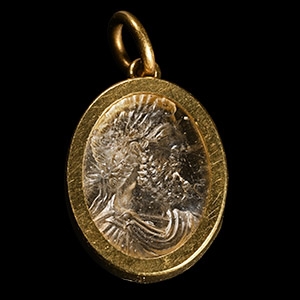
Yellow Sapphire Gemstone of Commodus in Later Gold Mount
Roman, 2nd century A.D. or laterSold for (Inc. bp): £1,430
The naturalistic pale yellow sapphire engraved with the bust of the emperor in profile right. 4.93 grams, 24 mm
Acquired in the 1980s. Ex European collection. Private collection of a London antiquarian.
The reign of Commodus (177-192 A.D.) is typically associated with the end of the period in Roman history, the golden era of peace. He initially reigned jointly with his father Marcus Aurelius (177-180 A.D.), and later alone. Commodus cultivated a personality cult which culminated in his performance as a gladiator in the Colosseum. He was eventually assassinated by a wrestler in the baths, marking the end of the Nerva-Antonine Dynasty. He was succeeded by Pertinax.
