
Loading, please wait...
LOT 0073
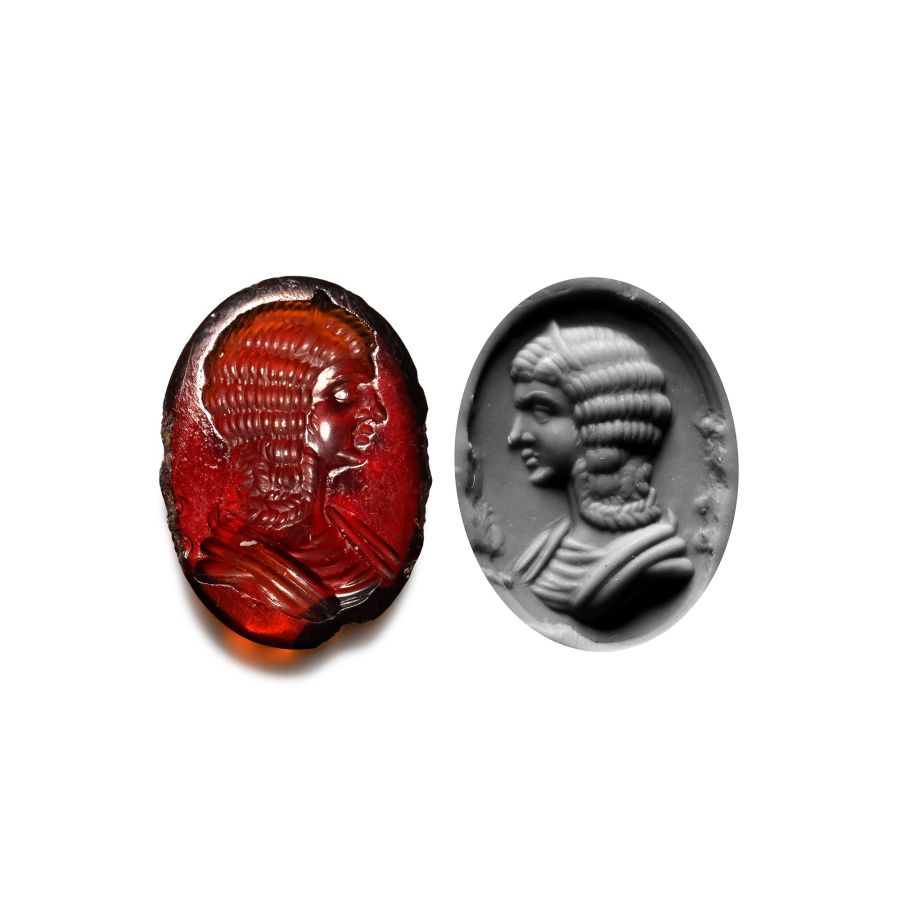
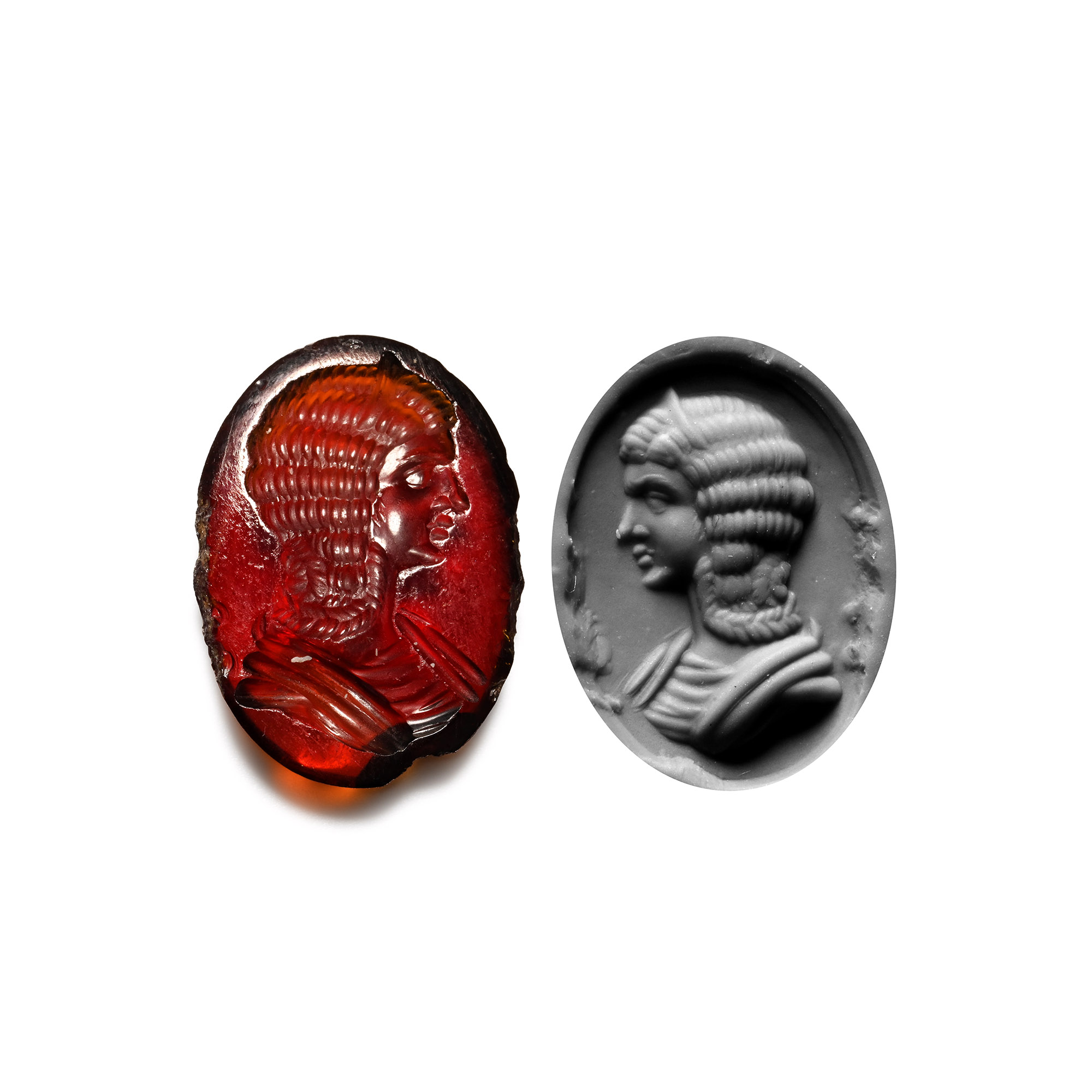
Roman Garnet Gemstone with Bust of Julia Domna
2ND-3RD CENTURY A.D.
3/4 in. (3.06 grams, 21 mm).
With incuse profile female bust with copious tiered curls and braids, palla to the shoulder; supplied with a museum-quality impression.
ProvenanceEx London, UK, gentleman, 1990s.
This lot has been checked against the Interpol Database of stolen works of art and is accompanied by search certificate number no.13002-244442.
Cf. similar cameo in Museum of Applied Arts, Budapest, accession no. 62.577.
FootnotesJulia Domna (170-217 A.D.) was one of the most honoured imperial women in the course of the Principate. Almost 600 inscriptions bear her name; numerous coin types portray her together with the emperors; important artworks where she is depicted (such as the Kassel Cameo, the Arch of the Argentarii and the Severan Arch in Leptis Magna) demonstrate that she occupied no secondary position in the Severan regime. She appears, consequently, to be a key figure of this period.
CONDITIONTimeLine Auctions follows a vetting process to ensure the authenticity and legality of all items, reinforcing our commitment to integrity and responsible trading. Each antiquity, antique, and coin lot undergoes thorough examination by a vetting committee of at least ten external specialists, professional trade association members, scientists, and archaeologists: Our Vetting Process
AUCTIONS:
TimeLine is a leading auction house specialising in antiquities, ancient art, collectables, natural history, coins, medals, and books. Our auctions offer museums, collectors, historians, and enthusiasts the opportunity to acquire unique and historically significant pieces.
LOT 0073
Roman Garnet Gemstone with Bust of Julia Domna
Estimate £3,000 - 4,000€3,480 - 4,640 (for guidance only)$4,050 - 5,400 (for guidance only)
-
Roman Glass Vessel
1st-3rd century A.D.Estimate: £100 - 140 (+bp*)
Opening Bid: £50
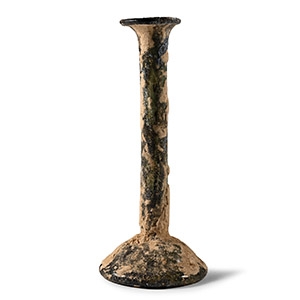
Tall thin translucent pale green vessel with wide foot and dimpled base, tapering stem and flared rim. 27.6 grams, 12.5 cm
From a London, UK, collection, 1990s. This lot is accompanied by an illustrated lot declaration signed by the Head of the Antiquities Department, Dr Raffaele D’Amato.
Similar bottles were produced in Roman Cyprus, mainly. Hayes had divided the Cypriot products into three classes on the basis of the character of the glass. This example belongs to the third class, i.e. ‘very thin walled pieces in a pale fabric, almost colorless in parts’. -
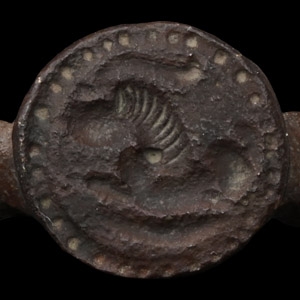
Roman Bronze Ring with Animal
3rd-5th century A.D.Sold for (Inc. bp): £20
Slender hoop with discoid bezel, piecrust design on the outer edge surrounding a zoomorphic motif. 4.88 grams, 24.90 mm overall, 19.78 x 18.85 mm internal diameter (approximate size British S, USA 9, Europe 20, Japan 19)
Ex German art market, 2000s. Acquired from an EU collector living in London. From the collection of a Surrey, UK, gentleman. -
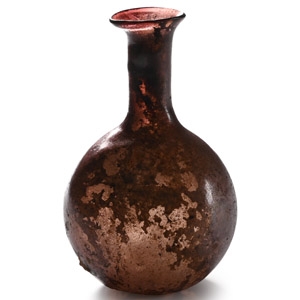
Roman Aubergine Glass Bottle
1st century B.C-1st century A.D.Estimate: £300 - 400 (+bp*)
Opening Bid: £165
With bulbous body, tubular neck, broad everted rim; extensive iridescence. 10.6 grams, 70 mm
From an important London collection of glass, 1990s. This lot is accompanied by an illustrated lot declaration signed by the Head of the Antiquities Department, Dr Raffaele D'Amato.
Similar bottles were found in the Cemetery of Ein-Gedi in the Judaean Desert, in a settlement abandoned in 40-37 B.C, and in Homs, Syria, dated to the first half of the first century A.D. These are among the first earliest datable blown bottles.
