
Loading, please wait...
LOT 0847
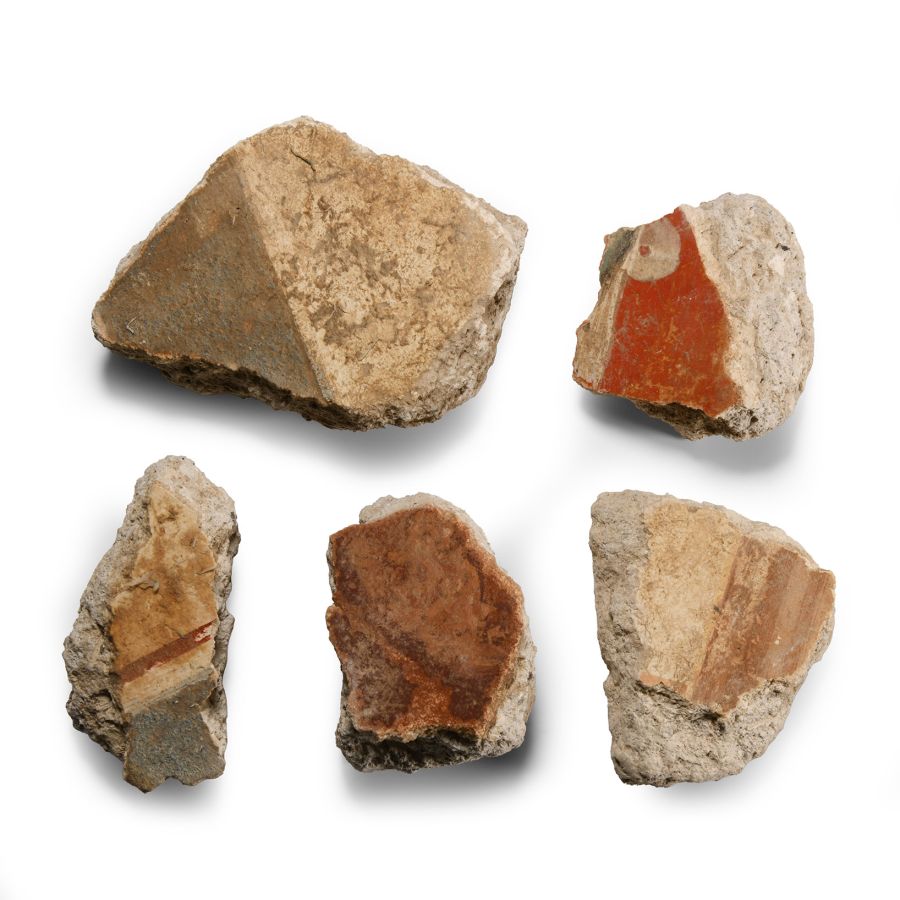
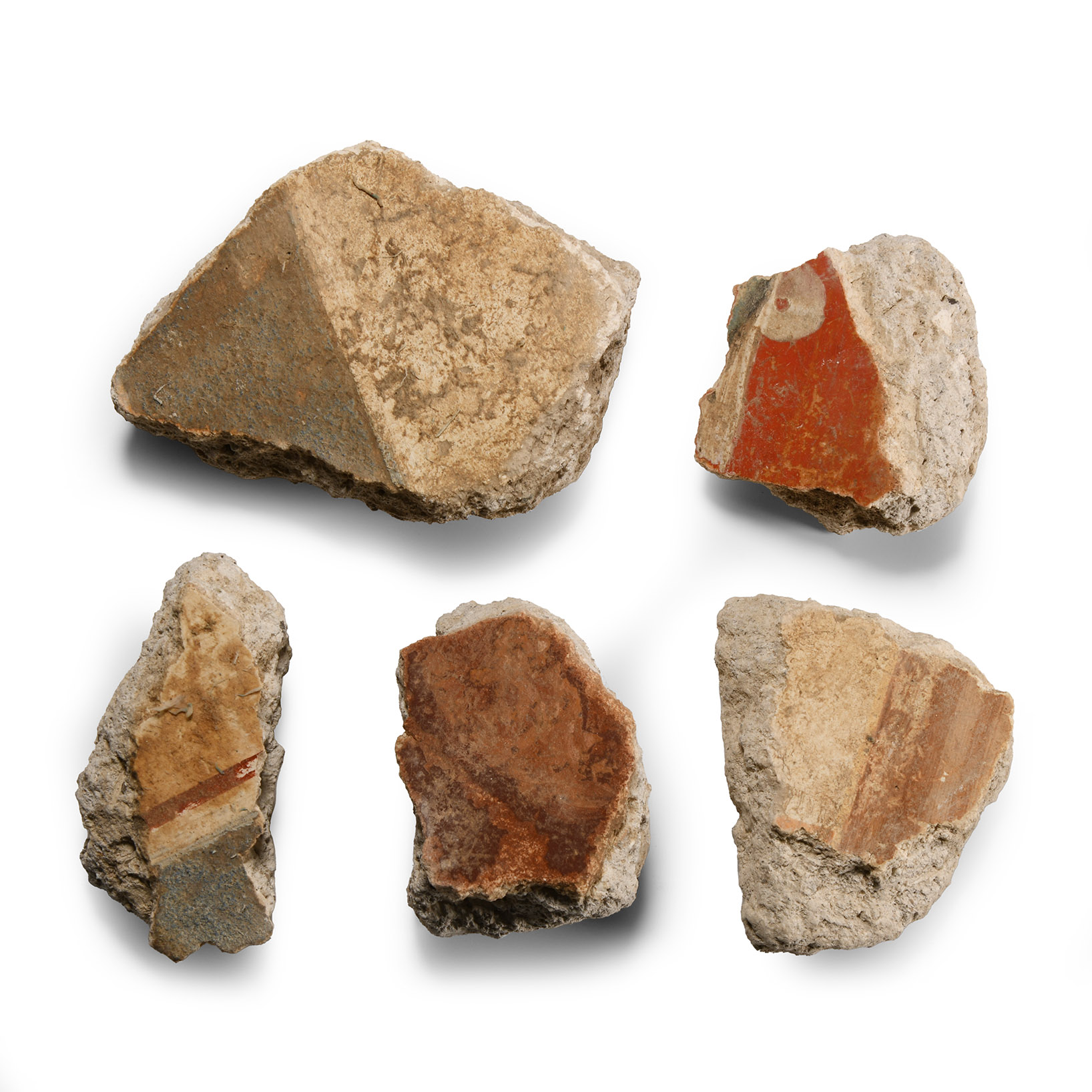
Roman Fresco Wall Plaster Collection
1ST CENTURY A.D.
2 1/8 - 4 in. (417 grams total, 5.5-10 cm).
Fragments of wall plaster with rendered surface painted red with brown detailing to the edge; impression of timber laths to the reverse. [No Reserve]
ProvenanceAcquired in the 19th century.
Ex Jeger collection, Switzerland.
Cf. Hakanen, V., 'VI Wall Plaster Fragments' in Berg, R., Kuivalainen, I., Domus Pompeiana M. Lucretii, IX,3, 5.24, The inscriptions, Works of Art and Finds from the Old and New Excavations, Vantaa, 2019, pp.196-224, figs.3-4.
FootnotesThese small fragments, for analogies with the fragments of Pompeii, seems to belong to the second style of Roman painting, red panels representing highlight and shadow, decorated with vegetal interlaces. Some panels were probably framed by a red grenade fillet. A fragment shows alternate blue and red colour over a cream background, maybe pertinent to a socle.
CONDITIONTimeLine Auctions follows a vetting process to ensure the authenticity and legality of all items, reinforcing our commitment to integrity and responsible trading. Each antiquity, antique, and coin lot undergoes thorough examination by a vetting committee of at least ten external specialists, professional trade association members, scientists, and archaeologists: Our Vetting Process
AUCTIONS:
TimeLine is a leading auction house specialising in antiquities, ancient art, collectables, natural history, coins, medals, and books. Our auctions offer museums, collectors, historians, and enthusiasts the opportunity to acquire unique and historically significant pieces.
-
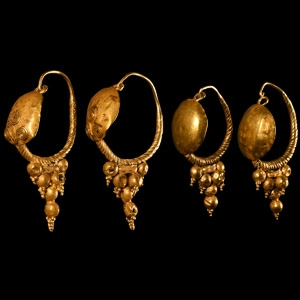
Roman Gold Earring Pairs
2nd-3rd century A.D. or earlierSold for (Inc. bp): £1,430
Two pairs of earrings with decoratively twisted hoops, domed plaques and pyramid bulbs embellished with granule clusters; one pair with gold wire spirals to the plaques. 16.97 grams total, 42-50 mm
Acquired between 1950-1970s. Ex Swiss private collection. -
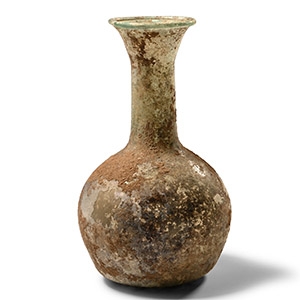
Roman Glass Toilet Bottle
1st century B.C.-1st century A.D.Estimate: £150 - 200 (+bp*)
Opening Bid: £83
With globular body, everted rim, cylindrical neck, rounded shoulder merging with concave wall, rounded base. 61 grams, 14 cm
Ex London, UK, collection, 1980-1990s.
This toilet bottle could be associated with the Isings form 6 and De Tommaso type 7. These small bottles are among the earliest known blown glass. The everted rim seems to distinguish examples made in Italy and the western Mediterranean provinces from those of the Eastern Mediterranean, on which the rim is usually folded in the form of a flange. -
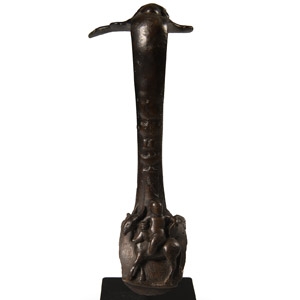
Roman Bronze Tankard Handle with Drunken Putto on Donkey
2nd century A.D.Sold for (Inc. bp): £221
Comprising a crescent plaque above with facing mask a a thumb-pad, lateral scrolls; perpendicular D-section bar with ribbing to the outer face; rectangular lower attachment panel with scrolled upper corners, high-relief putto (?) holding a patera in one hand and tankard in the other, riding an ass side-saddle; mounted on a custom-made stand. 318 grams total, 17 cm including stand
From a collection acquired on the UK art market from various auction houses and collections mostly before 2000. From an important Cambridgeshire estate; thence by descent.
This type of bronze handles are usually depicting mythological scenes. The scene of the putto riding a donkey is often linked to Bacchic processions. The face of the character riding the donkey could also correspond to that of Silenus, who in the same processions is often represented riding such an animal.
