
Loading, please wait...
LOT 0119
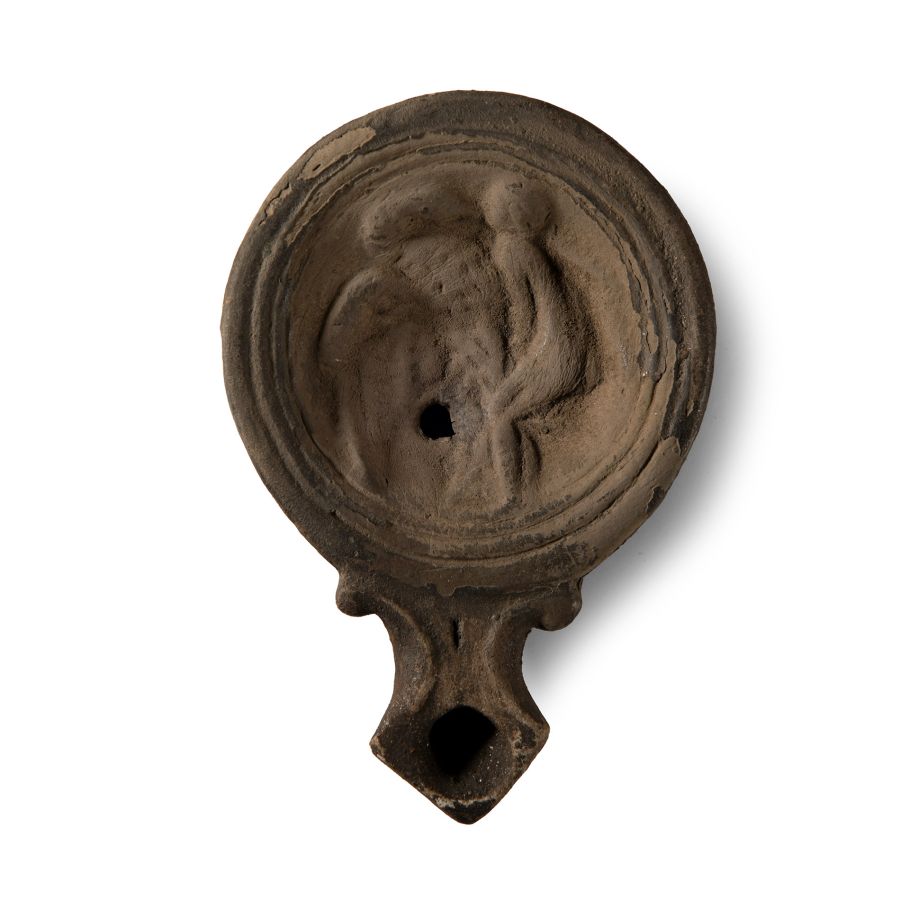
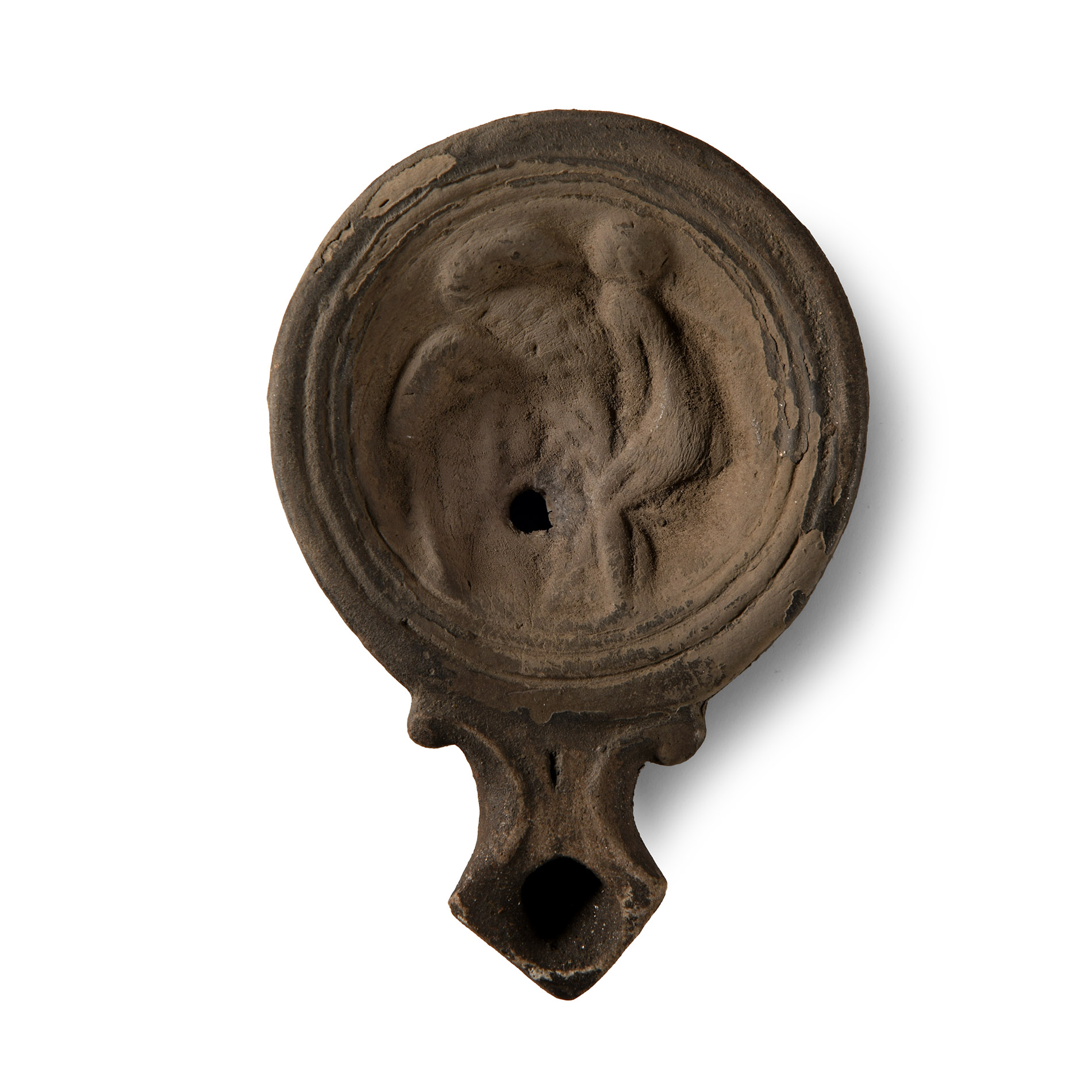
Roman Erotic Leda and the Swan Terracotta Oil Lamp
CIRCA 1ST-2ND CENTURY A.D.
4 5/8 in. (74 grams, 11.7 cm).
With a long canal nozzle with volutes, discus with one filling hole and three concentric lines enclosing a central scene of Leda and the swan, softly rendered anatomical details and carefully modelled plumage; two old stickers to base.
ProvenanceFrom the collection of Arno Jumpertz, Leverkusen, Germany, 1924-1984; much of the collection was exhibited at the Neus Museum, 1985.
Accompanied by a previous catalogue information slip.
The lamp's style refers to the Loeschcke type I, a style popular during the Augustan and Imperial times.
CONDITIONTimeLine Auctions follows a vetting process to ensure the authenticity and legality of all items, reinforcing our commitment to integrity and responsible trading. Each antiquity, antique, and coin lot undergoes thorough examination by a vetting committee of at least ten external specialists, professional trade association members, scientists, and archaeologists: Our Vetting Process
AUCTIONS:
TimeLine is a leading auction house specialising in antiquities, ancient art, collectables, natural history, coins, medals, and books. Our auctions offer museums, collectors, historians, and enthusiasts the opportunity to acquire unique and historically significant pieces.
-
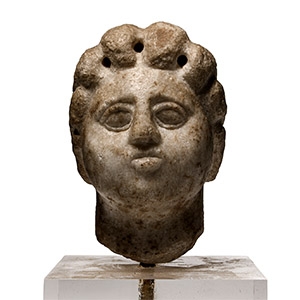
Romano-British Marble Head of a Lady
Circa 2nd century A.D.Sold for (Inc. bp): £975
Carved in the round with fleshy facial features, almond-shaped eyes and small pouting mouth; the hair modelled with hollowed curls above the brow; mounted on a custom-made display stand. 1.6 kg total, 17 cm high including stand
Found Cambridgeshire, UK. From a collection acquired on the UK art market from various auction houses and collections mostly before 2000. From an important Cambridgeshire estate; thence by descent.
These kind of sculptures represented people or divinities of the Roman Britannia. They are found in several civilian tombstones, characterised by provincial style, that was enhanced by colouring which is absent today. The image here represented is a domina (a high-status middle-aged woman) in a typical hairstyle of 2nd-3rd century A.D. (Graham, 1984, p.222). In these provincial artworks the strong influence of the Celtic art is evident, especially in the eyes and hair of the sculpture. -
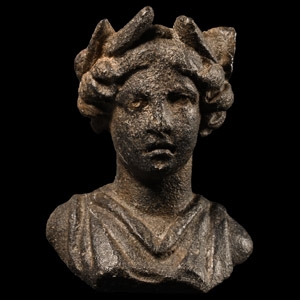
Roman Bronze Statuette Head of Apollo
1st-2nd century A.D.Sold for (Inc. bp): £416
With delicately modelled youthful features, thick hair framing the face adorned with a laurel-wreath secured at the rear, traces of silvering to the eyes; ledge base; possibly Apollo the sun-god, or a lar (guardian spirit). 31 grams, 32 mm
From a collection acquired on the UK art market from various auction houses and collections mostly before 2000. From an important Cambridgeshire estate; thence by descent.
The use of domestic gods continued in the Roman Empire also in later times. Of particular interest is a group of sculptures discovered in the Theodosian Palace in Stobi. The finds consist of marble and bronze statuettes and reliefs that were deposited in one of the ornamental basins located in the peristyle. Four of the smaller bronze sculptures— a lar, Apollo, Venus, and a satyr— may have formed the contents of a lararium. The palace was in use until the 5th century A.D., but the sculptures consists of heirloom and reused pieces dated at 2nd-1st century B.C. However, an unusual feature of this bronze assemblage is the fact that they date overwhelmingly to the 3rd century A.D. -
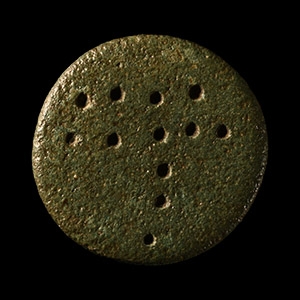
Romano-British 'Published' Bronze Gaming Counter
Circa 1st century A.D. or laterSold for (Inc. bp): £293
Discoid in form with twelve impressed dots, two parallel lines and one perpendicular. 4.5 grams, 18 mm
Found Cirencester, UK, prior to 1999. Acquired 4 February 1999. From the important private collection of dice and gaming pieces of Colin Narbeth, London, UK, collection no.59. Accompanied by a copy of the relevant Celtic & Roman Artefacts book pages where this object is published.
