
Loading, please wait...


LOT 0099
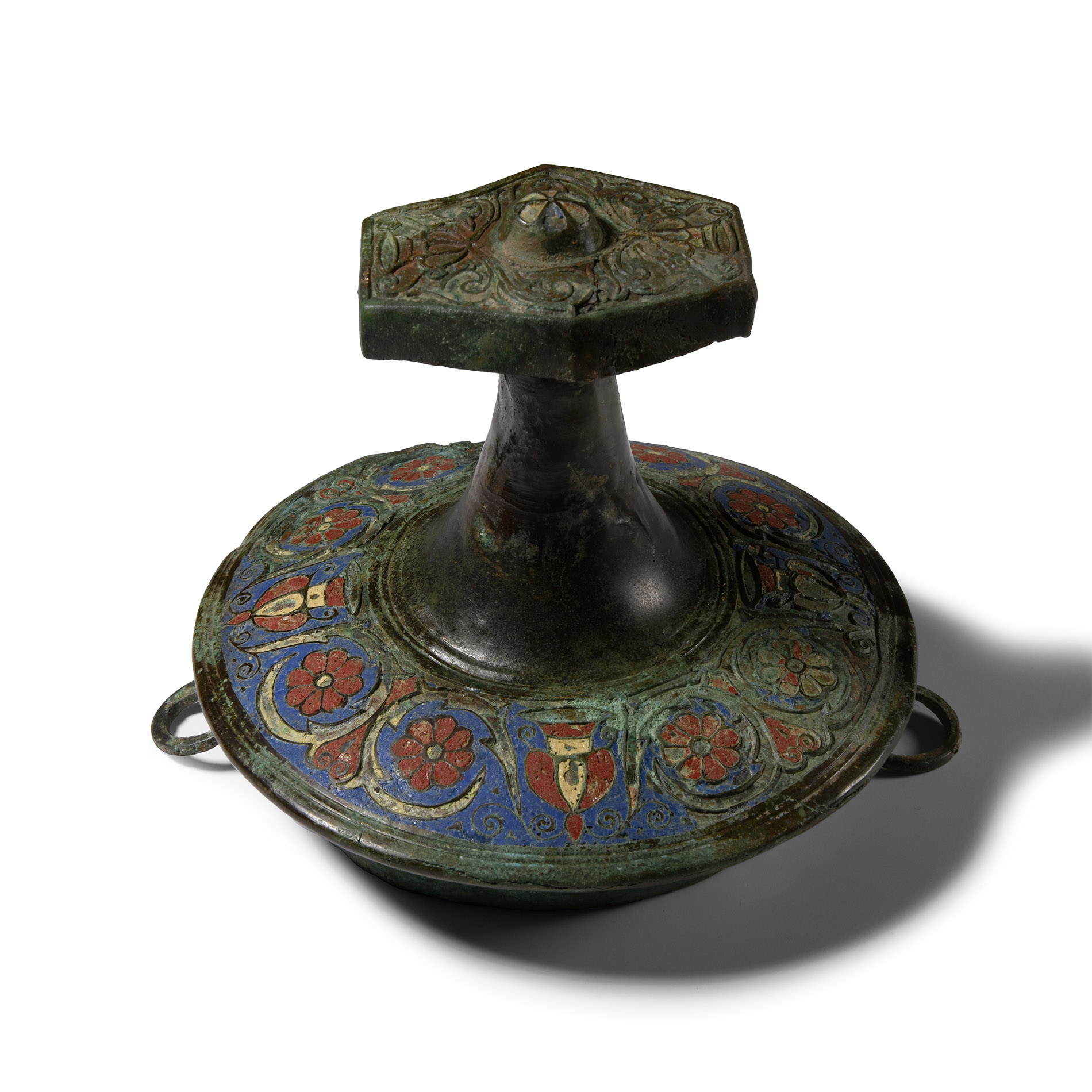
Roman Enamelled Bronze Vessel Lid
2ND-4TH CENTURY A.D.
6 in. (435 grams, 15 cm wide).
With carinated body and gently inverted lower rim, circumferential frieze displaying 'yellow' and red champlevé enamelled flower heads within foliate roundels, alternating with stylised amphoras and volute scrolls creating heart shapes set against a rich blue field; central projecting stem with hexagonal plate, ornamented with a central domed flower head, amphora and foliate motifs surrounding; two suspension lugs with loops to the perimeter of the lower rim; repaired.
ProvenanceAcquired from Ariadne Galleries Inc, New York, 30 October 2003.
This lot has been checked against the Interpol Database of stolen works of art and is accompanied by search certificate no.11622-198955.
Cf. The Metropolitan Museum, New York, accession numbers 47.100.5 and 47.100.8, for enamelled copper-alloy vessels and accession number 2000.505a-o, for ceremonial chariot fittings with very similar enamelled design and of similar hexagonal form to the lid plate.
FootnotesChamplevé is a decorative technique which involves cutting cells into a metal surface and filling the void with enamel, using the raised metal borders between the cells to create the design outline.
CONDITIONTimeLine Auctions follows a vetting process to ensure the authenticity and legality of all items, reinforcing our commitment to integrity and responsible trading. Each antiquity, antique, and coin lot undergoes thorough examination by a vetting committee of at least ten external specialists, professional trade association members, scientists, and archaeologists: Our Vetting Process
AUCTIONS:
TimeLine is a leading auction house specialising in antiquities, ancient art, collectables, natural history, coins, medals, and books. Our auctions offer museums, collectors, historians, and enthusiasts the opportunity to acquire unique and historically significant pieces.
-
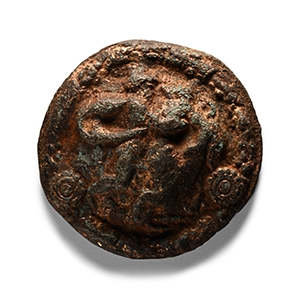
Roman Gilt Bronze Phalera with Theseus and the Minotaur
2nd century B.C.- 2nd century A.D.Sold for (Inc. bp): £182
Domed roundel with high-relief design of combat between a bearded hero and a monster, wreath and rosettes to the rim. 32 grams, 49 mm
Found near Sedgeford, Norfolk, UK, in the 1980s. Acquired in the late 1990s. Property of a Norfolk, UK, collector.
According to the legend, Theseus, prince of Athens, went to the island of Crete to kill a monster who was the son of queen Pasiphae and a wild bull, although officially he was the son of Minos and Pasiphae. Theseus chased him into the labyrinth, killed him and found his way out with the help of the comb of Ariadne, daughter of King Minos. The myth has its representation in the Archaic, Classical and Hellenistic period, and was widely depicted in the Graeco-Roman world. The present repoussé appliqué was probably used as a furniture or horse harness ornament. -
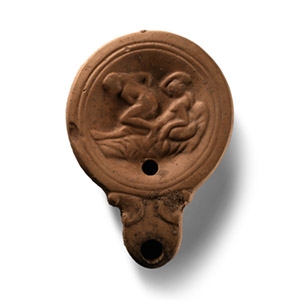
Roman Terracotta Oil Lamp with Erotic Scene
2nd century A.D.Sold for (Inc. bp): £1,235
With broad discus and long nozzle flanked by volute scrolls, low-relief scene with two lovers on a bed. 44 grams, 95 mm
From a London collection of erotica, formerly in the collection of the late Mr S.M., London, UK. -

Roman Bronze Mars Rider Statuette
2nd-3rd century A.D.Sold for (Inc. bp): £221
Modelled in the round, nude male with legs in straddling pose, left hand thrust forward and right arm raised with hand open; head exaggerated with shoulder-length hair and crested helmet. 35.6 grams, 60 mm
From a collection acquired on the UK art market from various auction houses and collections mostly before 2000. From an important Cambridgeshire estate; thence by descent.
The pseudo-Corinthian or Apulo-Corinthian helmet, here represented on the head of the divinity, was originally a legionary helmet, then became, in the Late Consular Age, an officer's helmet, then a typical attribute of military commanders and then of the war god, Mars. However, this statuette of Mars has strong Celtic connotations, as evidenced by the torques around the neck and the warrior god's hair.
