
Loading, please wait...
_900x900.jpg "Roman Enamelled Bronze Miniature Votive Altar")
_200x200.jpg "Roman Enamelled Bronze Miniature Votive Altar")
.jpg "Roman Enamelled Bronze Miniature Votive Altar")
LOT 0767
Roman Enamelled Bronze Miniature Votive Altar
3RD-4TH CENTURY A.D.
1 3/8 in. (22.8 grams, 34 mm).
Formed with four out-turned legs and sub-square top with knop to each corner and central circular void, rectangular panel to each side face with arched lower edge and alternating foliate and geometric polychrome enamelled design.
ProvenanceFound Cambridgeshire, pre 2000.
LiteratureCf. The British Museum's Portable Antiquities Scheme, record id. NARC-E42213, for similar and discussion.
CONDITIONTimeLine Auctions follows a vetting process to ensure the authenticity and legality of all items, reinforcing our commitment to integrity and responsible trading. Each antiquity, antique, and coin lot undergoes thorough examination by a vetting committee of at least ten external specialists, professional trade association members, scientists, and archaeologists: Our Vetting Process
AUCTIONS:
TimeLine is a leading auction house specialising in antiquities, ancient art, collectables, natural history, coins, medals, and books. Our auctions offer museums, collectors, historians, and enthusiasts the opportunity to acquire unique and historically significant pieces.
-
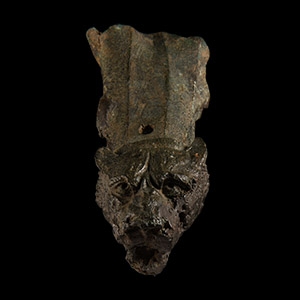
Roman Bronze Lion Fitting
2nd-3rd century A.D.Estimate: £800 - 1,000 (+bp*)
Opening Bid: £444
Displaying a naturalistic lion's head projecting from a facetted bar with piercing for attachment; recessed eyes to accept separate inserts. 100 grams, 88 mm
‘The Ancient Menagerie Collection’ formerly the property of a Cambridgeshire lady, collected since the 1990s and acquired from auctions and dealers throughout Europe and the USA, now ex London collection. -
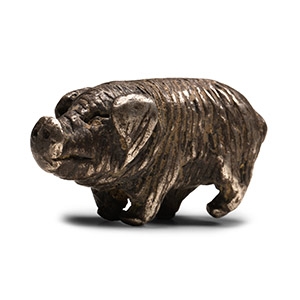
Roman Silver Pig Statuette
1st-4th century A.D.Sold for (Inc. bp): £845
Formed in the round with naturalistic detailing, curled tail. 28.7 grams, 32 mm
‘The Ancient Menagerie Collection’ formerly the property of a Cambridgeshire lady, collected since the 1990s and acquired from auctions and dealers throughout Europe and the USA, now ex London collection. -
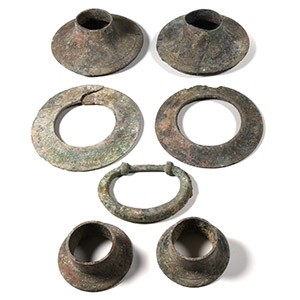
Roman Bronze Chariot Wheel Hub Group
1st-4th century A.D.Sold for (Inc. bp): £74
Comprising three pairs of fittings of different types, together with a terret ring; one split. 1.4 kg total, 6.9-12.4 cm
Acquired 1990s-early 2000s. East Anglian private collection.
