
Loading, please wait...

LOT 0794
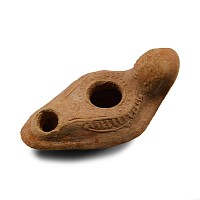
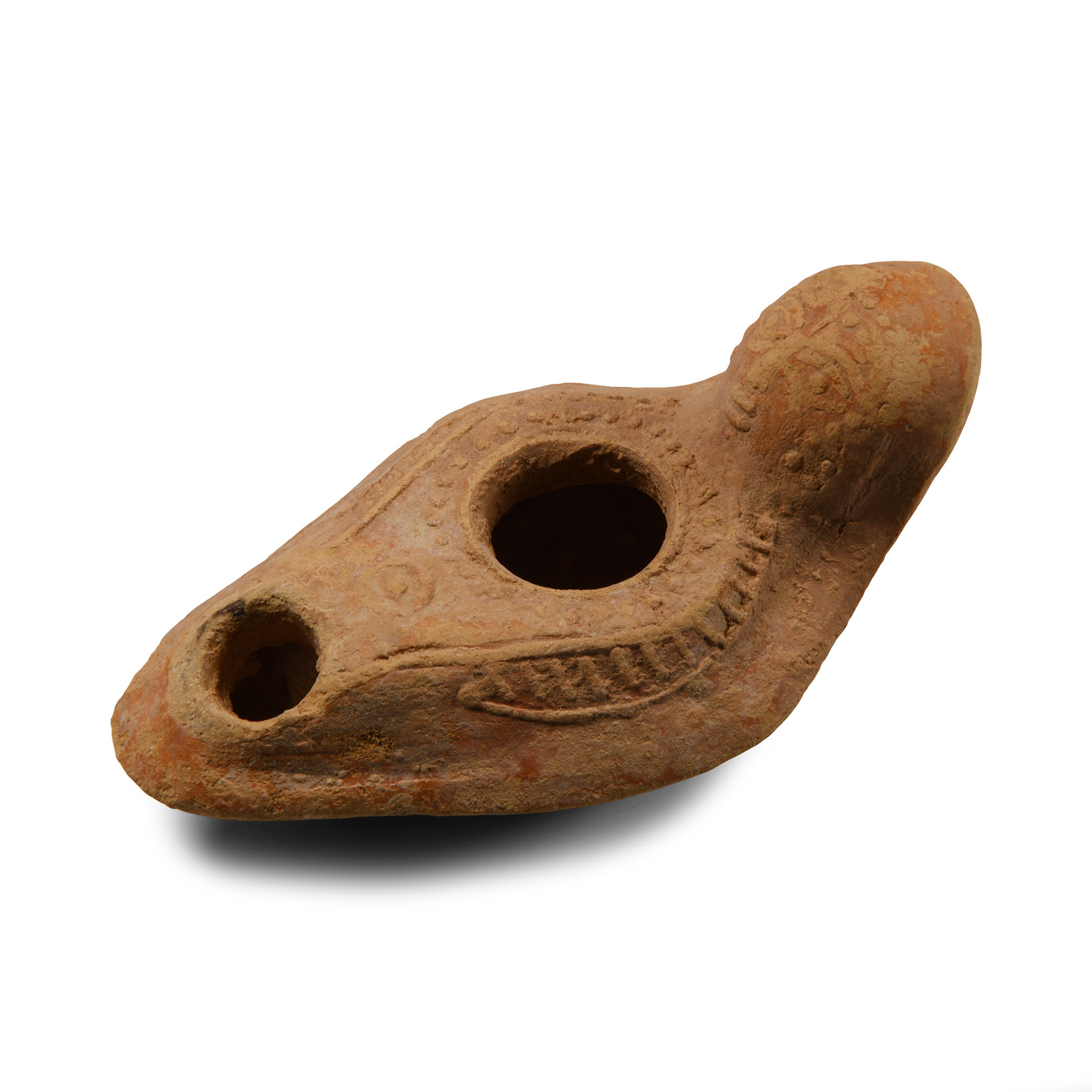
Roman Early Christian Terracotta Oil Lamp
3RD-4TH CENTURY A.D.
4 in. (64 grams, 10 cm).
With decorated bow shaped nozzle, large central filling-hole surrounded by a dotted ridge, shoulder decorated by geometric patterns; the handle shaped as a human face representing a head of Christ or a saint.
ProvenanceCollected from 1970-1999.
From the collection of the late Mr S.M., London, UK.
Cf. Porat, R., Davidovich, U., Langford, B., Zissu, B., 'Votive Offerings from the Late Roman Period in the Te' omim Cave, Western Jerusalem Hills' in Taal, O., Weiss, Z., Expression of Cult in Southern Levant in the Greco-Roman period, Turnhout, 2017, pp.111-130.
FootnotesThe lamp seems to be a variant of the type Beit Nattif lamps, usually with pyramidal handle (here substituted by a head of a saint or Christ) and a reddish slip on the upper part. This was the most widespread type of lamps in use in Judaea in the Late Roman Period.
CONDITIONTimeLine Auctions follows a vetting process to ensure the authenticity and legality of all items, reinforcing our commitment to integrity and responsible trading. Each antiquity, antique, and coin lot undergoes thorough examination by a vetting committee of at least ten external specialists, professional trade association members, scientists, and archaeologists: Our Vetting Process
AUCTIONS:
TimeLine is a leading auction house specialising in antiquities, ancient art, collectables, natural history, coins, medals, and books. Our auctions offer museums, collectors, historians, and enthusiasts the opportunity to acquire unique and historically significant pieces.
-

Roman Lead Commercial Weight of 1 Mna
Dated SE 230 (83/2 B.C.)Estimate: £3,000 - 4,000 (‡+bp*)
Opening Bid: £1,111
Square in plan with ribbed edge and hatched reverse; ETOYΣ ΛΣ (date) ΔHMOΣIA MNA (denomination) with border to initial lamda, two crossed cornucopiae, to left a monogram; latticework design to the reverse. 704 grams, 96 mm
Acquired in the mid 1980s-1990s. Private collection, Switzerland, thence by descent. Private collection, since the late 1990s. This lot has been checked against the Interpol Database of stolen works of art and is accompanied by search certificate number no.12225-222343.
Such commercial weights were produced in cities currently or formerly under Seleukid control. The inscription ΔHMOΣIA ('public'), indicates that this was used as an official market weight. -
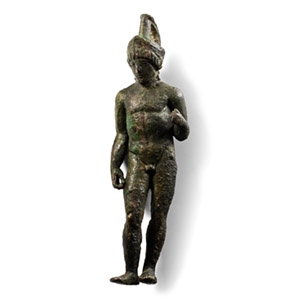
Roman Bronze Statue of Mars Gradivus
2nd century B.C.Sold for (Inc. bp): £4,940
Modelled in the round as a young beardless warrior hero with muscular body and rounded shoulders; wearing a high-crested pseudo-Attic helmet with a diadem; the hair arranged in orderly locks over his brow; the bent left hand would originally have held a shield and the extended right hand a spear. 278 grams, 13.5 cm high
Ex collection of Dr Djafari (1900-1981), Kaiserslautern, Germany. Accompanied by an academic report by Dr Raffaele D'Amato. This lot has been checked against the Interpol Database of stolen works of art and is accompanied by search certificate number no.11812-206498.
This statue of Mars Gradivus, the marching god of war, was probably a cult offering. The statuette still presents an archaic Etruscan hairstyle, being part of the Italic statuettes of the god produced as votive offering to the temples or for private lararia. A Gallo-Roman period temple dedicated to the cult of Mars with a similar statuette has recently been found in Brittany. -
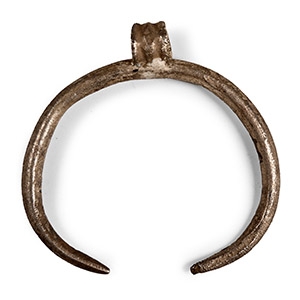
Roman Silver Lunar Pendant
2nd-3rd century A.D.Sold for (Inc. bp): £78
Of crescentic form with integral ribbed suspension loop. 2.66 grams, 30 mm
Ex German art market, 2000s. Acquired from an EU collector living in London. From the collection of Surrey, UK, gentleman.
