
Loading, please wait...


LOT 0770
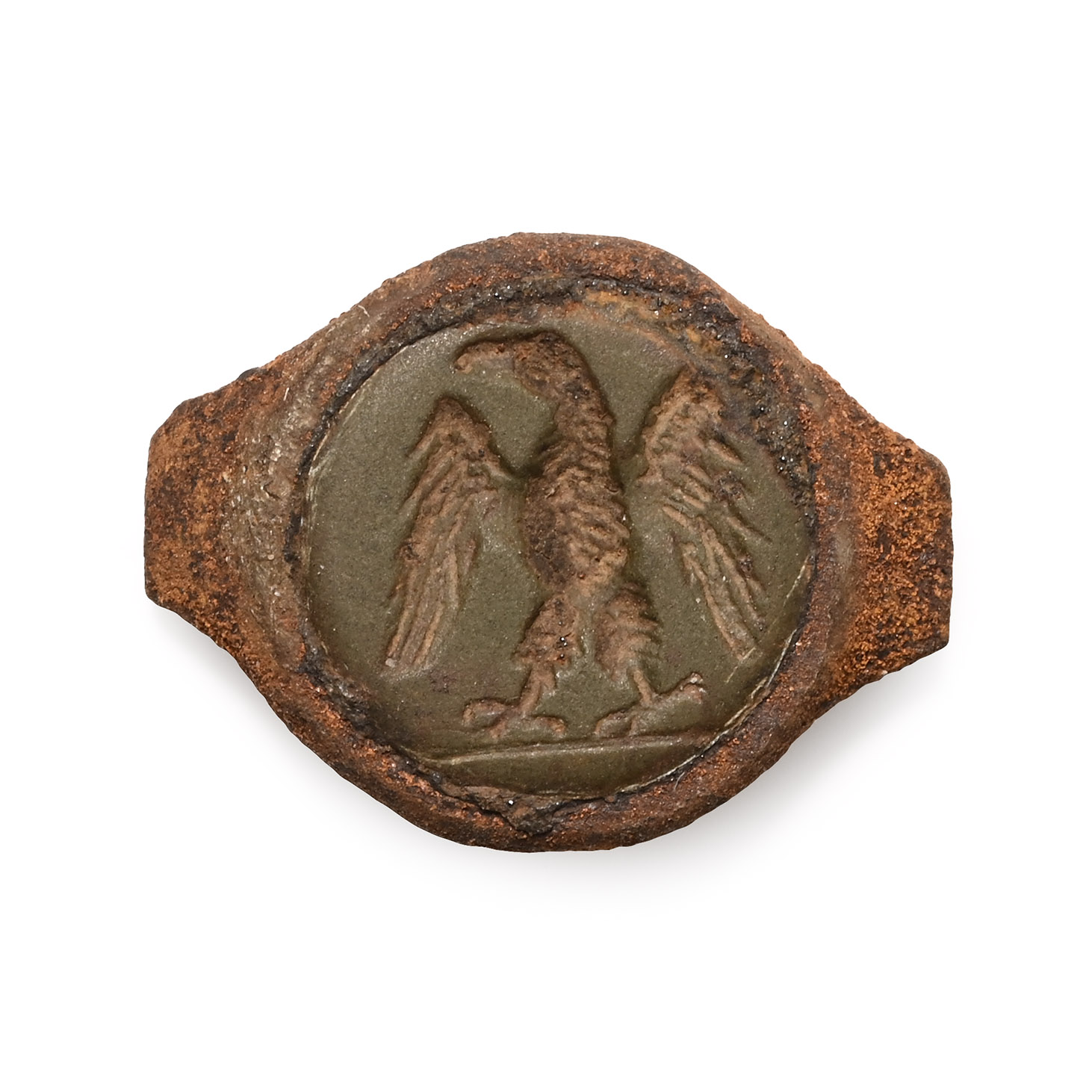
Roman Eagle Gemstone in Remains of Bronze Ring
CIRCA 2ND-3RD CENTURY A.D.
3/4 in. (4.17 grams, 20 mm).
A round intaglio with a standing eagle on a baseline with its wings spread and head turned left.
ProvenanceAcquired 1980-2015.
Ex Abelita family collection.
TimeLine Auctions follows a vetting process to ensure the authenticity and legality of all items, reinforcing our commitment to integrity and responsible trading. Each antiquity, antique, and coin lot undergoes thorough examination by a vetting committee of at least ten external specialists, professional trade association members, scientists, and archaeologists: Our Vetting Process
AUCTIONS:
TimeLine is a leading auction house specialising in antiquities, ancient art, collectables, natural history, coins, medals, and books. Our auctions offer museums, collectors, historians, and enthusiasts the opportunity to acquire unique and historically significant pieces.
LOT 0770
Roman Eagle Gemstone in Remains of Bronze Ring
Estimate £200 - 300€230 - 350 (for guidance only)$270 - 410 (for guidance only)
-

Roman Gold Ring with Head of Apollo
1st century A.D.Sold for (Inc. bp): £2,340
Hollow-formed shank with inset ellipsoid garnet cloison intaglio bust of Apollo with frond and laurel-leaf wreath to the hair. 3.05 grams, 23.01 mm overall, 12.14x15.09 mm internal diameter (approximate size British E, USA 2 1/4, Europe 2.41, Japan 3)
European art market. This lot has been checked against the Interpol Database of stolen works of art and is accompanied by search certificate number no.12222-222339. -

Roman Coloured Glass Bracelet Group
Circa 2nd-4th century A.D.Sold for (Inc. bp): £124
Comprising one round-section in deep blue, one similar in deep red, and a D-section in pale blue/turquoise. 14.3 grams total, 42-55 mm
Formerly with a Bournemouth gentleman. Ex Essex collection. Property of a Scottish collector, acquired in 2013.
Bangles did not occur in a vacuum after the Roman invasion but were an integral part of globalising networks of cross-Channel trade and connections with the European mainland in the early first century A.D. According to J. Price bangles were first developed in southern Britain in the late Claudio-Neronian period (A.D. 43–65/70) and that in subsequent periods the craft of bangle-making quickly spread further north with the advance of the Roman army. -
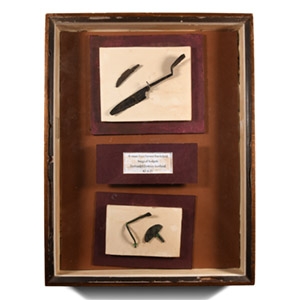
Roman Bronze Battlefield Surgical Scalpels
Circa 83-87 A.D.Sold for (Inc. bp): £546
Mounted in an old custom glazed presentation case with explanatory labels; found Inchtuthil, Scotland. 1.42 kg total, 38 x 29.2 cm
From the Roman legionary fortress Inchtuthil, Perthshire, 83-87 A.D. Private UK collection. Acquired in the 1980s. Property of a Cambridgeshire gentleman.
