
Loading, please wait...
_900x900.jpg "Roman Decorated Votive Lead Mirror")
_200x200.jpg "Roman Decorated Votive Lead Mirror")
.jpg "Roman Decorated Votive Lead Mirror")
LOT 0687
Roman Decorated Votive Lead Mirror
2ND-3RD CENTURY A.D.
4 1/4 in. (43 grams, 11 cm).
With ribbed handle, discoid plate with raised rib to one face, running scrolls to the other, lateral struts.
ProvenanceEx German art market, 2000s.
Acquired from an EU collector living in London.
From the collection of Surrey, UK, gentleman.
Cf. Spasić Durić, D., Град Виминацијум-The city of Viminacium, (in Serbian), Pozarevac, 2015, fig.78, for similar.
FootnotesMany examples of this category from the Danube region were found in female graves, where they possibly served as grave goods considered appropriate for their connection with general issues of fertility, good fortune, and beauty, or even as protective amulets. Since lead mirror frames have been found in this Roman province only in graves of women, it is probable that these miniature mirrors, fitted with a central glass, were expected to serve as ritual or magical tools to assist souls of dead women in the afterlife.
CONDITIONTimeLine Auctions follows a vetting process to ensure the authenticity and legality of all items, reinforcing our commitment to integrity and responsible trading. Each antiquity, antique, and coin lot undergoes thorough examination by a vetting committee of at least ten external specialists, professional trade association members, scientists, and archaeologists: Our Vetting Process
AUCTIONS:
TimeLine is a leading auction house specialising in antiquities, ancient art, collectables, natural history, coins, medals, and books. Our auctions offer museums, collectors, historians, and enthusiasts the opportunity to acquire unique and historically significant pieces.
-
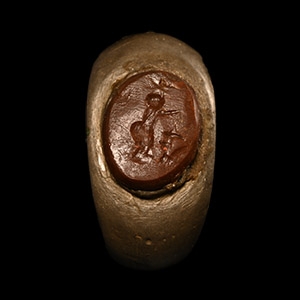
Roman Silver Ring with Advancing Bull Gemstone
Circa 2nd century A.D.Sold for (Inc. bp): £338
With a later inset jasper cloison, intaglio advancing bull motif. 8.62 grams, 26.05 mm overall, 20.85 mm internal diameter (approximate size British N 1/2, USA 6 3/4, Europe 14.35, Japan 13)
Acquired between the 1960s-early 1990s. From an old UK private collector from Worthing, West Sussex, UK. Property of K.P., a Cornish lady collector, UK. -
.jpg)
Roman Bronze Goddess Applique
2nd-3rd century A.D.Sold for (Inc. bp): £1,300
The goddess Tyche or Cybele with a facing female bust wearing a mural crown, braided hair cascading to the sides, high-relief lenticular eyes, and small slit mouth, two iron fixing rivets; the lower part with detailed necklace of pendants, catena decorative chain, lateral braids, ferrous fixture; old collector's label 'BR.APP.064' to verso; repaired and mounted on a custom-made display stand. 3.66 kg total, 20.5 cm including stand
Private collection of Mr S.A., Switzerland, 1990s, thence by descent.
The crown that characterises the bronze applique (corona muralis = wall crown) was a military decoration using symbolism from the Hellenistic age. Often associated with Tyche (Fortuna), the crown was also an attribute of the goddess Cybele, particularly when made of wood. However, the presence of a necklace similar to a late Roman statuette of Tyche at the Metropolitan Museum of Art seems to point more to the first identification. This bronze applique was probably used as decoration for a chariot used in a procession for the goddess, or as a furniture decoration. -
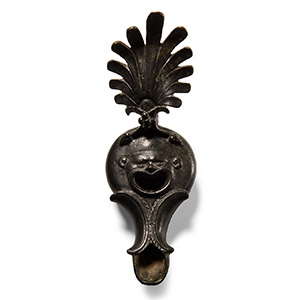
Roman Bronze Lamp with Theatrical Mask
1st-2nd century A.D.Estimate: £2,500 - 3,500 (‡+bp*)
Opening Bid: £1,111
Nozzle with quasi-volutes, theatrical mask surrounding the central opening; ring-handle with palmette attachment; base moulded. 220 grams, 13.3 cm
Acquired from Weber, Kohl. Ex private collection, Rhemish, Germany. with Gorny & Mosch, 14 December 2010, lot 499. Private collection, Europe. This lot has been checked against the Interpol Database of stolen works of art and is accompanied by search certificate number no.11800-206492.
The principal parts of a lamp were the body or reservoir which contained the oil (infundibulum); the flat circular top (discus) on which the design, if any, was placed, sometimes with an ornamented rim (margo), the nozzle, with a hole for the insertion of the wick (rostrum, nasus, myxus), the wick, known as ellydinium, the handle (ansa, manubrium).
