
Loading, please wait...
LOT 1444
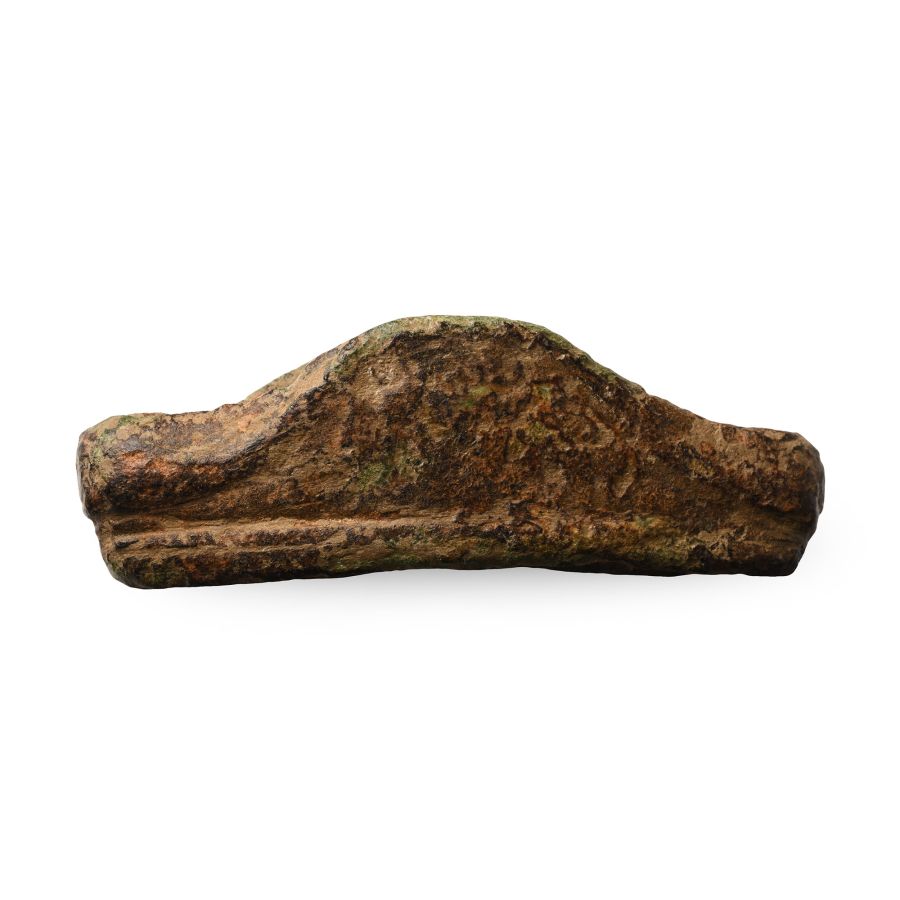
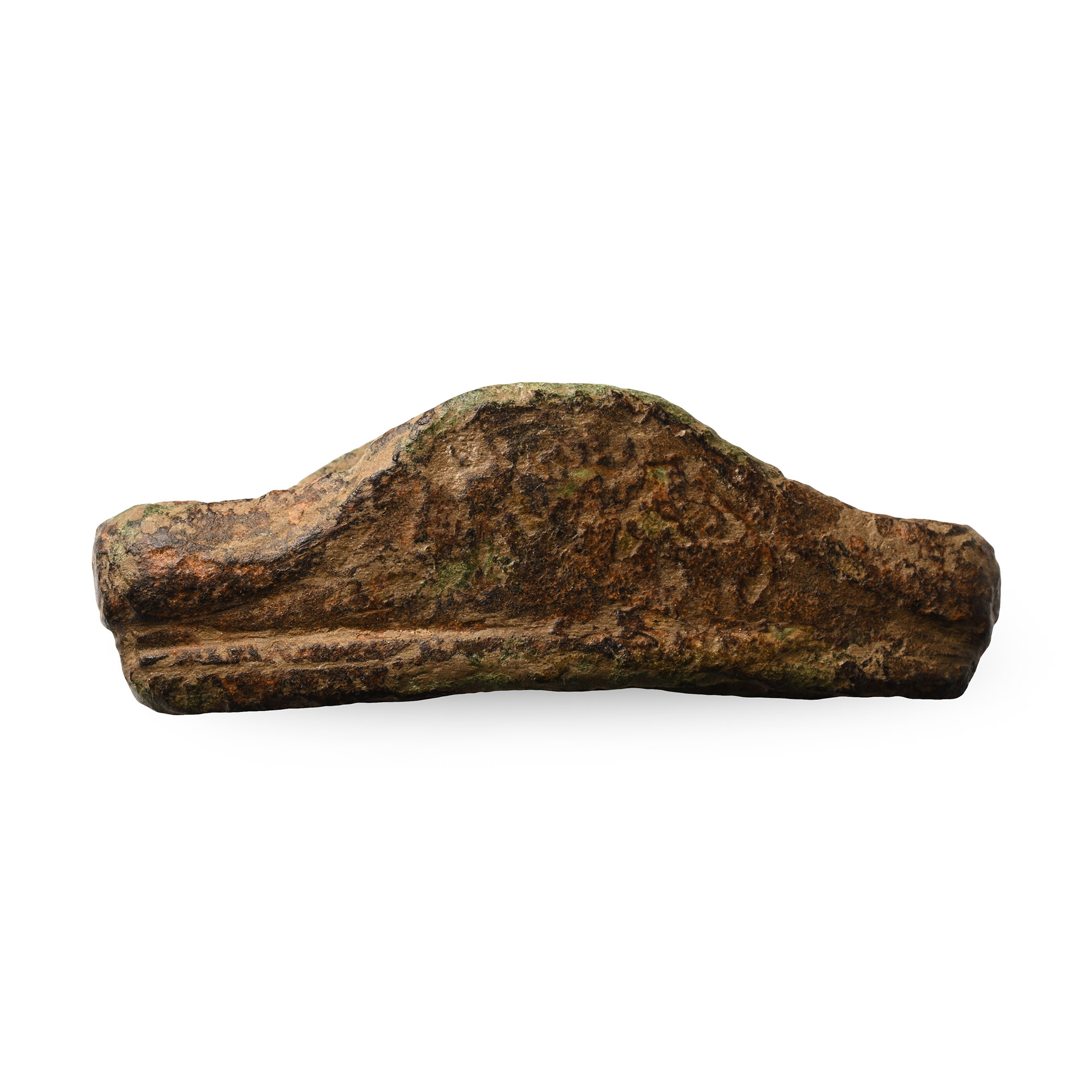
Roman 'Crown Type' Sword Hilt Guard
1ST CENTURY B.C.-1ST CENTURY A.D.
1 7/8 in. (17.6 grams, 47 mm).
Ellipsoid in section with central slot to accept the tang; scooped 'cocked hat' profile to the broad faces, with horizontal rounded band to the lower edge. [No Reserve]
ProvenanceFound Tuesday 1st April 2025 in Wenham Parva, Babergh, Suffolk, UK.
Accompanied by a copy of the British Museum's Portable Antiquities Scheme (PAS) report no.SF-92FBDC.
Cf. Stead, I.M., British Iron Age Swords and Scabbards, London, 2006, p.13.
CONDITIONTimeLine Auctions follows a vetting process to ensure the authenticity and legality of all items, reinforcing our commitment to integrity and responsible trading. Each antiquity, antique, and coin lot undergoes thorough examination by a vetting committee of at least ten external specialists, professional trade association members, scientists, and archaeologists: Our Vetting Process
AUCTIONS:
TimeLine is a leading auction house specialising in antiquities, ancient art, collectables, natural history, coins, medals, and books. Our auctions offer museums, collectors, historians, and enthusiasts the opportunity to acquire unique and historically significant pieces.
-
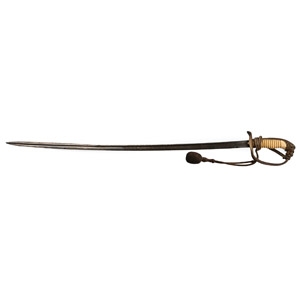
Kriegsmarine WWI German Naval Officer's Sword
Early 20th century A.D.Sold for (Inc. bp): £364
Comprising a slender single-edged blade with etched maritime design; the hilt composed of a ribbed bone handle, a lion-head pommel, and an ornate guard with a folding edge to one side. 728 grams, 87.5 cm
From the private collection of author and historian Dr DeWitt Bailey, one of the global authorities on the confederate army in the US civil war; thence by descent to his grandson. -
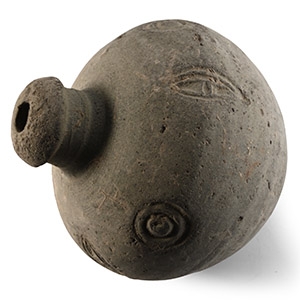
Byzantine 'Greek Fire' Ceramic Fire Bomb or Hand Grenade
9th-11th century A.D.Sold for (Inc. bp): £117
Ovoid in profile with pointillé and linear decoration, domed filler hole; intended to be filled with explosive liquid and a wick, and used as a hand grenade. 389 grams, 98 mm
From an important specialist collection, London, UK, 1990s onwards. Accompanied by an academic paper by military specialist Dr Raffaele D'Amato, dated 15 July 2019 and titled 'Eastern Roman Empire - Greek Fire Bomb or Hand Grenade (μεσαίον kακάβιον) 9th-11th century AD'.
Apart from the use of siphons or manual flame-throwers called cheirosiphona, special corps of Roman soldiers employed terracotta grenades, in the form of small jars, abundantly evidenced in archaeological excavations. They were called μεσαία kακαβιά or κυτροκακάβια where the former had a bulbous shape and the latter a more cylindrical form. -
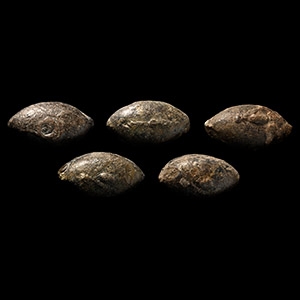
Roman Lead Slingshot Group
1st century B.C.Sold for (Inc. bp): £247
A mixed group of four lentoid-section biconical lead slingshot, three fitted with iconic winged thunderbolts on one side, and one with the Tanit goddess symbol, possibly alluding to a Balearic-Punic origin. 155 grams total, 28-30 mm
From the collection of a Surrey, UK, gentleman; acquired in the 1990s.
The slingshots are belonging to the type IIb of the Völling classification. The practice of inscribing slingshots developed early, in 4th century BC Greece. Most inscriptions are names (in full or abbreviated) of generals or commanders of units of slingers. Some are slogans of the contesting sides. Individual letters occasionally appear, sometimes in conjunction with a name or motif or numbers.
