
Loading, please wait...
_900x900.jpg "Roman Coloured Glass Bracelet Group")
_200x200.jpg "Roman Coloured Glass Bracelet Group")
.jpg "Roman Coloured Glass Bracelet Group")
LOT 0825
Roman Coloured Glass Bracelet Group
CIRCA 2ND-4TH CENTURY A.D.
1 5/8 - 2 1/8 in. (14.3 grams total, 42-55 mm).
Comprising one round-section in deep blue, one similar in deep red, and a D-section in pale blue/turquoise. [No Reserve]
ProvenanceFormerly with a Bournemouth gentleman.
Ex Essex collection.
Property of a Scottish collector, acquired in 2013.
Cf. Ivleva, T,, 'The origin of Romano-British Glass Bangles: Forgotten Artefacts from the Late Pre-Roman Iron Age' in Britannia, 2020, pp.1-46, fig.3, for similar.
FootnotesBangles did not occur in a vacuum after the Roman invasion but were an integral part of globalising networks of cross-Channel trade and connections with the European mainland in the early first century A.D. According to J. Price bangles were first developed in southern Britain in the late Claudio-Neronian period (A.D. 43–65/70) and that in subsequent periods the craft of bangle-making quickly spread further north with the advance of the Roman army.
CONDITIONTimeLine Auctions follows a vetting process to ensure the authenticity and legality of all items, reinforcing our commitment to integrity and responsible trading. Each antiquity, antique, and coin lot undergoes thorough examination by a vetting committee of at least ten external specialists, professional trade association members, scientists, and archaeologists: Our Vetting Process
AUCTIONS:
TimeLine is a leading auction house specialising in antiquities, ancient art, collectables, natural history, coins, medals, and books. Our auctions offer museums, collectors, historians, and enthusiasts the opportunity to acquire unique and historically significant pieces.
-
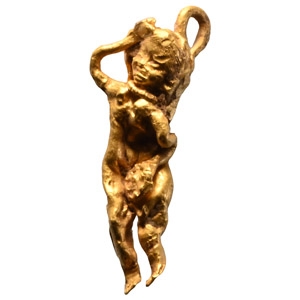
Roman Gold Cupid Pendant
1st-4th century A.D.Sold for (Inc. bp): £338
Hollow-formed with loop above the head, the right hand raised to the head and the lowered left hand holding a rosette. 2.78 grams, 24 mm
From the collection of a Cambridge, UK, lady. -
.jpg)
Roman Bronze Dolphin Brooch
Circa 2nd century A.D.Sold for (Inc. bp): £26
With deep curved bow, dorsal fin to the apex and fantail footplate, hinged pin. 7.89 grams, 36 mm
Property of the vendor's grandfather, thence by family descent, circa 1985. From the private collection of a New York, USA gentleman. -
.jpg)
Roman Votive Terracotta Hand Group
Circa 1st century A.D.Sold for (Inc. bp): £124
Each moulded with finger detailing to one face; or from children's dolls. 23 grams total, 34-53 mm
Ex German art market, 2000s. Acquired from an EU collector living in London. From the collection of Surrey, UK, gentleman.
