
Loading, please wait...
_900x900.jpg "Roman Carnelian Gemstone with Vulcan")
_200x200.jpg "Roman Carnelian Gemstone with Vulcan")
.jpg "Roman Carnelian Gemstone with Vulcan")
LOT 0075
Roman Carnelian Gemstone with Vulcan
1ST CENTURY B.C.-1ST CENTURY A.D.
3/8 in. (0.25 grams, 10 mm).
Depicting a nude blacksmith seated on a stool before a forge, hammer in his right hand, holding an object he is hammering with the other hand.
ProvenancePrivate collection, North Germany.
with Gorny & Mosch, 14 December 2005, no.238.
Accompanied by a copy of an Art Loss Register certificate no.S00075379.
Cf. an intaglio with a kneeling Hephaestus (late 4th-1st century B.C.) in brown and white agate at the Walters Art Museum, accession no.42462, for the type.
FootnotesProbably a Roman copy of a Hellenistic subject. Some Roman ring intaglios were dedicated to Vulcan (Greek Hephaestus), god of the blacksmiths, artisans, and carpenters. Usually, the god is represented standing or working in his forge, wearing a wide-brimmed hat and a one-shouldered tunic, identifying him as a craftsman. In his right hand, he holds a hammer over an anvil, and in his left a pair of long metalworking tongs. Sometimes he is naked, seated and working.
CONDITIONTimeLine Auctions follows a vetting process to ensure the authenticity and legality of all items, reinforcing our commitment to integrity and responsible trading. Each antiquity, antique, and coin lot undergoes thorough examination by a vetting committee of at least ten external specialists, professional trade association members, scientists, and archaeologists: Our Vetting Process
AUCTIONS:
TimeLine is a leading auction house specialising in antiquities, ancient art, collectables, natural history, coins, medals, and books. Our auctions offer museums, collectors, historians, and enthusiasts the opportunity to acquire unique and historically significant pieces.
-
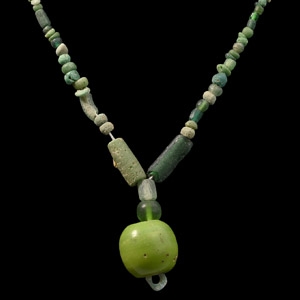
Roman Green Glass Bead Necklace String
1st-4th century A.D. and laterSold for (Inc. bp): £65
Restrung designer necklace string of tubular, oblate and other types with barrel-shaped pendant centrepiece. 31.8 grams, 36 cm
London, UK, collection, 2000s. -
.jpg)
Roman Bronze Ring with Bust
3rd-4th century A.D.Sold for (Inc. bp): £59
Square bezel with beaded border, profile bust with vexillum. 2.12 grams, 22.18 mm overall, 20.22 mm internal diameter (approximate size British T, USA 9 1/2, Europe 21.26, Japan 20)
Acquired on the London art market in the late 1980s-1990s. From the family collection of an East London, UK, gentleman. -
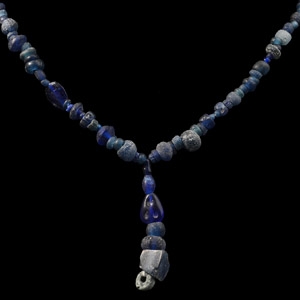
Roman Deep Blue Glass Bead Necklace String
1st-4th century A.D. and laterSold for (Inc. bp): £33
Restrung designer necklace string of biconvex, oblate and other types. 13.9 grams, 33.5 cm
London, UK, collection, 2000s.
