
Loading, please wait...
LOT 0093
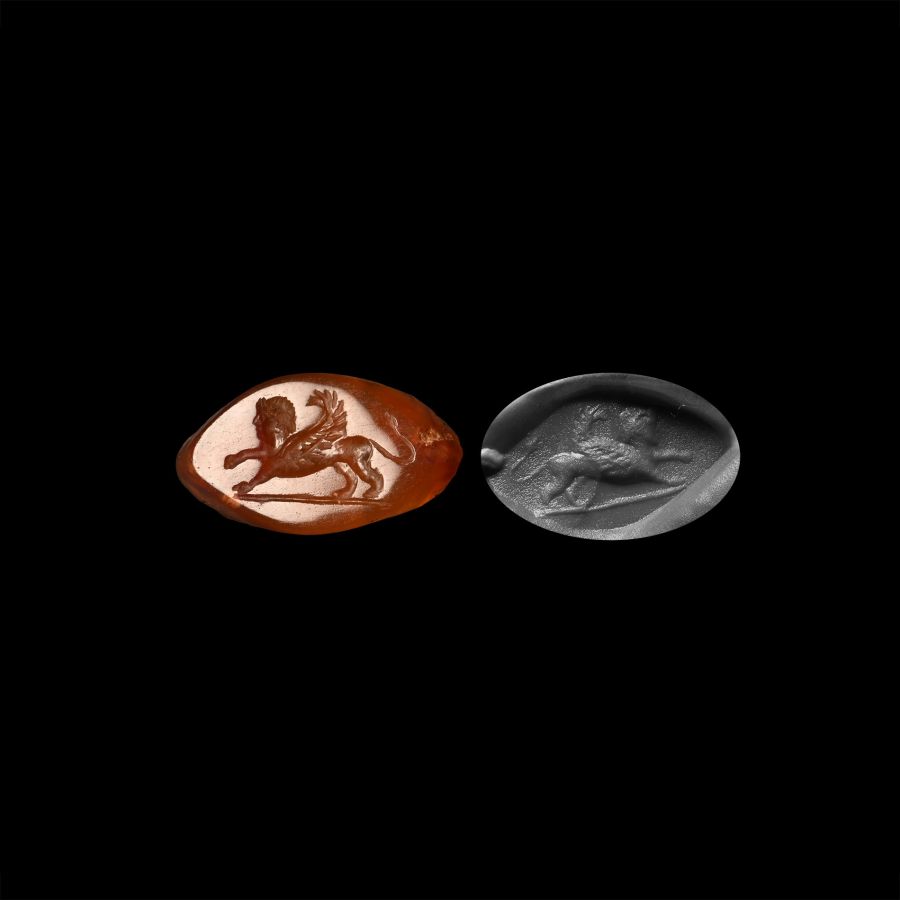
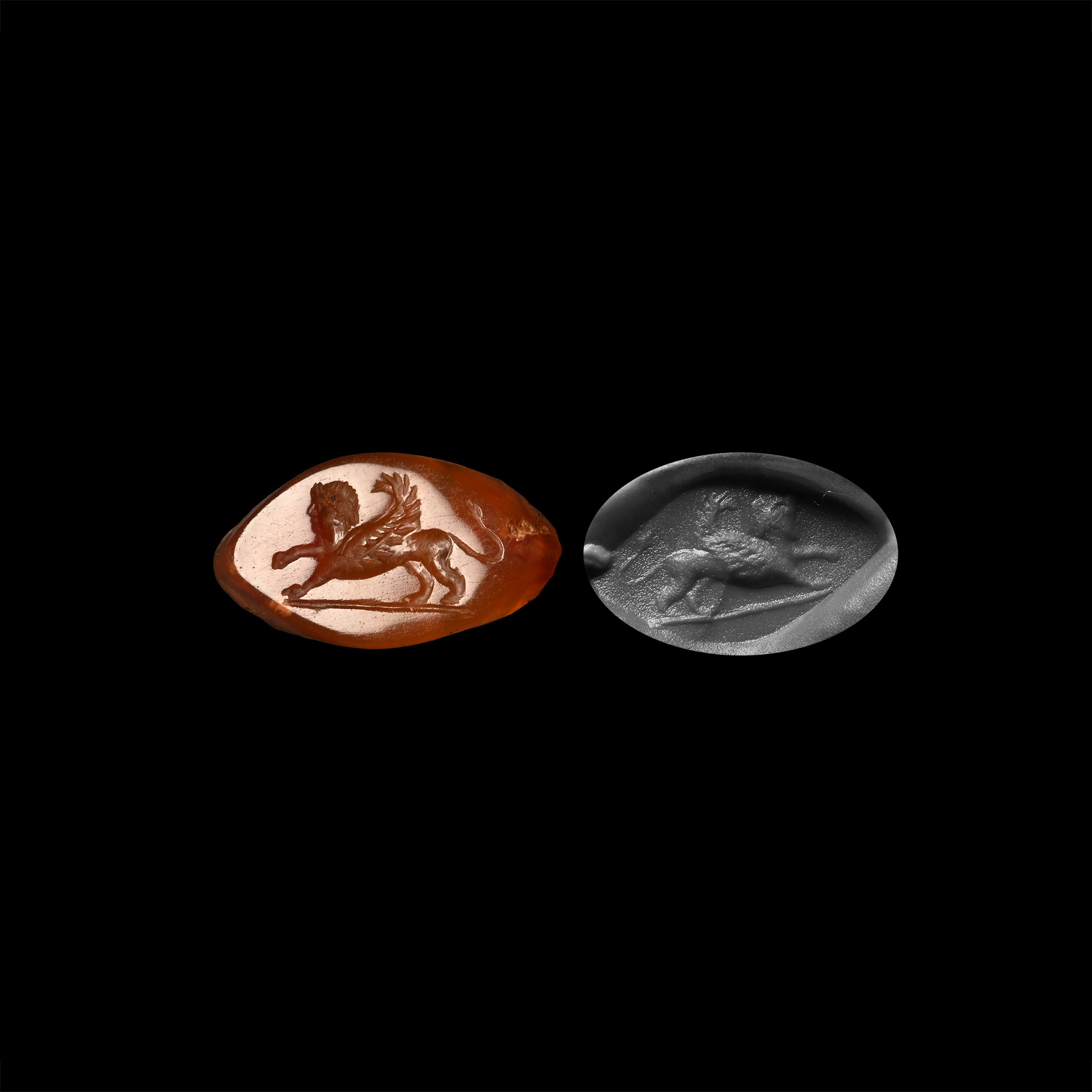
Roman Carnelian Bezel Fragment with Sphinx
2ND-3RD CENTURY A.D.
5/8 in. (0.99 grams, 15 mm).
Once forming a part of a ring carved from a single piece of carnelian, polished and displaying the mythical creature advancing left on a groundline; accompanied by a museum-quality impression.
ProvenanceUK private collection before 2000.
UK art market.
Property of a London gentleman.
TimeLine Auctions follows a vetting process to ensure the authenticity and legality of all items, reinforcing our commitment to integrity and responsible trading. Each antiquity, antique, and coin lot undergoes thorough examination by a vetting committee of at least ten external specialists, professional trade association members, scientists, and archaeologists: Our Vetting Process
AUCTIONS:
TimeLine is a leading auction house specialising in antiquities, ancient art, collectables, natural history, coins, medals, and books. Our auctions offer museums, collectors, historians, and enthusiasts the opportunity to acquire unique and historically significant pieces.
-
.jpg)
Roman Glass and Other Mixed Bead Group
Circa 1st millennium B.C. or laterSold for (Inc. bp): £46
A restrung designer necklace composed of early drawn and lampwork glass, mostly oblate forms with a central pendant ring. 13.4 grams, 69.5 cm long
Fine condition.
Acquired 1980-2015. Ex Abelita family collection. -
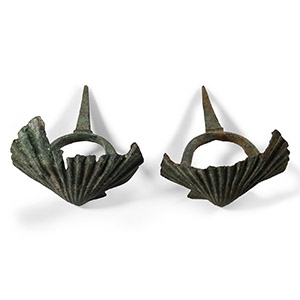
Roman Bronze Scallop Shell Attachment Pair
Circa 2nd-3rd century A.D.Estimate: £2,000 - 3,000 (+bp*)
Opening Bid: £833
Each composed of shell-shaped body with a D-shaped lug to reverse, the lug with tapering spike to the centre. 343 grams total, 12.5 cm each
Private collection, Rosenheim, Germany, 1960s.
This pair could have been used as a double key or door lock, based on comparison with some keys from the territory of Gaul (Boucher, 1971, pp.200-201). They comprised a strong ring with polygonal-section stem and a rectangular point. -
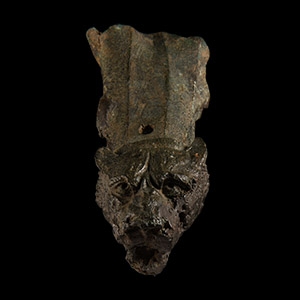
Roman Bronze Lion Fitting
2nd-3rd century A.D.Estimate: £800 - 1,000 (+bp*)
Opening Bid: £444
Displaying a naturalistic lion's head projecting from a facetted bar with piercing for attachment; recessed eyes to accept separate inserts. 100 grams, 88 mm
‘The Ancient Menagerie Collection’ formerly the property of a Cambridgeshire lady, collected since the 1990s and acquired from auctions and dealers throughout Europe and the USA, now ex London collection.
