
Loading, please wait...
_900x900.jpg "Roman Bulbous Glass Vase")
_200x200.jpg "Roman Bulbous Glass Vase")
.jpg "Roman Bulbous Glass Vase")
LOT 0744
Roman Bulbous Glass Vase
2ND-3RD CENTURY A.D.
5 in. (37 grams, 12.5 cm).
With long slender neck and everted rim. [No Reserve]
ProvenanceAcquired 1970s-1996.
Property of a North American collector.
London collection, 2016.
TimeLine Auctions follows a vetting process to ensure the authenticity and legality of all items, reinforcing our commitment to integrity and responsible trading. Each antiquity, antique, and coin lot undergoes thorough examination by a vetting committee of at least ten external specialists, professional trade association members, scientists, and archaeologists: Our Vetting Process
AUCTIONS:
TimeLine is a leading auction house specialising in antiquities, ancient art, collectables, natural history, coins, medals, and books. Our auctions offer museums, collectors, historians, and enthusiasts the opportunity to acquire unique and historically significant pieces.
-
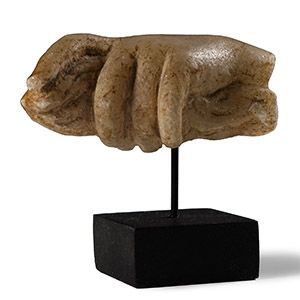
Roman Marble Statue Hand of Jupiter
1st century B.C.-2nd century A.D.Sold for (Inc. bp): £468
Left hand, likely from a larger statue of the god Jupiter, modelled gripping a thunderbolt; thumb and forefinger positioned on the top and side, the remaining three digits curled beneath; mounted on a custom-made display stand. 118 grams total, 74 cm wide including stand
From an important English collection, 1980s. Private collection, England. -
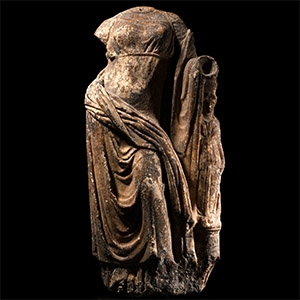
Roman Marble Draped Female Torso
2nd-3rd century A.D.Sold for (Inc. bp): £12,350
Carved in high-relief, a high-status female wearing a palla with a loosely draped stola draped from the left shoulder and arm and drawn across the hips; the left forearm resting on the head of a figure of Venus on a socle base, socket to accept separately carved left hand (absent); mounting sockets to neck and right hip; plain to the reverse; mounted on a custom-made stand. 23 kg total, 55.5 cm including stand
Private collection, England. Accompanied by an academic report by Dr Raffaele D'Amato. This lot has been checked against the Interpol Database of stolen works of art and is accompanied by search certificate number no.12228-215645. -
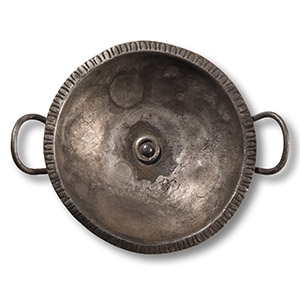
Roman Silver Decorated Dish
Circa 4th-5th century A.D.Sold for (Inc. bp): £416
Comprising a shallow bowl fitted with handles and raised foot, the rim engraved with petals. 39 grams, 95 mm wide
From a North Yorkshire, UK, private collection. Acquired from Adam Partridge Auctioneers, Macclesfield, UK. Property of Mr A.B., an American collector.
In regards of the shape, Roman silver vessels usually fall into three classes: (1) vessels for eating; (2) vessels for drinking; (3) jugs and saucepans (trullae). The first class includes flat, circular dishes (lances), often of considerable size; the situlae or buckets, and the bowls with projecting rims (our specimen) of various dimensions. The form of the present bowl (probably used for spices, like pepper [piperatoria]) occurs all over the Mediterranean basin, and is Alexandrian in origin.
