
Loading, please wait...
LOT 0828
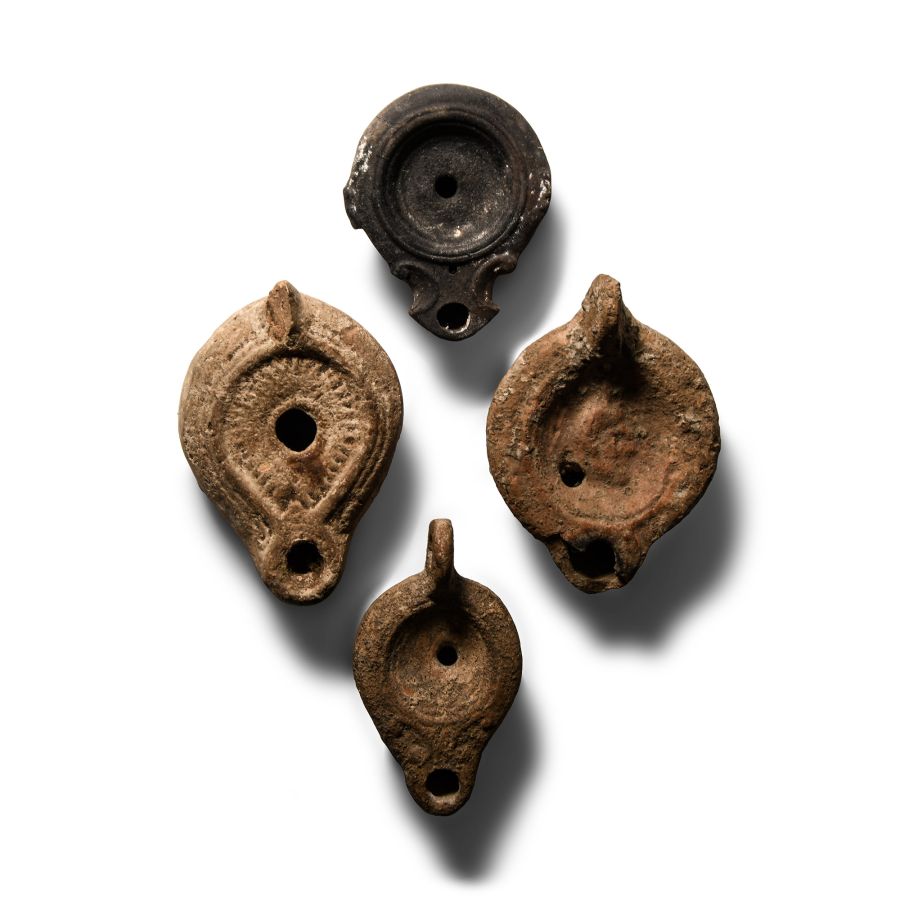
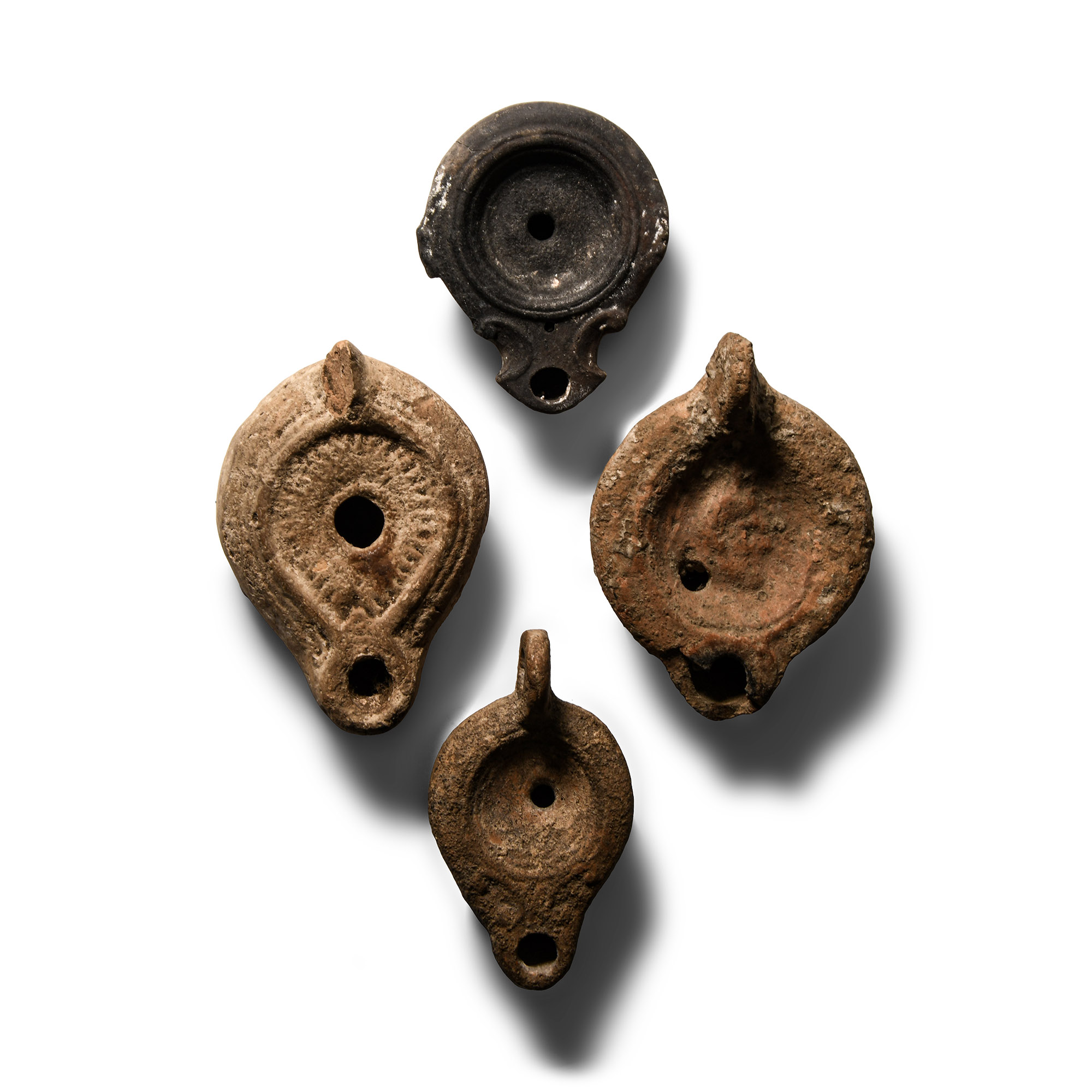
Roman Buffware Oil Lamp Group
1ST-3RD CENTURY A.D.
2 5/8 - 3 1/4 in. (140 grams total, 67-82 mm).
Comprising four mould made lamps, one with ring handle with two shallow grooves on upper part, central filling-hole, small air hole in the lower part; one with volute lug handle, flat shoulder with a rounded outer ridge, flat-bottomed discus, central filling-hole, V-shaped channel between discus and nozzle, air hole above club; the other two with ring handles and grooves on upper and lower parts, shoulder with shallow pronounced relief, filling hole with air hole in front of the nozzle. [4, No Reserve]
ProvenanceFrom a collection acquired on the UK art market from various auction houses and collections mostly before 2000.
From an important Cambridgeshire estate; thence by descent.
See Bussière, J., Lindros Wohl, B., Ancient Lamps in the J. Paul Getty Museum, Malibu, 78, 314, 392-393, for the types.
FootnotesThe lamps have connections with models of 1st-3rd centuries A.D., in particular with Bayley type A group i, Bussiere form D VII and D X 5.
CONDITIONTimeLine Auctions follows a vetting process to ensure the authenticity and legality of all items, reinforcing our commitment to integrity and responsible trading. Each antiquity, antique, and coin lot undergoes thorough examination by a vetting committee of at least ten external specialists, professional trade association members, scientists, and archaeologists: Our Vetting Process
AUCTIONS:
TimeLine is a leading auction house specialising in antiquities, ancient art, collectables, natural history, coins, medals, and books. Our auctions offer museums, collectors, historians, and enthusiasts the opportunity to acquire unique and historically significant pieces.
-
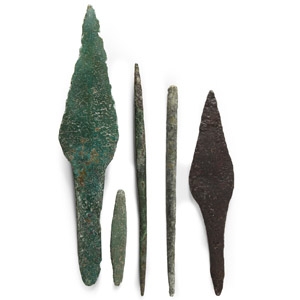
Bronze Age to Roman Bronze Artefact Collection
11th century B.C.-3rd century A.D.Sold for (Inc. bp): £46
Comprising two arrowheads with foliate head and square-sectioned tang and three awls. 45 grams total, 3.6-10.8 cm
Acquired prior to 2000. Ex private collection, Cambridgeshire, UK.
The two arrowheads are similar to specimens found in Luristan. They belong to the type V of the Khorasani classification. The bow was widely used by the Luristan people. The shape of the blade is often flat or ovate in the cross section with lanceolate profile and two cutting edges. -
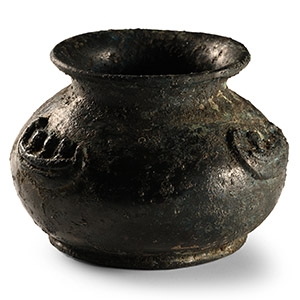
Roman Bronze Vessel with Boats
2nd-3rd century A.D.Estimate: £300 - 400 (+bp*)
Opening Bid: £150
Squat jar with concentric rings to the base, flared rim to the mouth three high-relief galley images to the shoulder. 166 grams, 43 mm high
Ex German art market, 2000s. Acquired from an EU collector living in London. From the collection of Surrey, UK, gentleman.
The vase evokes a scene of maritime or river trade, usually linked to navigation on the Rhine or on the great rivers of Roman Gaul. In particular, the shape of the ship and the three people only half visible on its deck closely resemble the famous relief of the wine merchants of Neumagen-Dhron. The small jar was probably for domestic toilette use. -
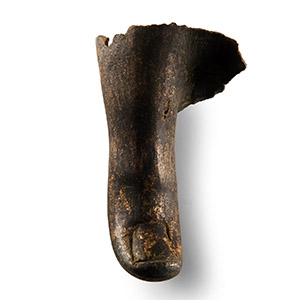
Roman Gilt Bronze Statue Thumb
3rd century A.D.Sold for (Inc. bp): £247
Hollow-formed left thumb with detailed nail. 178 grams, 95 mm
Acquired in Europe before 2001. European private collection.
