Loading, please wait...

Roman Brooch and Other Artefact Group Roman Brooch and Other Artefact Group Roman Brooch and Other Artefact Group
Use mousewheel to zoom in and out, click to enlarge
Details

LOT 0616

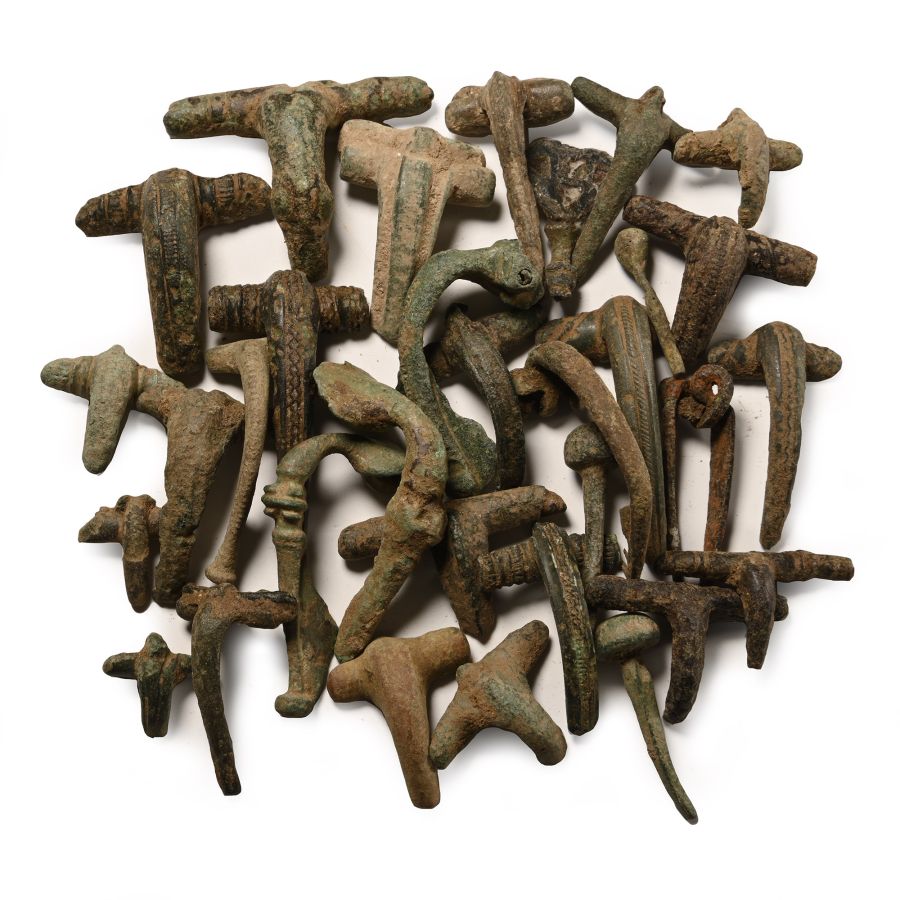
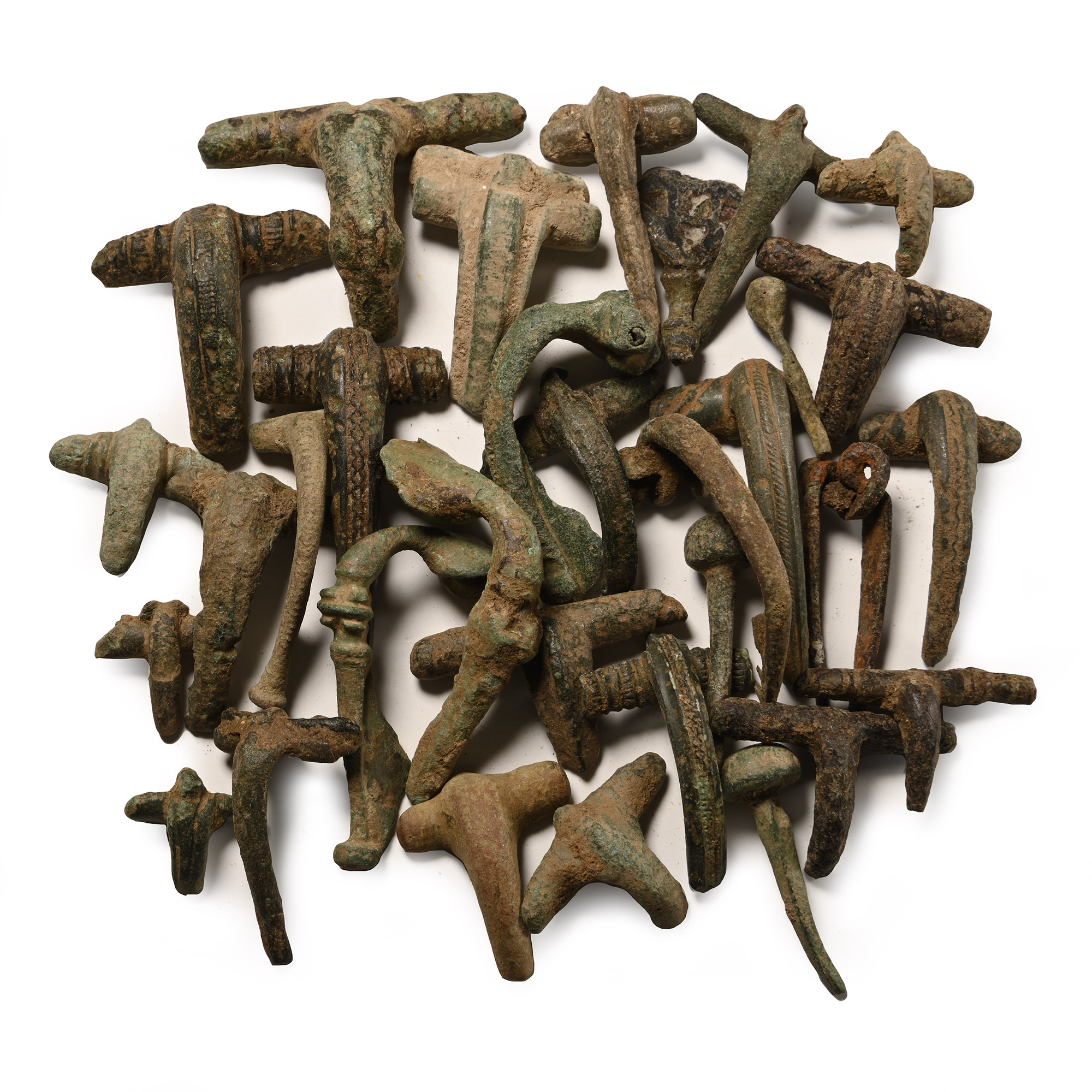
Roman Brooch and Other Artefact Group

1ST-4TH CENTURY A.D.

5/8 - 1 3/4 in. (194 grams total, 16-43 mm).

Including various brooch and pin fragments. [32, No Reserve]

Provenance

Found Suffolk, UK.
This lot is accompanied by an illustrated lot declaration signed by the Head of the Antiquities Department, Dr Raffaele D'Amato.

CONDITION
VETTING:

TimeLine Auctions follows a vetting process to ensure the authenticity and legality of all items, reinforcing our commitment to integrity and responsible trading. Each antiquity, antique, and coin lot undergoes thorough examination by a vetting committee of at least ten external specialists, professional trade association members, scientists, and archaeologists: Our Vetting Process


AUCTIONS:

TimeLine is a leading auction house specialising in antiquities, ancient art, collectables, natural history, coins, medals, and books. Our auctions offer museums, collectors, historians, and enthusiasts the opportunity to acquire unique and historically significant pieces.

Live Bidding

LOT 0616

Roman Brooch and Other Artefact Group

Sold for (Inc. bp): £117

Print page

RELATED LOTS
  • Roman Mosaic with Kantharos and Vines
    Roman Mosaic with Kantharos and Vines
    4th-6th century A.D.

    Sold for (Inc. bp): £9,100

    An attractive rectangular panel of mosaic tesserae with central ribbed kantharos executed in coral pink, amber-yellow, and green segments with tiered foot; issuing from the scaphoid opening two vines with curled tendrils and trefoil leaves in pale green; white field with grey-black border; restored and set into a mid 20th century reinforced mortar matrix. 56 kg, 67.5 x 67.5 cm


    Acquired in the 1950s-early 1990s. From the Igor Karmiloff (1925-2016) collection, UN economist and author of Flashbacks, Icons of Impermanence, Bloomington, 2009. This lot has been checked against the Interpol Database of stolen works of art and is accompanied by a search certificate number no.12746-233888. This lot has been cleared against the Art Loss Register database, and is accompanied by an illustrated lot declaration signed by the Head of the Antiquities Department, Dr Raffaele D'Amato.

    The motif of the kantharos, krater or amphora with vines emerging from the mouth is widely represented in classical art and was seemingly a popular motif for the mosaicist with examples found in areas as widespread as North Africa and northern Britain. The origins of the motif are probably to be found in the cult of Bacchus (Greek Dionysos) with its ritualised drunkenness expressed in the vine which gives rise to the grapes to be transformed into wine, and the drinking cup from which it is received. In later Roman times, the motif was reinterpreted as Christ (the Eucharist symbolised by the cup) from whom the vine grows representing the spread of the Christian message and the growth of the church (Watts, 1991, p.208).

    Lot Details

  • Roman Carnelian Gemstone with Female Portrait
    Roman Carnelian Gemstone with Female Portrait
    1st-2nd century A.D.

    Estimate: £200 - 300 (+bp*)

    Opening Bid: £100

    Ellipsoid in plan with intaglio profile portrait bust of a female with hair in a chignon. 0.22 grams, 9 mm


    Acquired on the German art market, 1989-1995. with The Museum Gallery, 19 Bury Place, London, WC1, UK, 1998-2003. Property of a London based academic, 2003 to present. This lot is accompanied by an illustrated lot declaration signed by the Head of the Antiquities Department, Dr Raffaele D'Amato.

    Lot Details

  • Lifesize Roman Marble Portrait Head of a Patrician Woman
    Under the Empress Furia Sabinia Tranquillina and Otacilia Severa
    Lifesize Roman Marble Portrait Head of a Patrician Woman
    3rd century A.D.

    Sold for (Inc. bp): £28,600

    Carved in fine-grained marble, the head depicting a matron of the patrician class with angular features, pronounced cheekbones and a softly wrinkled brow; her lips finely curved and gently closed, the heavy-lidded eyes incised with irises and drilled pupils, lending an expression of composed attentiveness; the hair parted centrally, arranged in thick curls drawn behind the prominent ears, coiled into a low chignon at the nape and continued as a braided tail over the crown, a coiffure closely associated with the mid-3rd century A.D.; attached to an antique bust, some restoration. 49 kg, 76.5 cm high


    French private collection, 18th century. with Mercier & Cie, Lille, France, 6 October 2019, no.199. Private collection, Europe. Accompanied by a copy of French passport no.217723, dated 27 February 2020. This lot has been checked against the Interpol Database of stolen works of art and is accompanied by a search certificate number no.12674-236274. This lot has been cleared against the Art Loss Register database, and is accompanied by an illustrated lot declaration signed by the Head of the Antiquities Department, Dr Raffaele D'Amato.

    The present work exhibits a distinctive coiffure that gained prominence among aristocratic Roman women during the mid-3rd century A.D., most notably under the empresses Furia Sabinia Tranquillina, consort of Gordian III, and Otacilia Severa, wife of Philippus Arabs. This elaborate arrangement - central parting, voluminous curls, and a braided crown - is a key chronological indicator, allowing the portrait to be securely dated to this period. The head is mounted on an 18th century bust inscribed 'IVLIA MAESA'. While this identification reflects an earlier attribution, current stylistic analysis suggests a slightly later date, aligning the portrait more plausibly with the generation following Julia Maesa’s death in A.D. 224/225.

    Lot Details

Stay up-to-date with the latest from TimeLine Auctions by joining our mailing list