
Loading, please wait...

LOT 0571
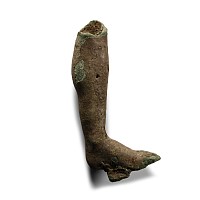
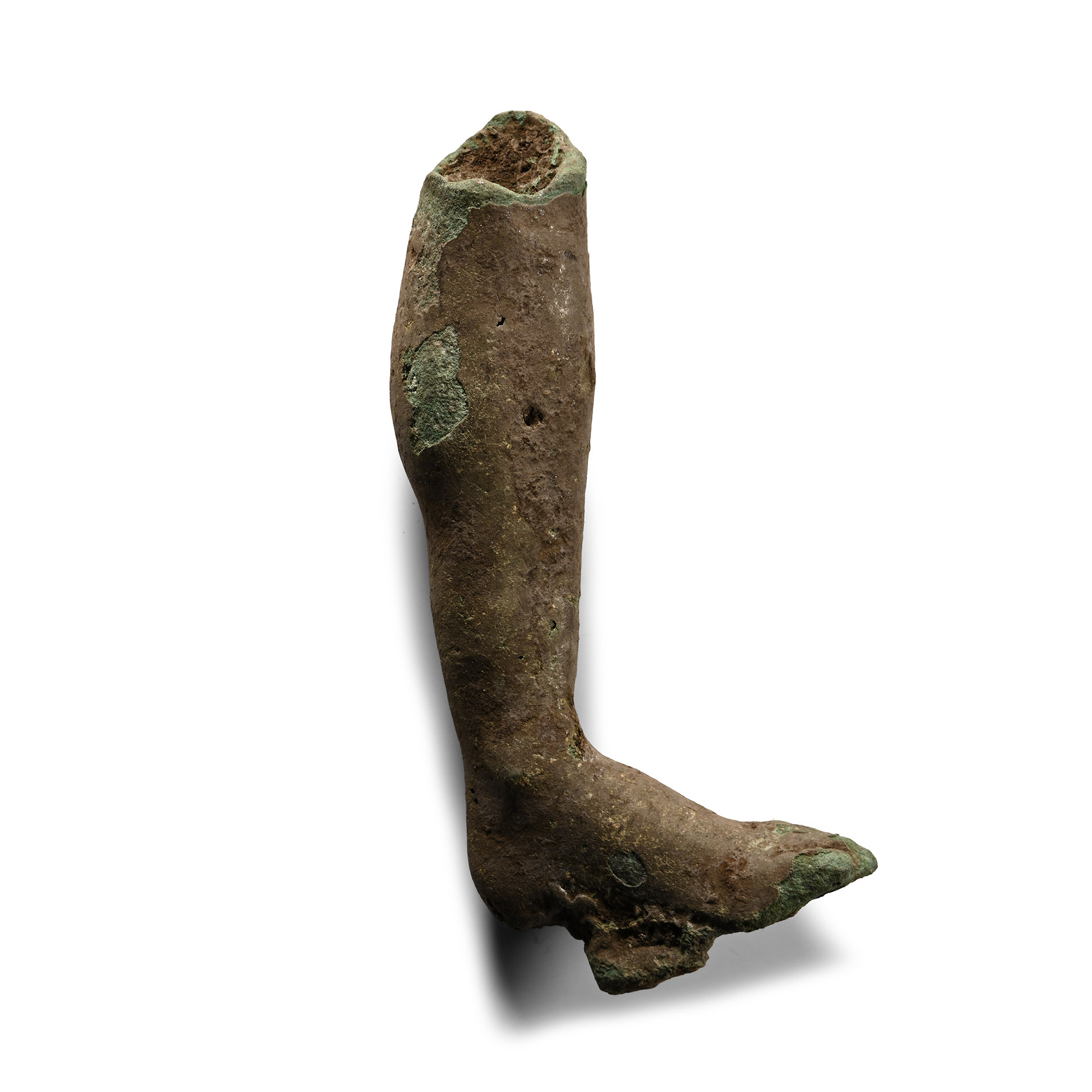
Roman Bronze Votive Statue Leg
2ND-3RD CENTURY A.D.
5 in. (435 grams, 12.9 cm).
Modelled as the lower left leg with anatomical detailing, sprue to the foot.
ProvenanceAcquired in the mid 1980s-1990s.
Private collection, Switzerland, thence by descent.
Private collection, since the late 1990s.
This lot is accompanied by an illustrated lot declaration signed by the Head of the Antiquities Department, Dr Raffaele D'Amato.
TimeLine Auctions follows a vetting process to ensure the authenticity and legality of all items, reinforcing our commitment to integrity and responsible trading. Each antiquity, antique, and coin lot undergoes thorough examination by a vetting committee of at least ten external specialists, professional trade association members, scientists, and archaeologists: Our Vetting Process
AUCTIONS:
TimeLine is a leading auction house specialising in antiquities, ancient art, collectables, natural history, coins, medals, and books. Our auctions offer museums, collectors, historians, and enthusiasts the opportunity to acquire unique and historically significant pieces.
LOT 0571
Roman Bronze Votive Statue Leg
Estimate £150 - 200€170 - 230 (for guidance only)$200 - 270 (for guidance only)
-
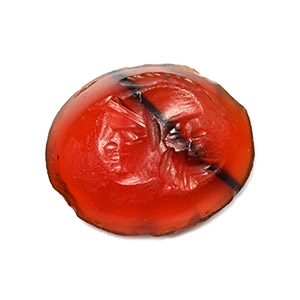
Roman Black-Banded Carnelian Gryllos Gemstone
1st-2nd century A.D.Estimate: £300 - 400 (+bp*)
Opening Bid: £150
Elliptical in plan with chamfered sides, intaglio gryllos motif with head of Silenus and a helmet-wearing male (Mars?). 0.54 grams, 12 mm
Acquired on the German art market, 1989-1995. with The Museum Gallery, 19 Bury Place, London, WC1, UK, 1998-2003. Property of a London based academic, 2003-present. This lot is accompanied by an illustrated lot declaration signed by the Head of the Antiquities Department, Dr Raffaele D'Amato. -
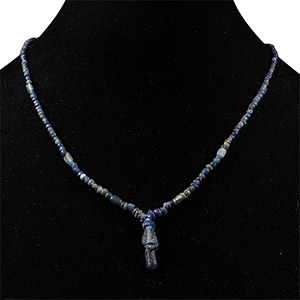
Roman Blue Glass Bead Necklace String
1st-4th century A.D. and laterSold for (Inc. bp): £117
Composed mainly of oblate and cylindrical beads, central feature composed of larger irregular beads; restrung. 7.55 grams, 35 cm
Ex London, UK, collection, 1990s. This lot is accompanied by an illustrated lot declaration signed by the Head of the Antiquities Department, Dr Raffaele D'Amato. -
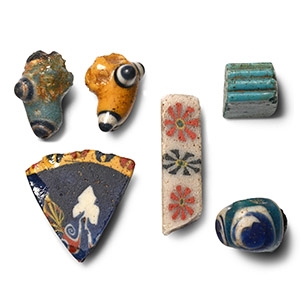
Roman Glass Inlay, Bead and Fragment Group
1st-4th century A.D.Estimate: £800 - 1,000 (‡+bp*)
Opening Bid: £400
Comprising: a polychrome mosaic glass fragment with leaf decoration and a banded yellow rim; a white mosaic glass inlay with red and black floral motifs; an oblate bead with 'eye' motifs; a turquoise-coloured thick inlay of four fingers with white nail detailing; a blue and a yellow shoe-shaped fragment with applied bosses. 5.48 grams total, 9-20 mm
Ex private Swiss collection. Acquired by Galerie Rhéa, Zurich, from the above in 2011. This lot is accompanied by an illustrated lot declaration signed by the Head of the Antiquities Department, Dr Raffaele D'Amato.
