
Loading, please wait...
_900x900.jpg "Roman Bronze Triskele Brooch")
_200x200.jpg "Roman Bronze Triskele Brooch")
.jpg "Roman Bronze Triskele Brooch")
LOT 0906
Roman Bronze Triskele Brooch
1ST CENTURY B.C.
1 5/8 in. (14 grams, 40 mm).
Comprising an openwork body with a three radiating running legs, central Medusa head with wings to the crown, the design from the reverse of a Republican denarius; catchplate and pin-lugs to the reverse.
ProvenanceEx German art market, 2000s.
Acquired from an EU collector living in London.
From the collection of Surrey, UK, gentleman.
TimeLine Auctions follows a vetting process to ensure the authenticity and legality of all items, reinforcing our commitment to integrity and responsible trading. Each antiquity, antique, and coin lot undergoes thorough examination by a vetting committee of at least ten external specialists, professional trade association members, scientists, and archaeologists: Our Vetting Process
AUCTIONS:
TimeLine is a leading auction house specialising in antiquities, ancient art, collectables, natural history, coins, medals, and books. Our auctions offer museums, collectors, historians, and enthusiasts the opportunity to acquire unique and historically significant pieces.
-
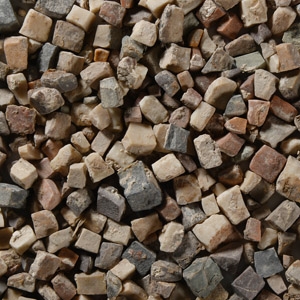
Roman Mosaic Stone Tesserae Group
1st-4th century A.D.Sold for (Inc. bp): £20
A mixed group of over hundred single tesserae of various colours and sizes. 130 grams total, 1-14 mm
Acquired 1980-2015. Ex Abelita family collection. -
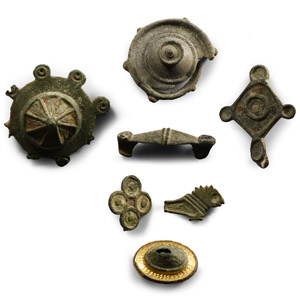
Roman Bronze Mixed Brooch Group
Circa 2nd century A.D.Sold for (Inc. bp): £98
Including lion, umbonate, equal-ended and other types. 36.1 grams total, 20-35 mm
Found Wiltshire, UK, before 1974. -
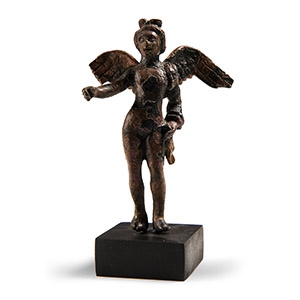
Roman Bronze Statuette of the Goddess Eos
2nd-3rd century A.D.Sold for (Inc. bp): £546
Modelled in the round, Eos (The Dawn) standing nude with left leg slightly flexed; the head with finely detailed face and hair dressed in a chignon; spread wings to the rear with feather detailing; left arm bent and hand resting on the hip with mantle wound about the shoulder and wrist; right arm extended and hand modelled open to accept an attribute; mounted on a custom-made display stand. 150 grams total, 11.2 cm including stand
From a collection acquired on the UK art market from various auction houses and collections mostly before 2000. From an important Cambridgeshire estate; thence by descent.
Eos, the ancient Greek goddess of the dawn, was perhaps the most resplendent of all the beings in the Greek pantheon. With the brilliant dye of saffron as her colour, she was also associated with roses, which also embody the glowing hues of the dawn.
