
Loading, please wait...

LOT 0788
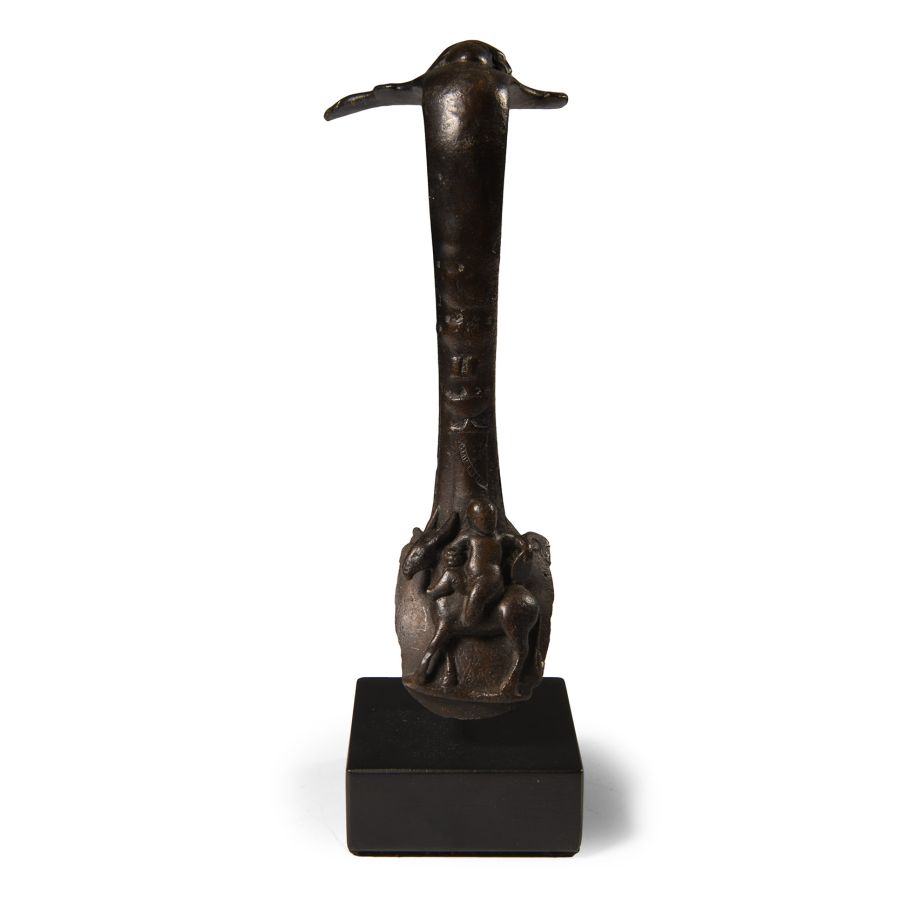
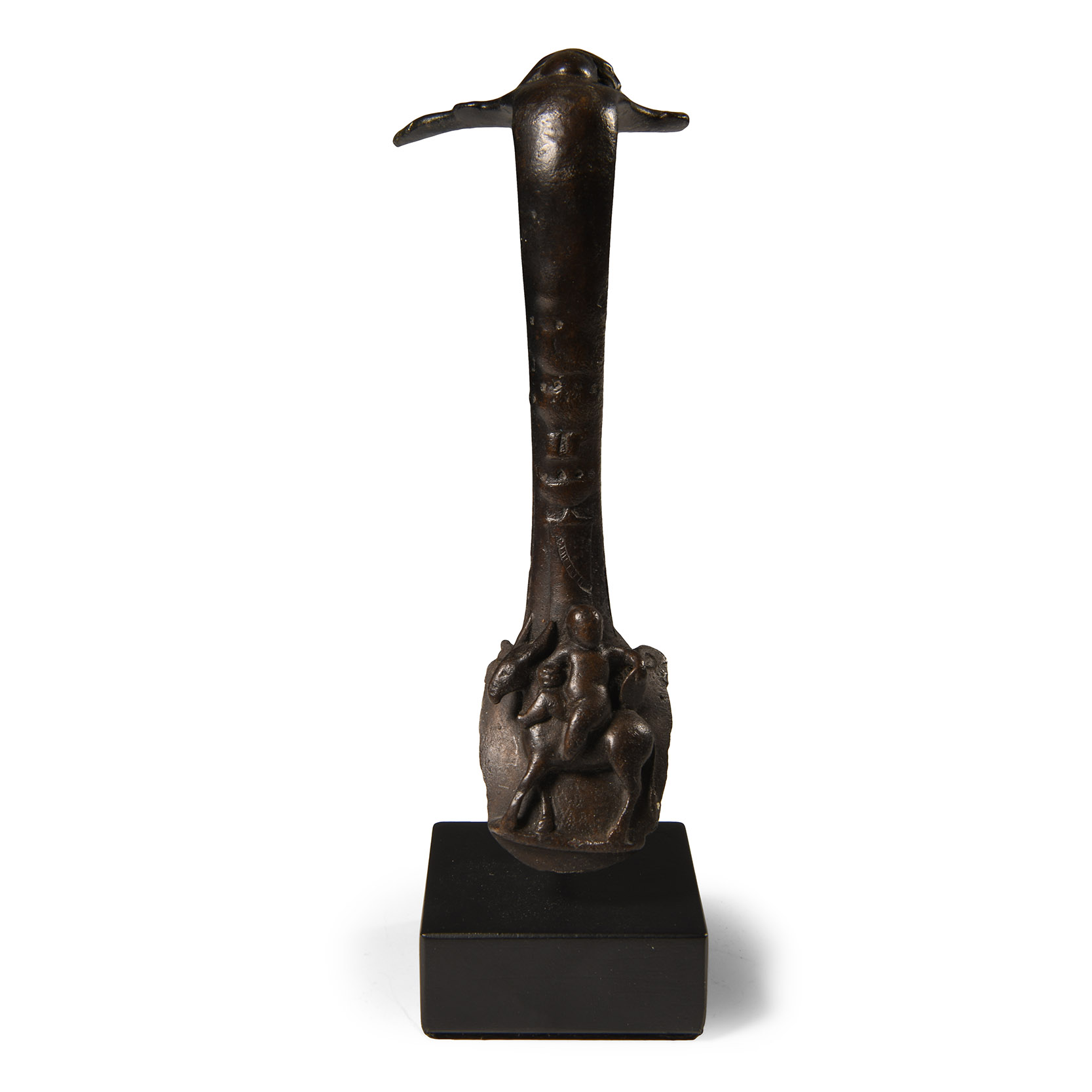
Roman Bronze Tankard Handle with Drunken Putto on Donkey
2ND CENTURY A.D.
6 3/4 in. (318 grams total, 17 cm including stand).
Comprising a crescent plaque above with facing mask a a thumb-pad, lateral scrolls; perpendicular D-section bar with ribbing to the outer face; rectangular lower attachment panel with scrolled upper corners, high-relief putto (?) holding a patera in one hand and tankard in the other, riding an ass side-saddle; mounted on a custom-made stand. [No Reserve]
ProvenanceFrom a collection acquired on the UK art market from various auction houses and collections mostly before 2000.
From an important Cambridgeshire estate; thence by descent.
Cf. Tassinari, S., La Vaisselle de Bronze, Romaine et Provinciale, au Musée des Antiquités Nationales, XXIXe supplément de Gallia, Paris, 1975, items 152, 173, 173, 178, for type.
FootnotesThis type of bronze handles are usually depicting mythological scenes. The scene of the putto riding a donkey is often linked to Bacchic processions. The face of the character riding the donkey could also correspond to that of Silenus, who in the same processions is often represented riding such an animal.
CONDITIONTimeLine Auctions follows a vetting process to ensure the authenticity and legality of all items, reinforcing our commitment to integrity and responsible trading. Each antiquity, antique, and coin lot undergoes thorough examination by a vetting committee of at least ten external specialists, professional trade association members, scientists, and archaeologists: Our Vetting Process
AUCTIONS:
TimeLine is a leading auction house specialising in antiquities, ancient art, collectables, natural history, coins, medals, and books. Our auctions offer museums, collectors, historians, and enthusiasts the opportunity to acquire unique and historically significant pieces.
LOT 0788
Roman Bronze Tankard Handle with Drunken Putto on Donkey
Sold for (Inc. bp): £221
-
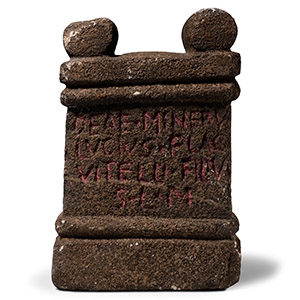
Stone Minerva Statuette House Altar
Roman, 2nd-4th century A.D. or laterSold for (Inc. bp): £4,160
Square-section with stepped base, gussetted collar and two parallel bars to the upper face; inscribed 'DEAE.MINERV[AE] / LVCIVS.PLAC[IDUS] / VITELLI.FIL[IVS].V[OTUM] / S[OLVIT].L[IBENS].M[ERITO]' (to the goddess Minerva, Lucius Plac[idus] son of Vitellius, discharges the vow freely, as is deserved); the inscription highlighted in crimson. 5.3 kg, 21.2 cm high
From a collection acquired on the UK art market from various auction houses and collections mostly before 2000. From an important Cambridgeshire estate; thence by descent.
Votive inscriptions follow a set pattern, since they were dedicated to a god or goddess to thank them for something they had done in response to a prayer. The person dedicating the stone would have previously promised to do this if the god answered their prayer. The formulation V.S.L.M. (votum solvit libens [or libenter] merito = in willing fulfilment of a vow) is attested for example at Bath, or on the Arae of the Hadrian's Wall. -
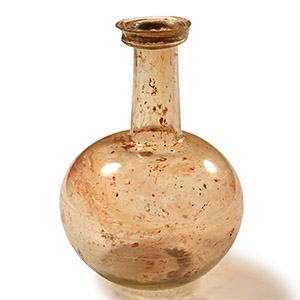
Roman Wheel-Cut Glass Vessel
3rd-4th century A.D.Sold for (Inc. bp): £494
With globular body and long tubular neck, dimple base, everted rim with gusset to the outer edge; wheel-cut horizontal lines to the body. 82 grams, 12.5 cm
Ex London, UK, collection, 1980-1990s.
This bottle belongs to a group of globular bottles with cylindrical necks (some longer than others) and plain or collar-like rims, which are decorated with parallel and/or intersecting circles or combinations of circles and other motifs. -
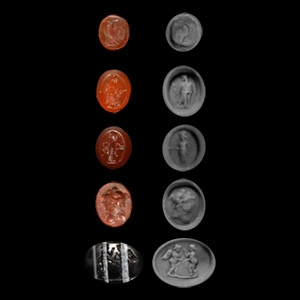
Gemstone Collection
Roman, 2nd century A.D. and laterSold for (Inc. bp): £910
Including two putti on a baseline, eagle perching, standing figure, female bust, in carnelian and other gemstones; each supplied with a museum-quality impression. 2.41 grams total, 8-13 mm
Private collection, England.
