
Loading, please wait...
LOT 0711
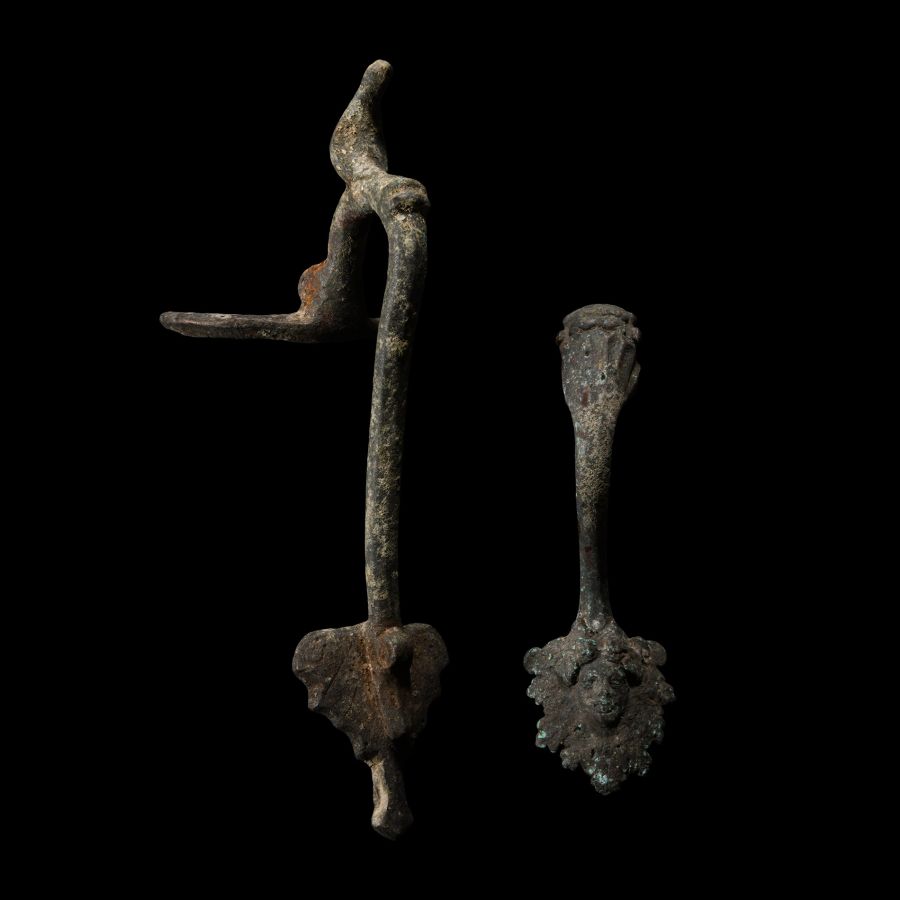
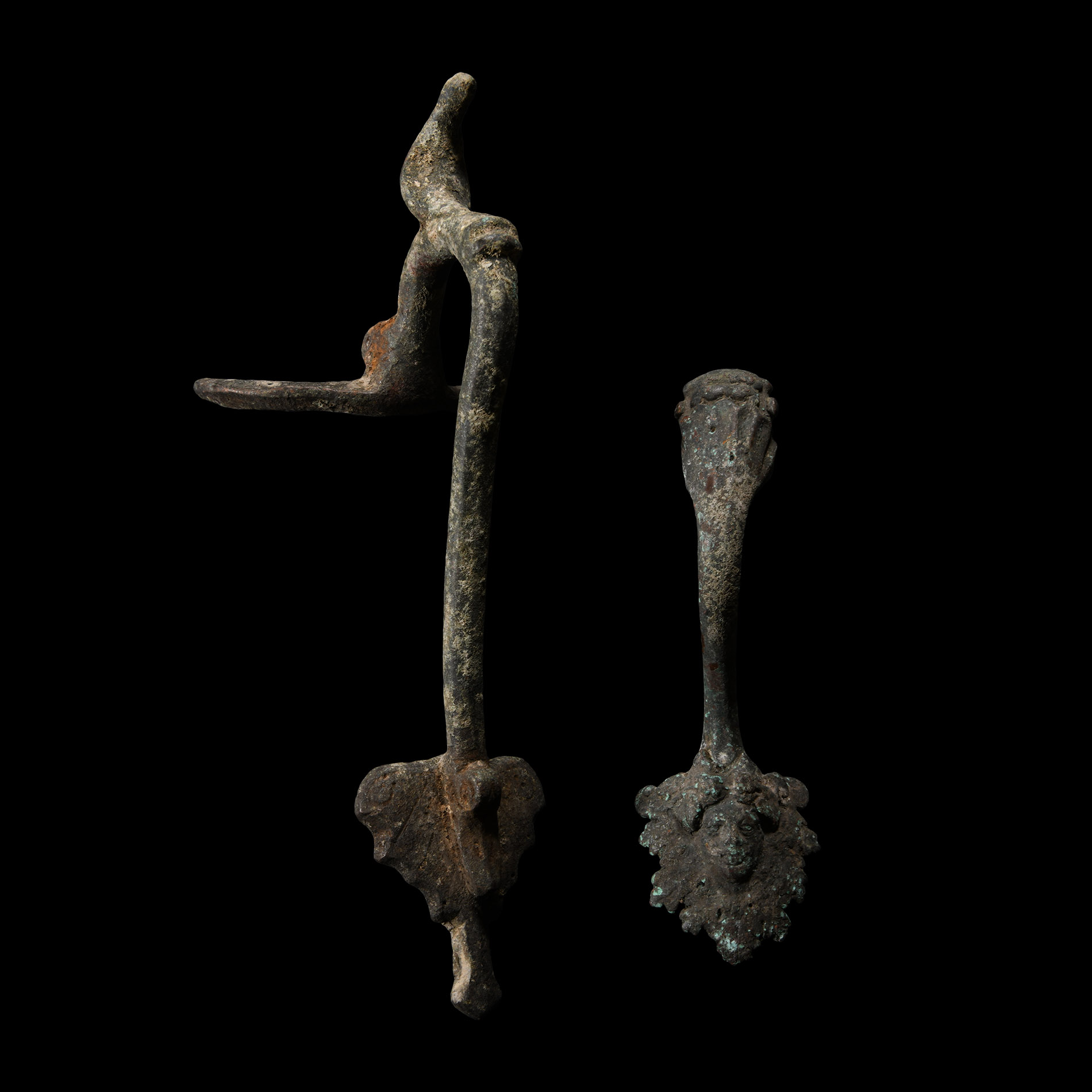
Roman Bronze Tankard Handle Group
CIRCA 2ND-4TH CENTURY A.D.
6 1/4 - 9 1/2 in. (605 grams total, 16-24 cm).
Comprising two differently sized handles: one featuring a leaf plaque to base with head of Bacchus(?) in relief, fluting and a second head to the top; one with a leaf plaque to base and swan head in relief, collars and thumb pad to top. [2, No Reserve]
ProvenanceAcquired 1990s-early 2000s.
East Anglian private collection.
TimeLine Auctions follows a vetting process to ensure the authenticity and legality of all items, reinforcing our commitment to integrity and responsible trading. Each antiquity, antique, and coin lot undergoes thorough examination by a vetting committee of at least ten external specialists, professional trade association members, scientists, and archaeologists: Our Vetting Process
AUCTIONS:
TimeLine is a leading auction house specialising in antiquities, ancient art, collectables, natural history, coins, medals, and books. Our auctions offer museums, collectors, historians, and enthusiasts the opportunity to acquire unique and historically significant pieces.
-
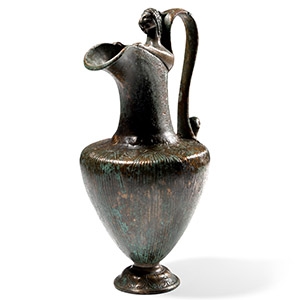
Roman Bronze Oinochoe with Lion Protome
1st century B.C.-1st century A.D.Sold for (Inc. bp): £4,680
The conical body decorated with overlapping petal-shaped panels, tapering neck with a wide spout, high arching handle with acanthus leaves, bust of a youthful male with long hair below (possibly Bacchus) the upper part terminating with a lion protome with the extended forelegs resting on the rim of the vessel, the high flaring foot possibly added later. 797 grams, 22.5 cm high
Excellent condition
Private collection, Rosenheim, Germany, 1960s. Accompanied by an academic report by Dr Raffaele D’Amato. This lot has been checked against the Interpol Database of stolen works of art and is accompanied by search certificate no.11734-201200.
Considering the primary function of oinochoe as drinking jugs, the images decorating them were often related to the god of wine, Bacchus, here probably represented as young Dionysus accompanied by a lion. -
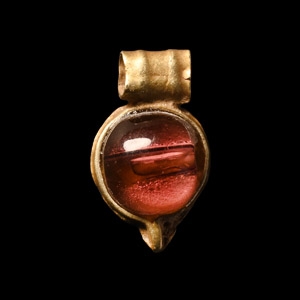
Roman Gold and Garnet Pendant
3rd-4th century A.D.Sold for (Inc. bp): £169
Displaying a polished garnet cabochon on a discoid setting, ribbed tubular suspension loop above. 0.15 grams, 8 mm
Acquired 1970-2010. Collection of a late Japanese gentleman. -
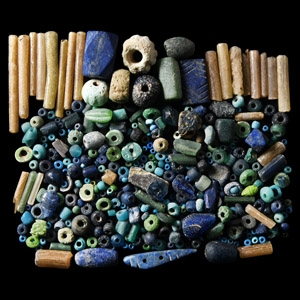
Roman Mixed Bead Group
2nd-5th century A.D.Sold for (Inc. bp): £59
Composed of mainly opaque polychrome glass, faience and stone beads of a variety of sizes and types, including melon, tubular, facetted, annular and barrel types, and others. 54 grams total, 2-36 mm
Ex W.J. collection, 1990s.
