
Loading, please wait...



LOT 0706
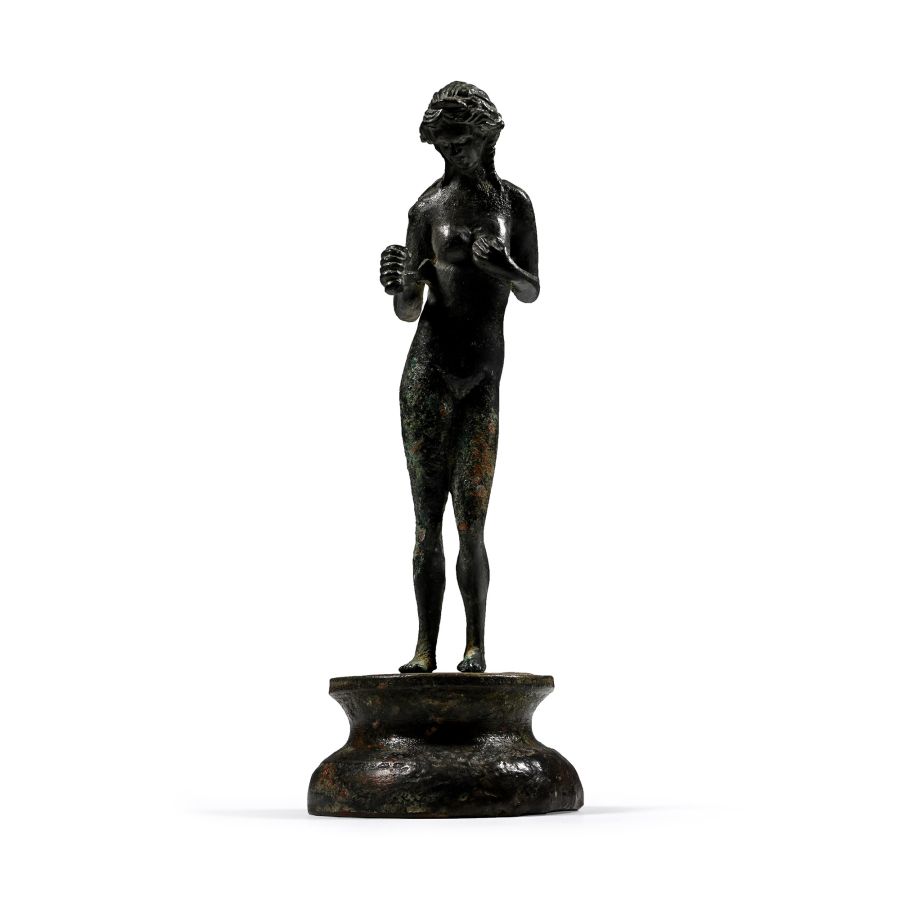
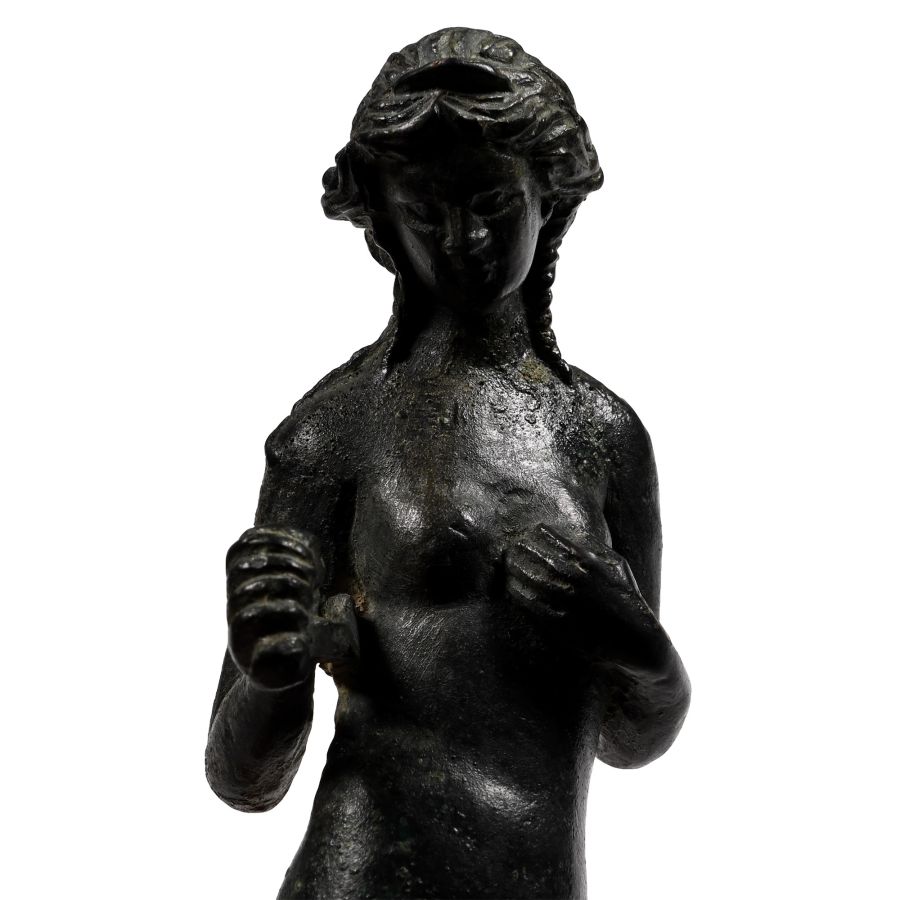
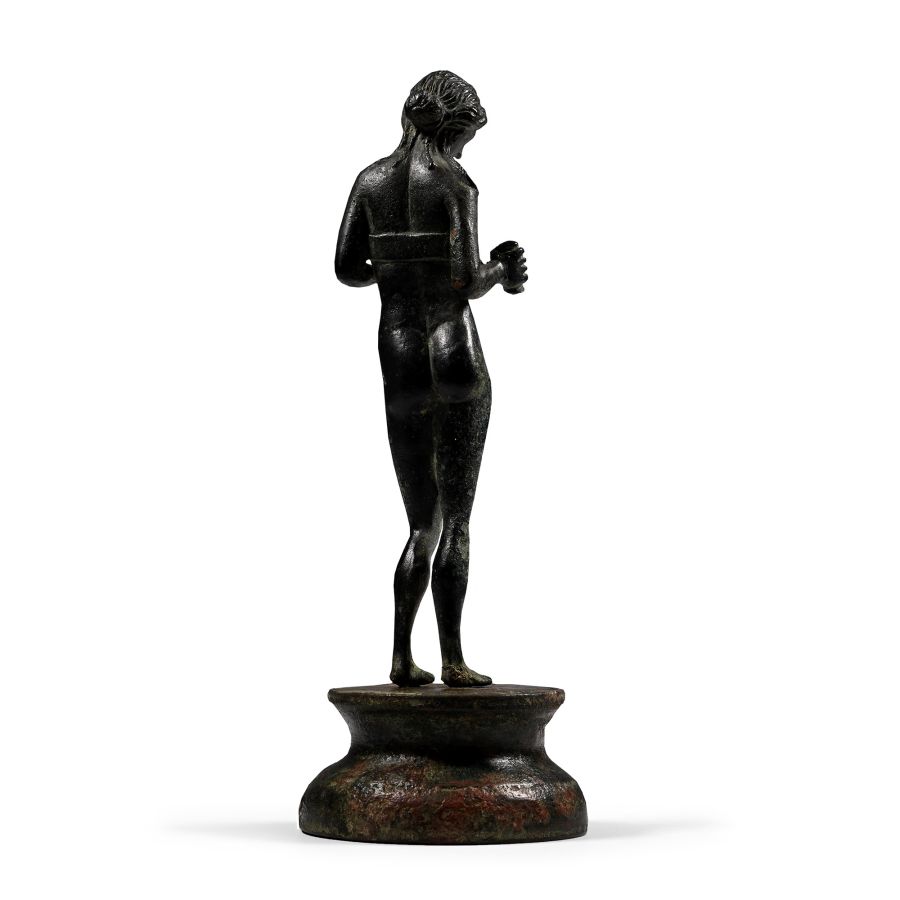
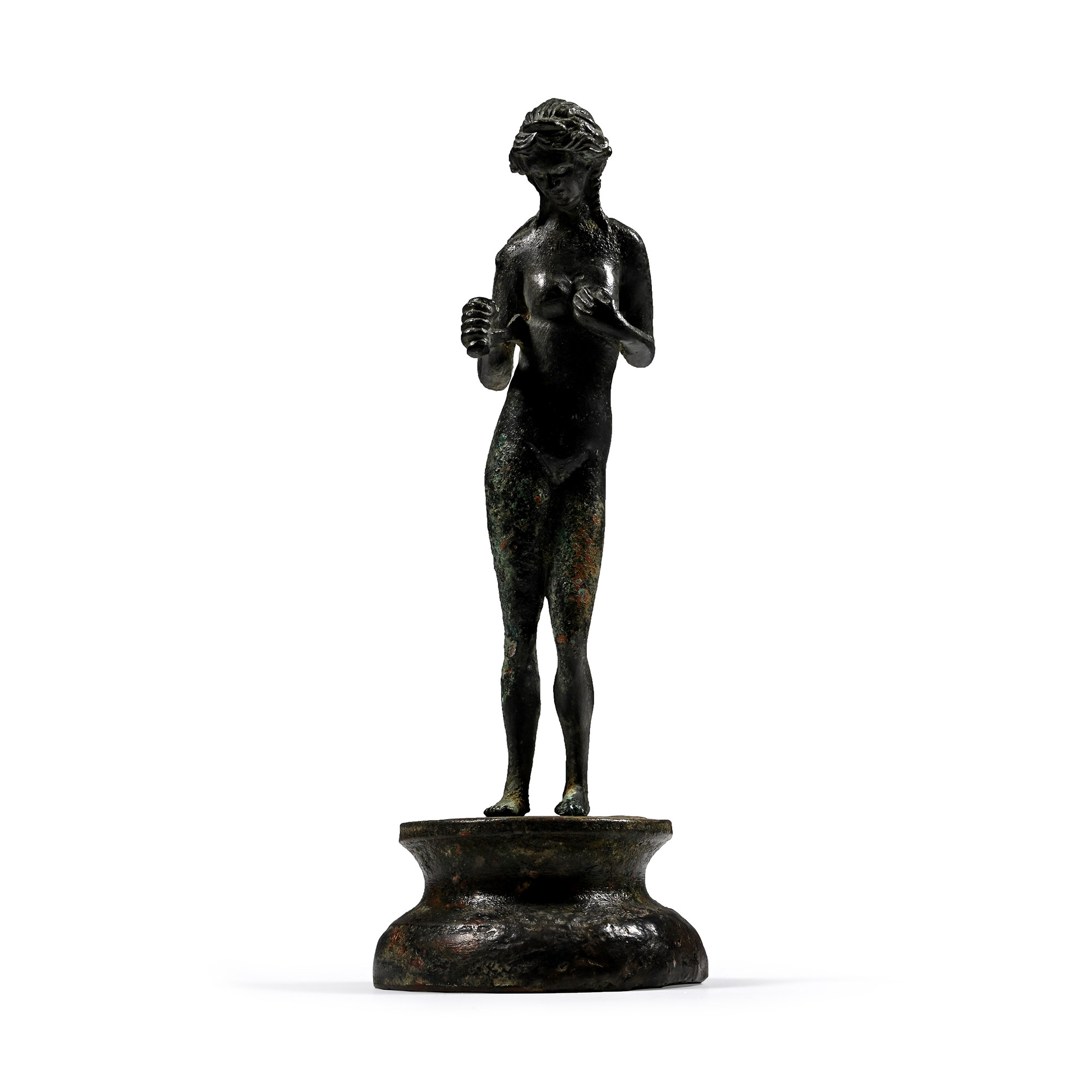
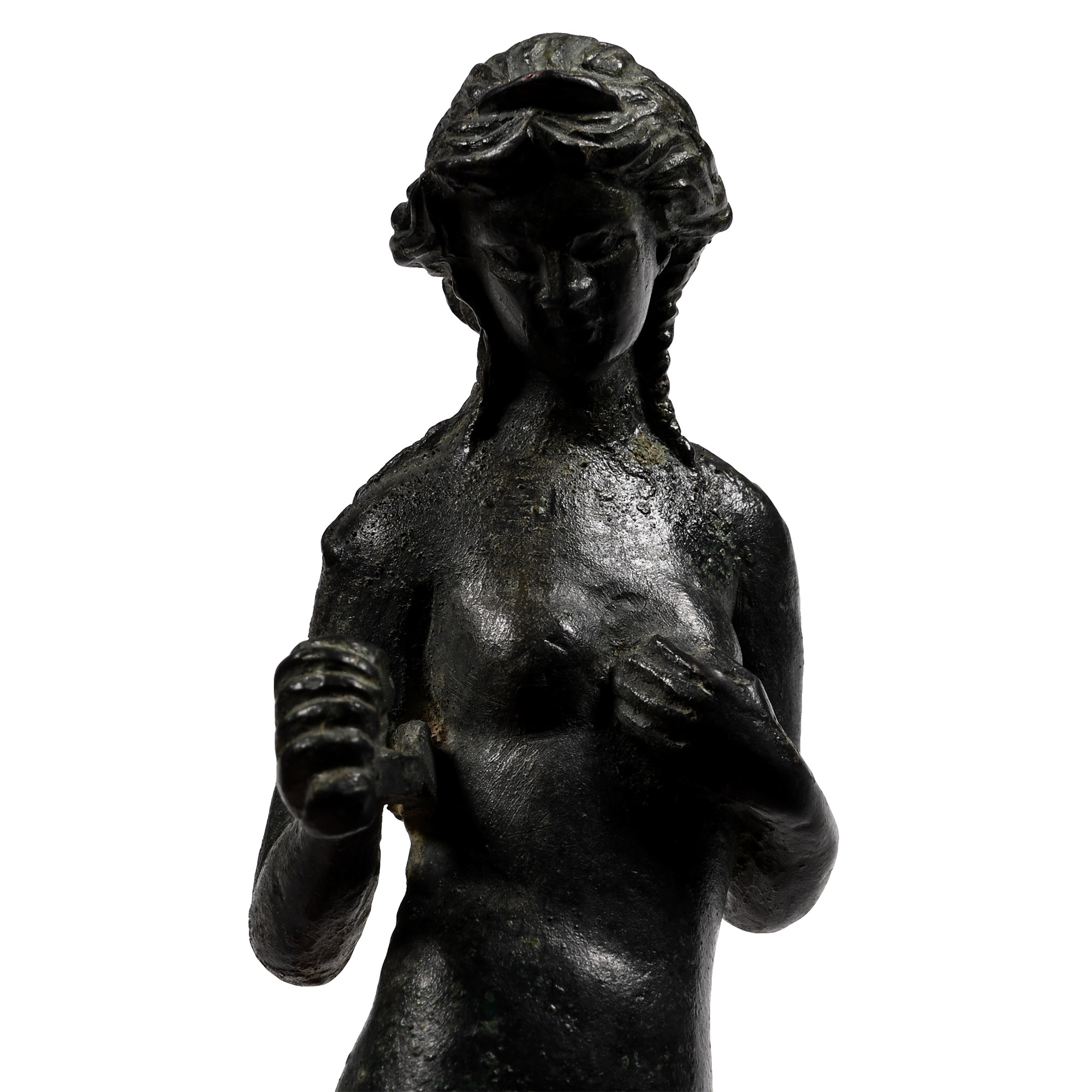
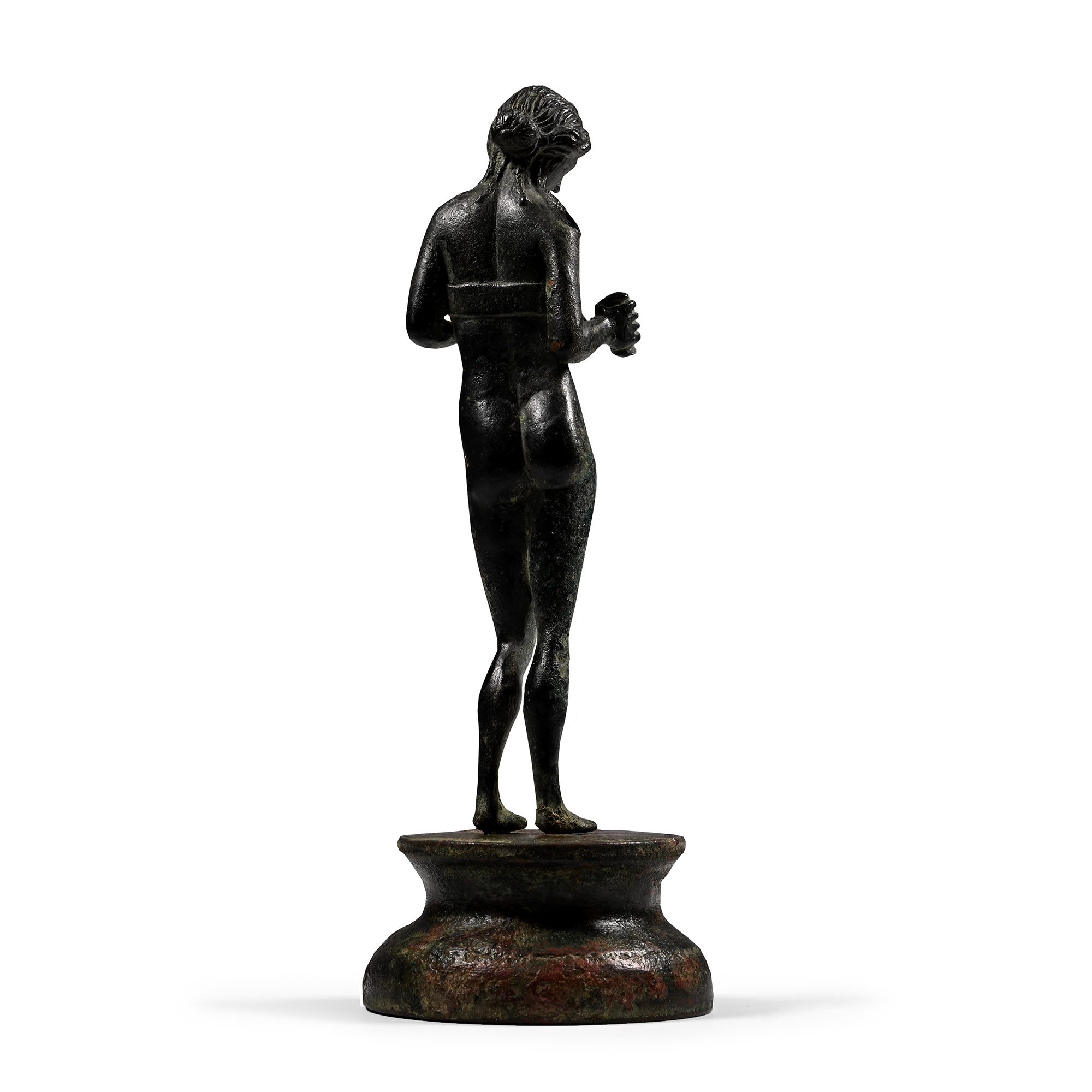
Roman Bronze Statuette of Venus
1ST-2ND CENTURY A.D.
6 1/2 in. (281 grams total, 16.5 cm high including stand).
The goddess of love rising from the sea, standing nude and bearing the weight on her right leg; her head turned to the right and looking down, finely worked facial detailing with marked eyelids and shallow pupils; the bountiful hair tied back in a low chignon with six long ringlets falling on her shoulders, wearing a diadem; a narrow sash wrapped around her back, holding one end pressed against her left breast and the coiled end held in her right hand; standing on a pedestal base.
ProvenanceEx German art market, 2000s.
Acquired from an EU collector living in London.
From the collection of a Surrey, UK, gentleman.
This lot has been checked against the Interpol Database of stolen works of art and is accompanied by a search certificate number no.12747-236332.
This lot has been cleared against the Art Loss Register database, and is accompanied by an illustrated lot declaration signed by the Head of the Antiquities Department, Dr Raffaele D'Amato.
See Boucher, S. & Tassinari, S., Musée de la Civilisation Gallo-Romaine a Lyon: Bronzes Antiques I. Inscriptions, Statuaire, Vaisselle, Lyon, 1976, item 65, for type; see also Reinach, S., Répertoire de la statuaire grecque et romaine, Paris, 1897, p.359, no.2; see also for the costume of the goddess Catullo, L., L'Antica Villa Romana del Casale di Piazza Armerina nel Passato e nel Presente, Messina, 2000, pp.60-63.
FootnotesThe goddess is depicted in the act of girding her chest with a fascia, similar to the one illustrated in the famous mosaics of Piazza Armerina, where the band is worn together with a subligaculum that covers her lower parts. It is modelled after a real two-piece bath costume of the ancient Romans.
CONDITIONTimeLine Auctions follows a vetting process to ensure the authenticity and legality of all items, reinforcing our commitment to integrity and responsible trading. Each antiquity, antique, and coin lot undergoes thorough examination by a vetting committee of at least ten external specialists, professional trade association members, scientists, and archaeologists: Our Vetting Process
AUCTIONS:
TimeLine is a leading auction house specialising in antiquities, ancient art, collectables, natural history, coins, medals, and books. Our auctions offer museums, collectors, historians, and enthusiasts the opportunity to acquire unique and historically significant pieces.
-
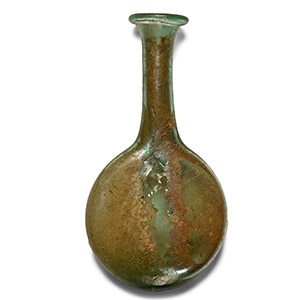
Roman Glass Vessel
1st-2nd century A.D.Estimate: £100 - 140 (+bp*)
Opening Bid: £50
With flattened discoid body and tall neck with flared mouth, applied rim. 20.5 grams, 10.6 cm
From a London, UK, collection, 1990s. This lot is accompanied by an illustrated lot declaration signed by the Head of the Antiquities Department, Dr Raffaele D’Amato. This lot is accompanied by an illustrated lot declaration signed by the Head of the Antiquities Department, Dr Raffaele D'Amato. -
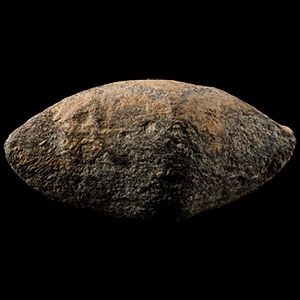
Roman Julius Caesar 'Battle of Munda' Lead Slingshot
45 B.C.Sold for (Inc. bp): £195
A biconical facetted lentoid-section lead sling shot (glans), inscription monogram a combination of letters 'C', 'A' and 'E', for 'C A E S' referring to Julius Caesar. 31.9 grams, 34 mm
Acquired on the UK art market. Property of a gentleman collector. Accompanied by an academic paper by military specialist Dr Raffaele D'Amato, dated 4th May 2022 and titled 'Roman Res Publica - Lead Slingshots (glandes) of Caesarian Age - 45 B.C circa'. This lot is accompanied by an illustrated lot declaration signed by the Head of the Antiquities Department, Dr Raffaele D'Amato.
The shot (type IIb of the Völling classification) is marked with the abbreviated name of Julius Caesar; it was used in quantity at the Battle of Munda (or Monda) against the last fellows of Pompey, the leaders of the Optimates, on the 17th March 45 BC. Similar shots were used by the Caesar's army. The slingers of Caesar's age were part of the light infantry. Caesar speaks of his Balearic slingers during the conquest of Gaul. They wore a short tunic, with leather or rope sandals to the feet, and a warm overcoat which could also have been used to store projectiles. They also used a satchel to carry very deadly lead-like stones or bullets. -
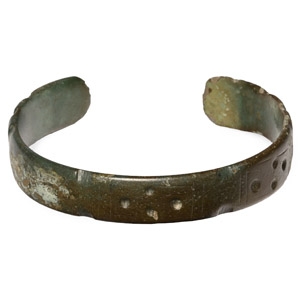
Late Roman Bronze Bracelet
4th-5th century A.D.Sold for (Inc. bp): £91
Flat-section penannular body with rounded terminals, the upper body divided into segments with vertical lines and each segment with four punched pellets, single punched pellet to each terminal. 30.6 grams, 61 mm
Ex German art market, 2000s. Acquired from an EU collector living in London. From the collection of a Surrey, UK, gentleman. This lot is accompanied by an illustrated lot declaration signed by the Head of the Antiquities Department, Dr Raffaele D'Amato.
