
Loading, please wait...



LOT 0123
Roman Bronze Statuette of Mercury
2ND-3RD CENTURY A.D.
3 7/8 in. (69 grams total, 98 mm including stand).
Shown standing nude with caduceus resting against the left forearm, a patera in the right hand, bunched lobes and centre-parted hairstyle; mounted on a custom-made display stand. [No Reserve]
ProvenanceFrom a collection acquired on the UK art market from various auction houses and collections mostly before 2000.
From an important Cambridgeshire estate; thence by descent.
Cf. Rolland, H., Bronzes Antiques de Haute Provence, Paris, 1965, items 27ff., for type.
FootnotesMercury is one of the most widespread divinities among the votive statuettes of Roman Age. The god of the Roman pantheon was similar to the Greek Hermes and the Etruscan Turms.
CONDITIONTimeLine Auctions follows a vetting process to ensure the authenticity and legality of all items, reinforcing our commitment to integrity and responsible trading. Each antiquity, antique, and coin lot undergoes thorough examination by a vetting committee of at least ten external specialists, professional trade association members, scientists, and archaeologists: Our Vetting Process
AUCTIONS:
TimeLine is a leading auction house specialising in antiquities, ancient art, collectables, natural history, coins, medals, and books. Our auctions offer museums, collectors, historians, and enthusiasts the opportunity to acquire unique and historically significant pieces.
-
.jpg)
Roman Yellow Glass Flask
Circa 1st-2nd century A.D.Estimate: £1,800 - 2,400 (+bp*)
Opening Bid: £1,000
Mould-blown from translucent glass, the globular body on a circular flat base tapering at the shoulders to a cylindrical neck with an everted rim; a single applied handle; the body decorated with a horizontal band of a continuous Vitruvian wave framed by a double circumferential line, decorative ridges above and below; accompanied by a custom-made display stand. 16.7 grams, 66 mm (33.9 grams total, 79.4 mm high including stand)
From the property of the late Mr SM, London, UK, 1948-2000. Ex J.L. collection Surrey, UK. -
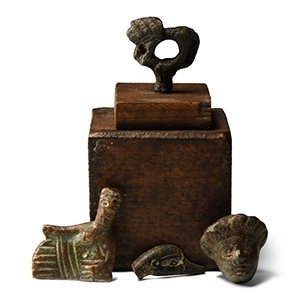
Roman Bronze Artefact Collection
1st-4th century A.D.Sold for (Inc. bp): £65
Including a recumbent figure with pleated clothing, a female head mount and other items. 89 grams total, 21-77 mm
From a collection acquired on the UK art market from various auction houses and collections mostly before 2000. From an important Cambridgeshire estate; thence by descent. -
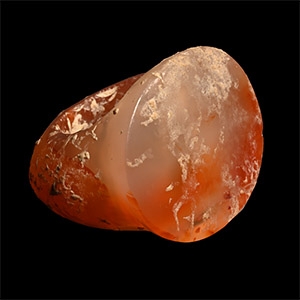
Roman Carnelian Ring
2nd-3rd century A.D.Sold for (Inc. bp): £572
With thick D-section hoop and stud to the underside, flared sides to the slightly domed plaque. 9.53 grams, 26.44 mm overall, 15.01 mm internal diameter (approximate size British I, USA 4 1/4, Europe 7.44, Japan 7)
Acquired in the mid 1980s-1990s. From the family collection of Mr S.A., Switzerland, thence by descent. Private collection since the late 1990s.
