
Loading, please wait...
LOT 0166
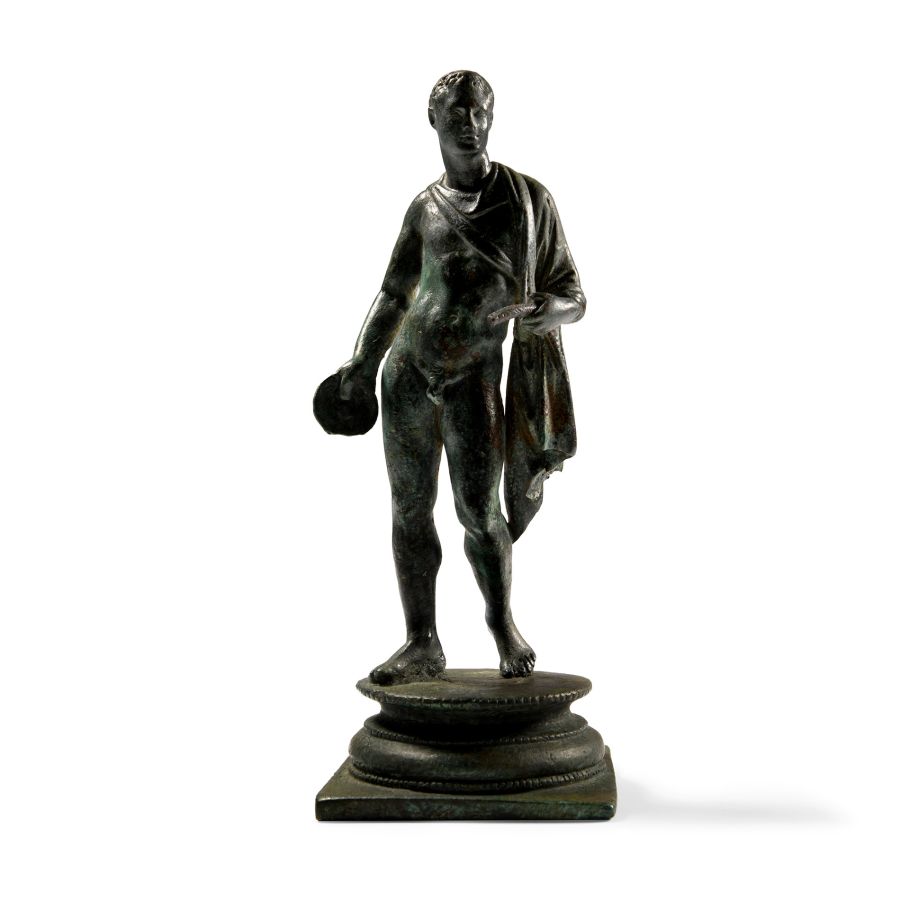
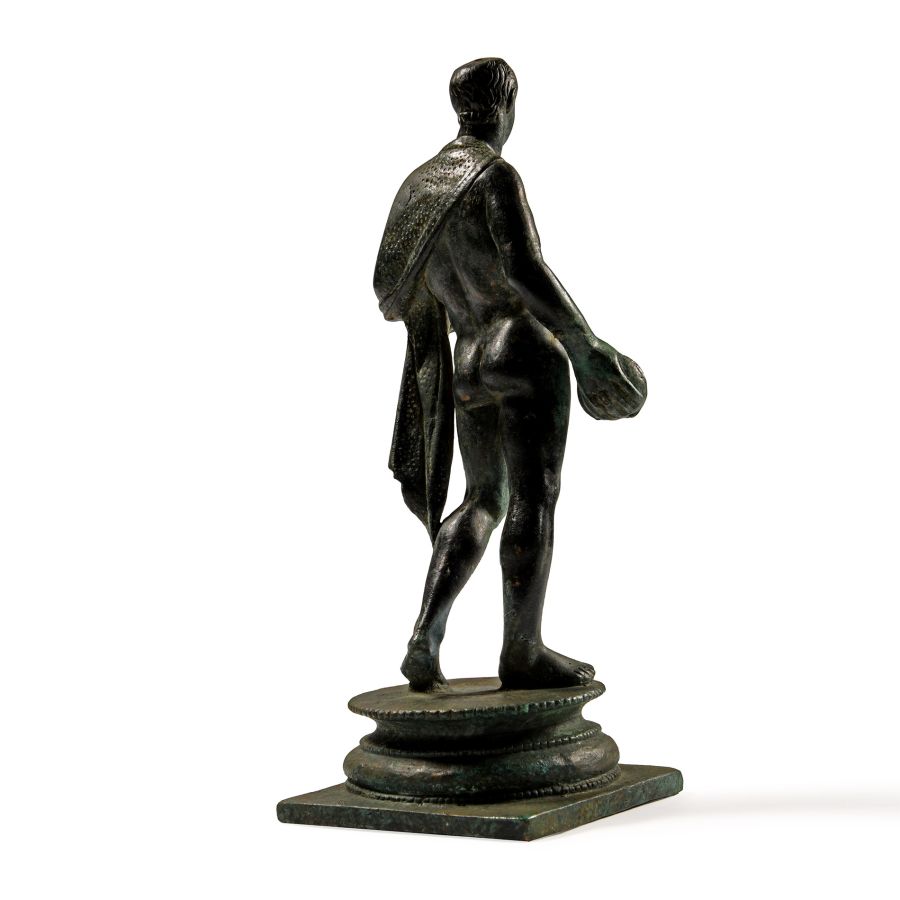
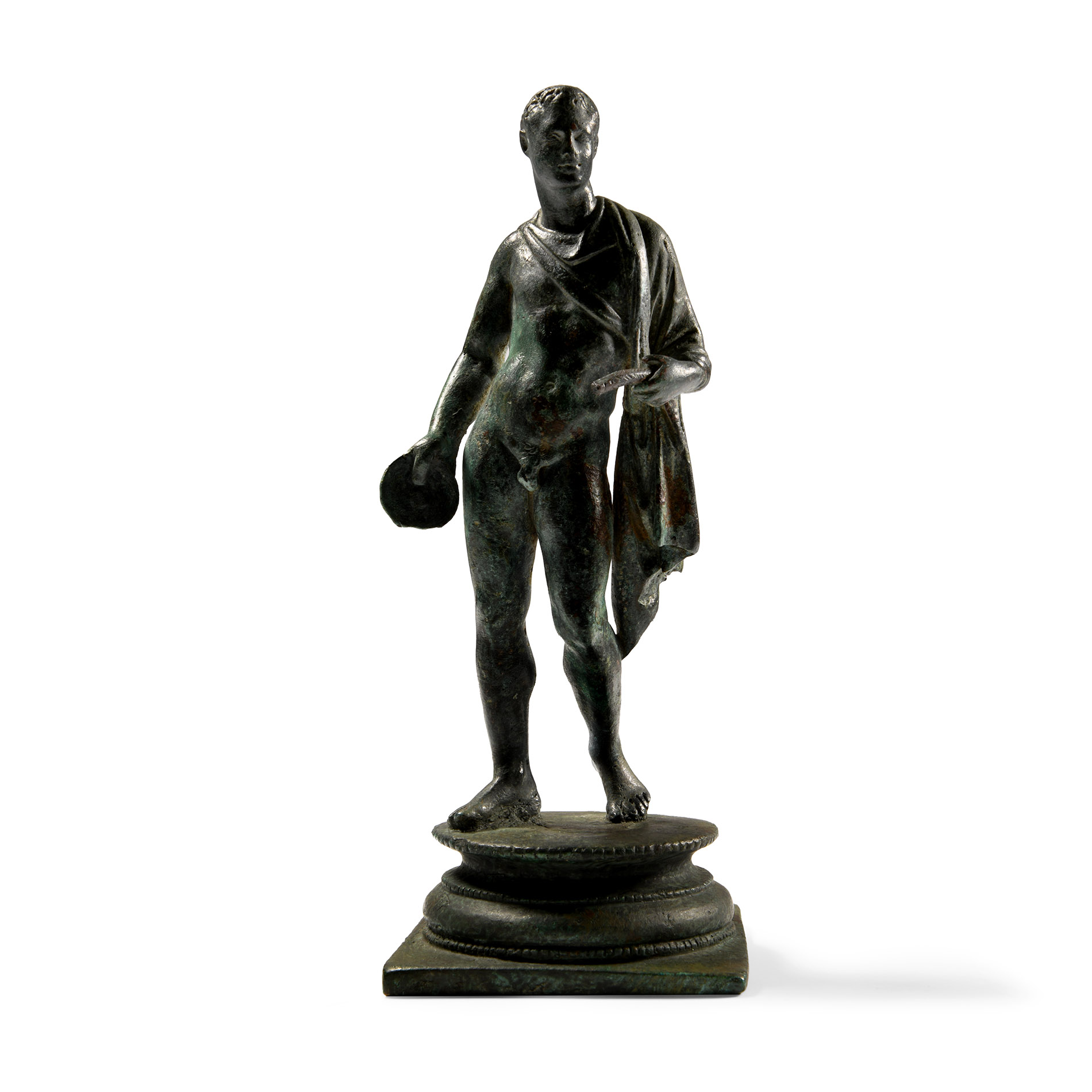
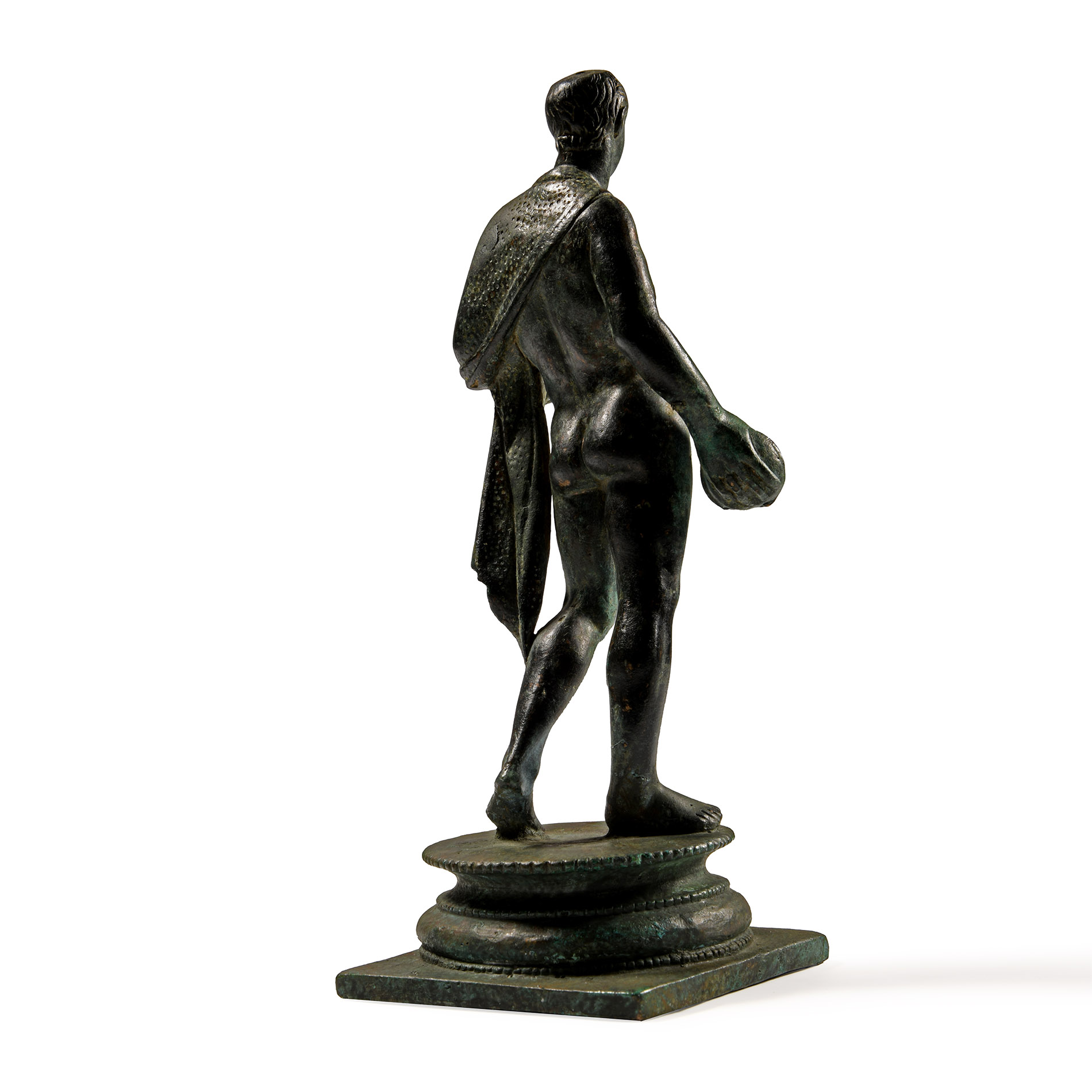
Roman Bronze Statuette of Mercury
1ST-2ND CENTURY A.D.
6 1/4 in. (957 grams, 16 cm high).
Standing erect on a tiered socle base in contrapposto pose; pointillé-textured mantle draped to the left shoulder, left arm bent, hand holding a wand; right arm loose at the side, hand holding a patera; finely modelled face with short wavy hair; shallow dimple or socket to the crown; standing on a possibly later tiered disc base with square foot.
ProvenanceAcquired on the German art market, 1990s.
Ex Cambridgeshire collection, UK.
Accompanied by an academic report by Dr Raffaele D’Amato.
This lot has been checked against the Interpol Database of stolen works of art and is accompanied by search certificate number no.12013-213587.
Exhibited at Harwich Museum, Harwich, Essex, UK, 3rd February-9th March 2024; accompanied by a copy of a photograph of the artefact on display.
LiteratureCf. Reinach, S., Repertoire de la statuarie Grecque et Romaine, Paris, 1930, p.149, no.8, for the type; Rolland, H., Bronzes Antiques de Haute Provence, Paris, 1965, items 27ff., for comparable examples; Boucher, S., Recherches sur les Bronzes Figurés de Gaule Pré-Romaine et Romaine, Rome, 1976, fig.192.
FootnotesMercury was the god of trade and industry, whose principle shrine in the city of Rome was at the Circus Maximus. The draped mantle is typical of statuary of Mercury from the 1st-2nd century A.D. (Boucher, pl.40, 43) and the 'baton' may in fact be the stem of a caduceus (Boucher, pl.46 (211)).
CONDITIONTimeLine Auctions follows a vetting process to ensure the authenticity and legality of all items, reinforcing our commitment to integrity and responsible trading. Each antiquity, antique, and coin lot undergoes thorough examination by a vetting committee of at least ten external specialists, professional trade association members, scientists, and archaeologists: Our Vetting Process
AUCTIONS:
TimeLine is a leading auction house specialising in antiquities, ancient art, collectables, natural history, coins, medals, and books. Our auctions offer museums, collectors, historians, and enthusiasts the opportunity to acquire unique and historically significant pieces.
LOT 0166
Roman Bronze Statuette of Mercury
Estimate £5,000 - 7,000€5,800 - 8,120 (for guidance only)$6,750 - 9,450 (for guidance only)
-
Late Roman Solid Gold Ring with Bird and Flower Gem
Circa 3rd-4th century A.D.Sold for (Inc. bp): £650
With tapering shoulders, cup bezel, inset green glass cabochon with intaglio bird and flower motif. 7.53 grams, 24.95 mm overall, 17.50 mm internal diameter (approximate size British J, USA 4 3/4, Europe 8.69, Japan 8)
From a late Japanese specialist collector, 1970-2000s. -
Roman Buffware Oil Lamp with Horse and Rider
Circa 2nd century A.D.Sold for (Inc. bp): £130
Comprising a ring handle, filling-hole and air hole in lower discus; the discus with a horse advancing left mounted by a cavalryman with a flying cloak. 44 grams, 73 mm
From a collection acquired on the UK art market from various auction houses and collections mostly before 2000. From an important Cambridgeshire estate; thence by descent.
The main charateristic of the type (Bussiere form D I 3) is the form of the nozzle, which is tangent to the lamp rim (nozzle form Bussiere 3). -
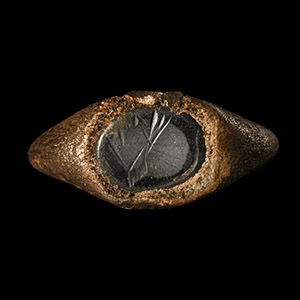
Roman Silver Ring with Profile Bust Gemstone
Circa 2nd century A.D.Sold for (Inc. bp): £91
With later inset stone intaglio of a profile helmetted bust. 2.95 grams, 21.16 mm overall, 16.87 mm internal diameter (approximate size British H 1/2, USA 4, Europe 6.81, Japan 6)
Acquired between the 1960s-early 1990s. From an old UK private collector from Worthing, West Sussex, UK. Property of K.P., a Cornish lady collector, UK.
