
Loading, please wait...
LOT 0887
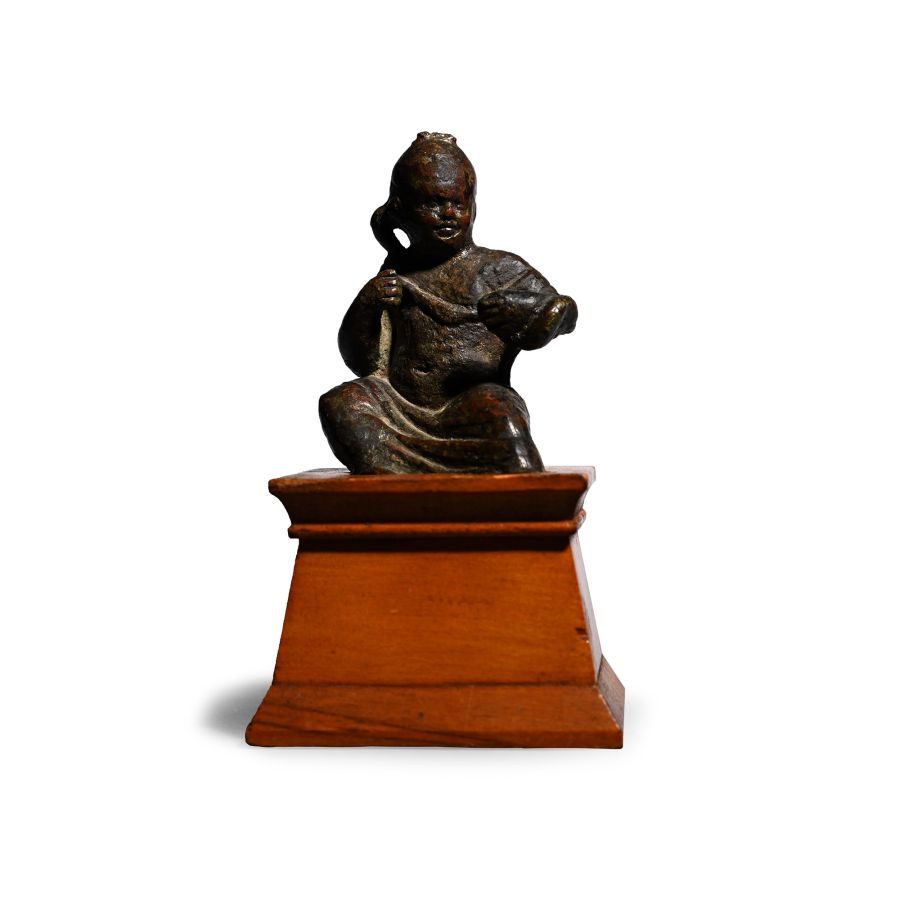
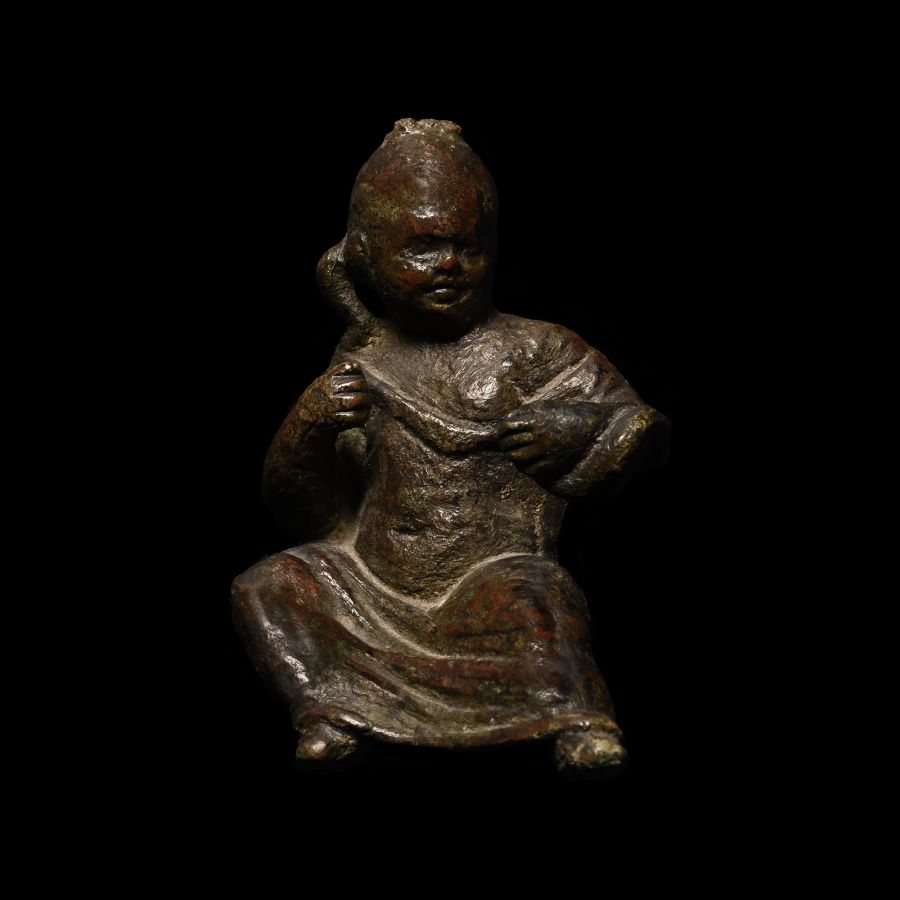
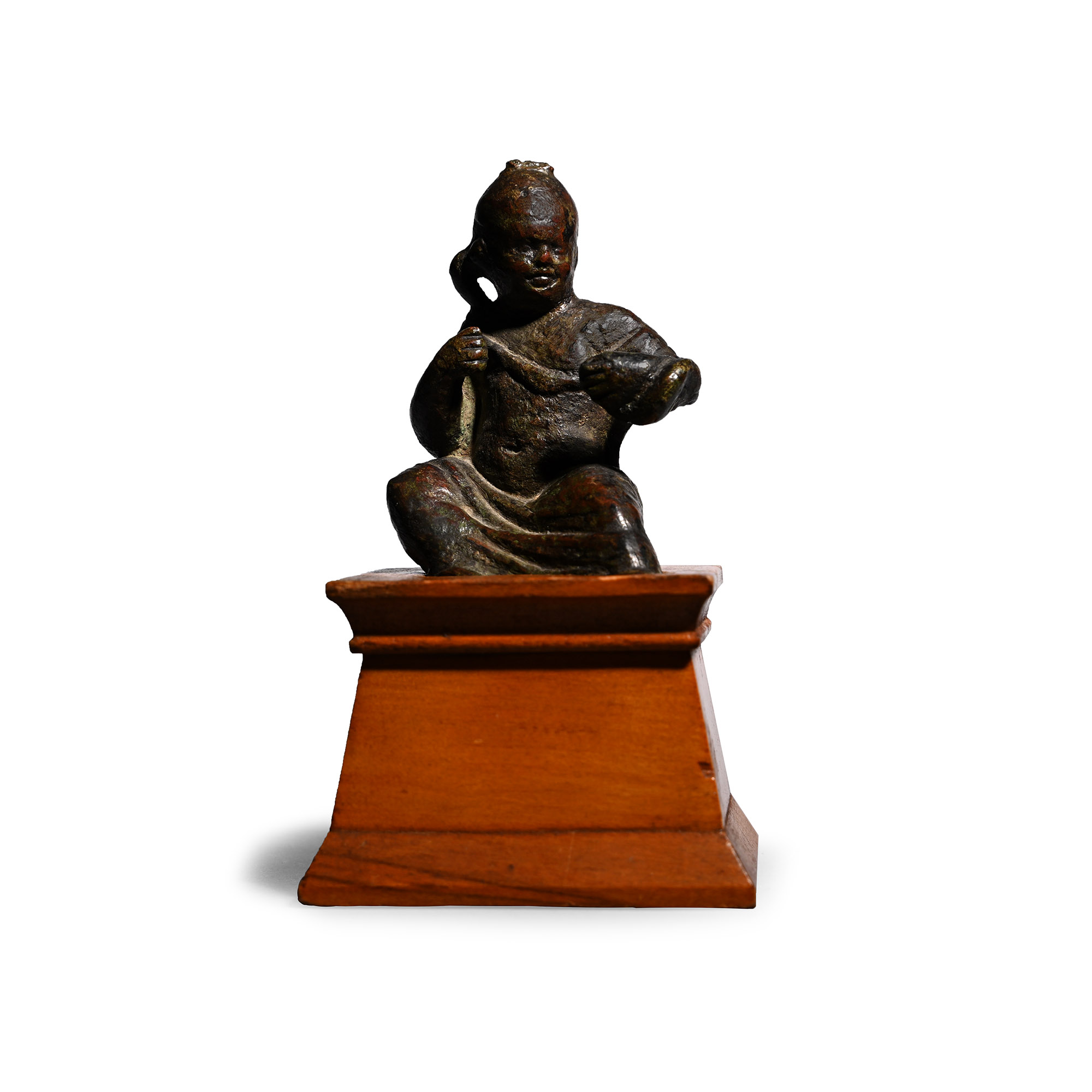
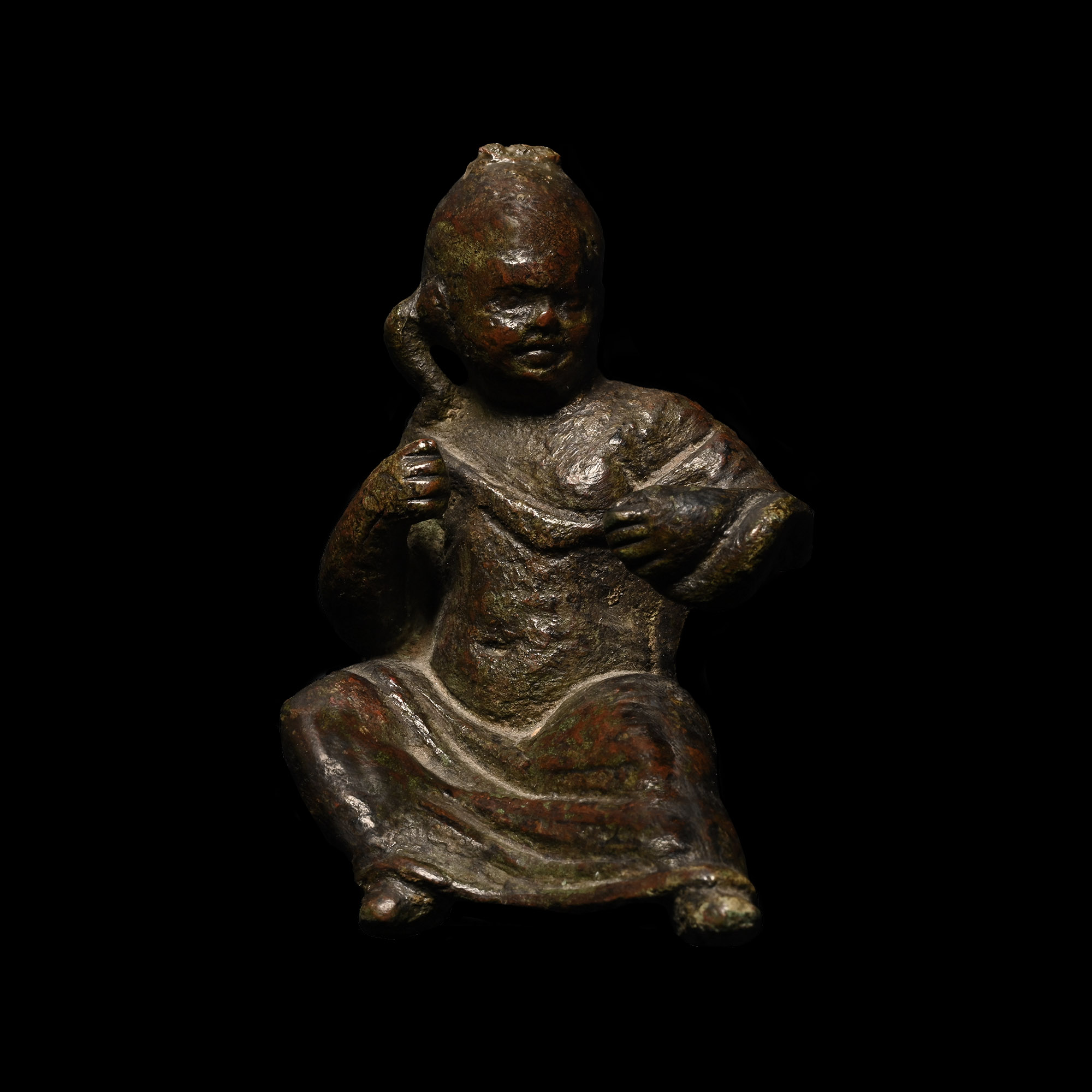
Roman Bronze Statuette of Harpocrates
1ST-3RD CENTURY A.D.
2 7/8 in. (4 in.) (213 grams, 73 mm (276 grams total, 10.2 cm including stand)).
Presented as a very young child sitting on the ground, wearing a long tunic which covers his body and legs down to his feet; right arm bent and hand raised to the shoulder, left hand curved around an object (absent); sporting the conventional sidelock behind the right ear; mounted in a custom-made tiered wooden stand.
ProvenanceEx Hanna Saba collection, Ambassador to Egypt-USA-France (1909-1992).
Private European collection.
This lot has been checked against the Interpol Database of stolen works of art and is accompanied by a search certificate number no.12098-218159.
This lot has been cleared against the Art Loss Register database, and is accompanied by an illustrated lot declaration signed by the Head of the Antiquities Department, Dr Raffaele D'Amato.
Cf. similar item in the British Museum, London, under accession no.1896,0724.1 with the god in standing pose; see Swan Hall, E., 'Harpocrates and Other Child Deities in Ancient Egyptian Sculpture' in Journal of the American Research Center in Egypt, Vol. 14, 1977, pp.55-58, fig.1, pl.XXVII; fig.4, for full discussion.
FootnotesThe god's name was Hellenized in the Ptolemaic era and later adopted by the Romans, but it originated in the figure of 'Horus the child', son of Isis and Osiris, who was worshipped especially in Alexandria.
CONDITIONTimeLine Auctions follows a vetting process to ensure the authenticity and legality of all items, reinforcing our commitment to integrity and responsible trading. Each antiquity, antique, and coin lot undergoes thorough examination by a vetting committee of at least ten external specialists, professional trade association members, scientists, and archaeologists: Our Vetting Process
AUCTIONS:
TimeLine is a leading auction house specialising in antiquities, ancient art, collectables, natural history, coins, medals, and books. Our auctions offer museums, collectors, historians, and enthusiasts the opportunity to acquire unique and historically significant pieces.
LOT 0887
Roman Bronze Statuette of Harpocrates
Estimate £2,000 - 3,000€2,320 - 3,480 (for guidance only)$2,700 - 4,050 (for guidance only)
-
Roman Aquamarine Gemstone with Portrait of Emperor Septimius Severus in Silver and Gold Ring
2nd-3rd century A.D.Sold for (Inc. bp): £9,100
With the bust of the emperor facing left, laurel wreath in his curly hair with ribbons falling behind his head, beard with characteristic forked tip, mounted in a large broad silver hoop widening to an oval bezel inset with a gold border. 18.89 grams, 28.88 mm overall, 21.34 mm internal diameter (approximate size British X 1/2, USA 11 3/4, Europe 26.92, Japan 25)
English private collection, 1980s-1990s. with Christie's, London, 7 October 2010, no.204. European private collection, acquired in 2010. Accompanied by copies of the relevant Christie's catalogue pages. Accompanied by an academic report by Dr Raffaele D’Amato. This lot has been checked against the Interpol Database of stolen works of art and is accompanied by a search certificate number no.12609-234621. This lot has been cleared against the Art Loss Register database, and is accompanied by an illustrated lot declaration signed by the Head of the Antiquities Department, Dr Raffaele D'Amato.
Comparison with contemporary coinage confirms that this bust with its prominent nose, chin, curly hair and forked tip beard, represents Septimius Severus (193-211 A.D.), and the image certainly conveys the strong character of the commander who led the Roman army to victory, not only in Europe but also in the Middle East. A similar portrait can be seen on the cameo in the Museum of Fine Arts, Boston (accession no.99.368). In the Boston cameo the emperor is likewise seen in profile, facing right, and his beard, with the forked tip, is identical. Another good comparison is with the cameo of the Imperial family preserved at the Cabinet des Medailles, Paris (Petruccioli, 2011, fig.230). Cameos and rings of this typology were often gifted and gifted to members of the Imperial entourage, and were a great instrument of Imperial propaganda. -
Roman Silver Ribbed Military Ring
1st-2nd century A.D.Sold for (Inc. bp): £182
Featuring a wide band with vertical ribbing to the outer face. 3.84 grams, 23.58 mm overall, 21.06 mm internal diameter (approximate size British V 1/2, USA 10 3/4, Europe 24.4, Japan 23)
Property of a Cambridgeshire, UK, collector. From his private collection since the 1970s; thence by descent circa 2000. Ex private collection of a Bedfordshire gentleman. This lot is accompanied by an illustrated lot declaration signed by the Head of the Antiquities Department, Dr Raffaele D'Amato. -
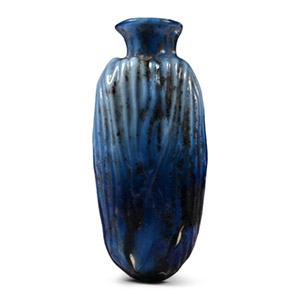
Roman Deep Blue Glass Date Flask
1st century A.D.Estimate: £3,000 - 4,000 (‡+bp*)
Opening Bid: £1,667
Mould-blown with elliptical body, short neck and thick everted rim, with modelled wrinkles imitating the texture of a dried date. 41.7 grams, 80 mm
Dr Gonik & Me Wirth, Geneva, 1970s. Private collection, Europe. Accompanied by an academic report by Dr Raffaele D'Amato. This lot has been checked against the Interpol Database of stolen works of art and is accompanied by a search certificate number no.12394-226935. This lot has been cleared against the Art Loss Register database, and is accompanied by an illustrated lot declaration signed by the Head of the Antiquities Department, Dr Raffaele D'Amato.
Dates were not only a staple of the Mediterranean diet, used to sweeten food and wine, but also a symbol for the New Year and a fruit often given as a gift on the occasion.
