
Loading, please wait...

LOT 0131
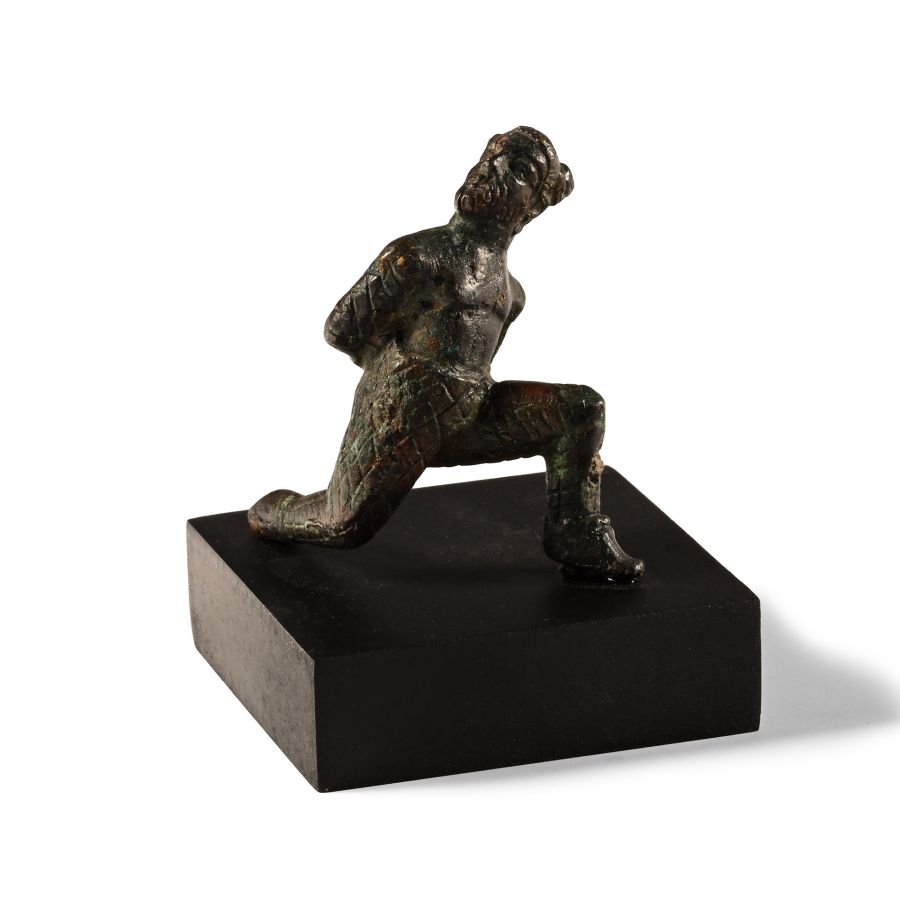
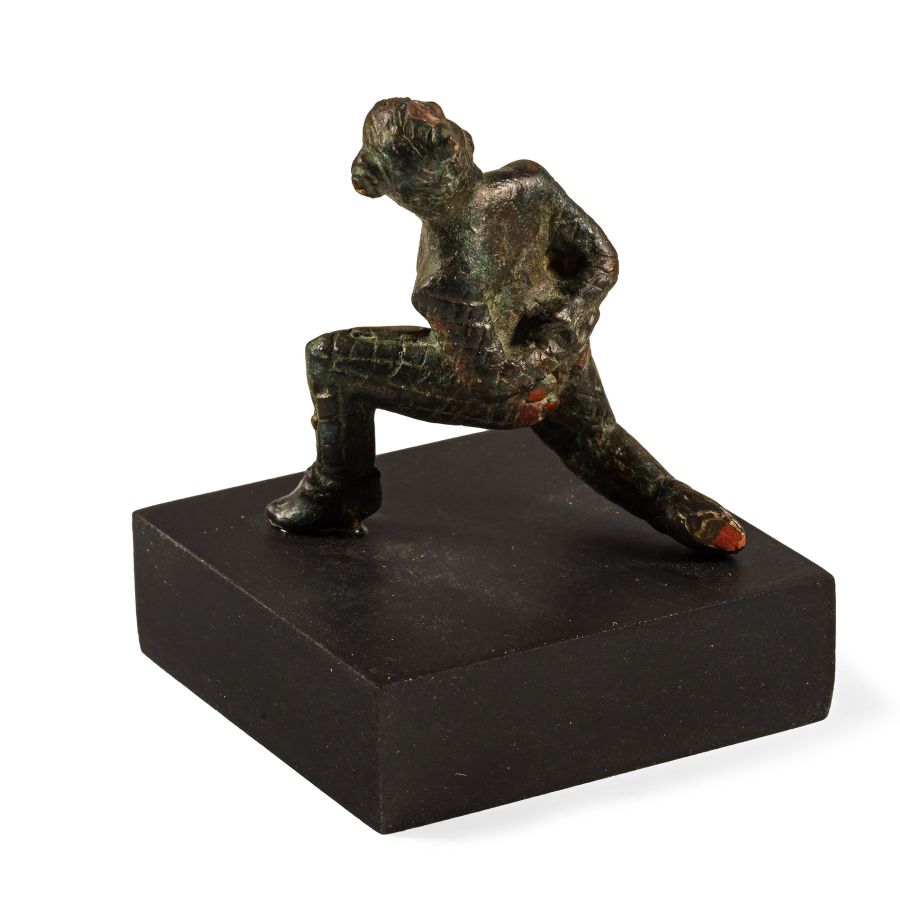
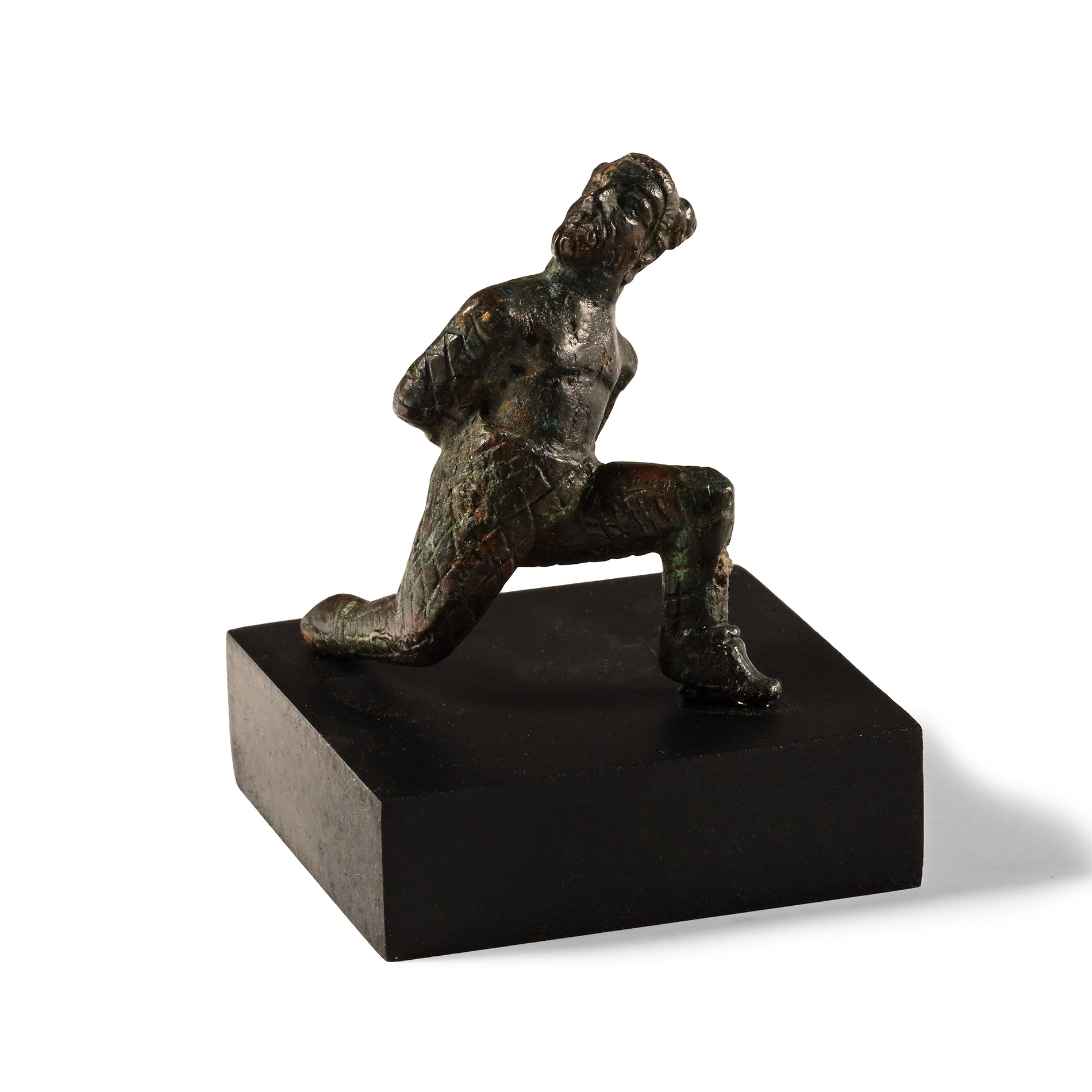
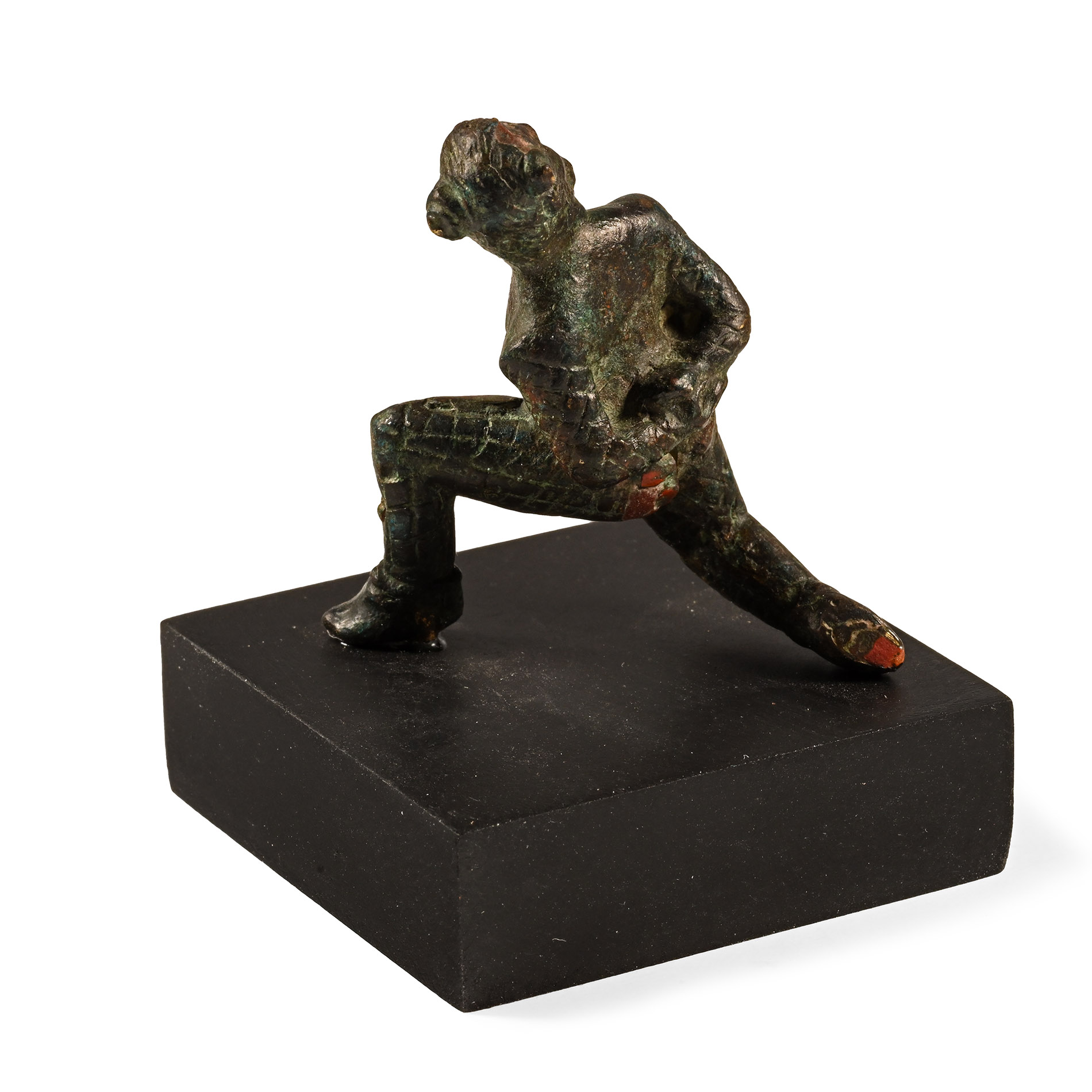
Roman Bronze Statuette of a Germanic Captive
LATE 2ND CENTURY A.D.
2 1/2 in. (93 grams total, 62 mm including stand).
Modelled with arms held behind the back, legs astride and left knee bent, head angled upwards over the right shoulder; the trousers and sleeves with incised crosshatched pattern, plain shoes; the hair drawn up in the 'Swabian knot' style above the right ear; mounted on a custom-made display stand. [No Reserve]
ProvenanceFrom a collection acquired on the UK art market from various auction houses and collections mostly before 2000.
From an important Cambridgeshire estate; thence by descent.
Cf. Rolland, H., Bronzes Antiques de Haute Provence, Paris, 1965, item 321; Beutler, F. et al., Der Adler Roms. Carnuntum und der Armee der Cäsaren, Bad-Deutsch Altenberg, 2017, item 1005, for similar.
FootnotesStatuettes of foreign ‘barbarian’ prisoners of this type have been found along the Danube. Their spread coincides with the Marcomannic wars of the Emperor Marcus Aurelius. The Swabian knot in this warrior’s hair has parallels with the warrior depicted on the contemporary Sarcophagus of Portonaccio, which represents a battle between Romans and Germanic Gauls.
CONDITIONTimeLine Auctions follows a vetting process to ensure the authenticity and legality of all items, reinforcing our commitment to integrity and responsible trading. Each antiquity, antique, and coin lot undergoes thorough examination by a vetting committee of at least ten external specialists, professional trade association members, scientists, and archaeologists: Our Vetting Process
AUCTIONS:
TimeLine is a leading auction house specialising in antiquities, ancient art, collectables, natural history, coins, medals, and books. Our auctions offer museums, collectors, historians, and enthusiasts the opportunity to acquire unique and historically significant pieces.
-
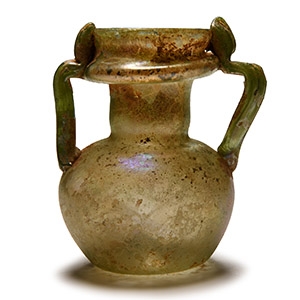
Roman Double-Handled Flask
1st-3rd century A.D.Sold for (Inc. bp): £845
Aqua glass jar with bulbous body, broad neck, double-folded flange rim, two lateral strap handles extending from the mouth to the shoulder. 49 grams, 10 cm high
Acquired on the German art market, 1989-1995. with The Museum Gallery, 19 Bury Place, London, WC, UK, 1998-2003. Property of a London based academic, 2003-present. -
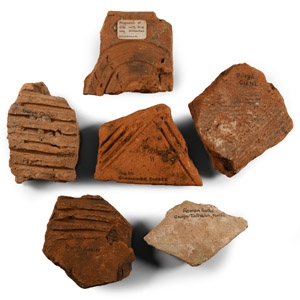
Romano-British and Other Decorated Floor Tile Fragment Group
1st-4th century A.D.Sold for (Inc. bp): £20
Including fragments of terracotta and other tegula with impressed geometric detailing; one with inked inscription: 'Roman Baths / Ghajn Tuffieha, Malta' and 'Floor tile / Sinscombe, Surrey / B1/71', and three pieces with inked inscriptions from: 'Burgh Castle', Norfolk, UK. 725 grams total, 83-88 mm
Found UK. From the collection of a late East Anglian teacher and antiquarian who retired to the Isle of Wight in Hampshire, UK. He amassed a large collection of objects between the 1960s-1980s. -
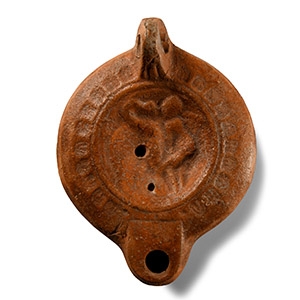
Roman Oil Lamp with Leda and The Swan
2nd century A.D.Estimate: £200 - 300 (+bp*)
Opening Bid: £100
A Roman North African terracotta oil lamp with grooved ring handle; discus decorated with the mythological scene depicting Leda and the swan embracing. 77 grams, 10.3 cm
Dr Suzanne Gozlan, thence by descent. Suzanne Gozlan (1921-2022), a doctor of History and Archaeology, served as a professor at the Ecole Normale d'Instituteurs de Chartres and lectured at the University of Paris 4 Sorbonne. Property of a Bristol, UK, gentleman.
In Greek mythology, Leda was the wife of King Tyndareus and queen of Sparta. According to the myth, Zeus, the king of the gods, was captivated by Leda's beauty and appeared before her in the form of a swan. He then either raped or seduced her and impregnated her. The same night, Leda slept with her husband who also impregnated her, as a result of these two unions she laid two eggs, each containing one set of twins. According to later Greek mythology Leda bore Helen (of Troy) and Polydeuces, children of Zeus, while at the same time bearing Castor and Clytemnestra, children of her husband.
