
Loading, please wait...
_900x900.jpg "Roman Bronze Statuette Hand Holding Victory Wreath")
_200x200.jpg "Roman Bronze Statuette Hand Holding Victory Wreath")
.jpg "Roman Bronze Statuette Hand Holding Victory Wreath")
LOT 0869
Roman Bronze Statuette Hand Holding Victory Wreath
1ST CENTURY A.D.
1 in. (19.6 grams, 23 mm).
Modelled in the round, right hand clutching a wreath of laurel leaves. [No Reserve]
ProvenanceFrom a collection acquired on the UK art market from various auction houses and collections mostly before 2000.
From an important Cambridgeshire estate; thence by descent.
Cf. Durham, E., Metal Figurines in Roman Britain, vol. 2, Reading, 2010, pl.181, for Flora holding up a wreath.
FootnotesThe hand raising the laurel wreath, symbol of Roman victory, could belong to a statuette representing the winged Victory, Nike. However, an important statuette of Flora, goddess of flowering and cereals, found in Witcombe Villa, represents her with raised hand holding a similar wreath, which does not necessarily correspond to a laurel wreath, but to an intertwined wreath of flowers , symbol of prosperity and spring.
CONDITIONTimeLine Auctions follows a vetting process to ensure the authenticity and legality of all items, reinforcing our commitment to integrity and responsible trading. Each antiquity, antique, and coin lot undergoes thorough examination by a vetting committee of at least ten external specialists, professional trade association members, scientists, and archaeologists: Our Vetting Process
AUCTIONS:
TimeLine is a leading auction house specialising in antiquities, ancient art, collectables, natural history, coins, medals, and books. Our auctions offer museums, collectors, historians, and enthusiasts the opportunity to acquire unique and historically significant pieces.
-
.jpg)
Roman Glass Pendant Pair
1st-4th century A.D.Sold for (Inc. bp): £52
A pair of bullae with integral loops, both showing iridescence. 1.29 grams total, 15-16 mm
Collected from 1970-1999. From the collection of the late Mr S.M., London, UK.
Freeborn Roman boys wore bullae until they reached adulthood, being given them eight days after their birth, on the same day that they were named. This important marked boys acceptance into the family. Bullae made of gold would only have been affordable to the members of the elite, whilst the lower classes wore pendants made of less expensive materials. The feminine equivalent was a lunar (crescentic) pendant. -
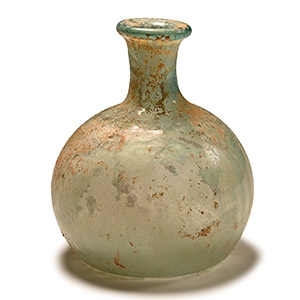
Roman Glass Toilet Bottle
1st century A.D.Sold for (Inc. bp): £195
With globular body, short everted rim and cylindrical neck, concave base. 73 grams, 10 cm
Ex London, UK, collection, 1980-1990s.
The bottle should be associated with Isings form 6 or Tommaso type 7. Small bottles of this typology are among the earliest known blown glass. The everted rim seems to distinguish examples made in Italy and the western Mediterranean provinces from those of the Eastern Mediterranean, on which the rim is usually folded in the form of a flange. -
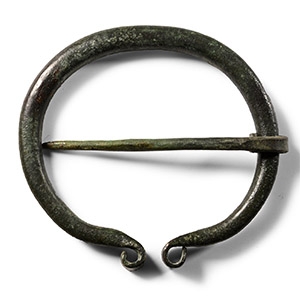
Roman Bronze Penannular Brooch
2nd-4th century A.D.Sold for (Inc. bp): £416
With round-section body and curved terminals, free-running pin. 29.8 grams, 57 mm
Ex German art market, 2000s. Acquired from an EU collector living in London. From the collection of Surrey, UK, gentleman.
