
Loading, please wait...
_900x900.jpg "Roman Bronze Statue of Venus Anadyomene")
_200x200.jpg "Roman Bronze Statue of Venus Anadyomene")
_900x900.jpg "Roman Bronze Statue of Venus Anadyomene")
_200x200.jpg "Roman Bronze Statue of Venus Anadyomene")
.jpg "Roman Bronze Statue of Venus Anadyomene")
.jpg "Roman Bronze Statue of Venus Anadyomene")
LOT 0187
Roman Bronze Statue of Venus Anadyomene
1ST-2ND CENTURY A.D.
5 1/2 in. (311 grams total, 14 cm including stand).
Venus (Greek Aphrodite), the goddess of love, rising from the sea, standing nude and bearing the weight on her left leg; her head turned to the right with slightly downcast eyes and finely worked facial detailing; the bountiful hair arranged on top of her head with two long ringlets falling on her shoulders and her left hand holding the end of one ringlet; mounted on a custom-made display stand.
ProvenanceSwiss private collection, 1970.
Private collection, Zurich, Switzerland.
This lot has been checked against the Interpol Database of stolen works of art and is accompanied by a search certificate number no.12684-236369.
This lot has been cleared against the Art Loss Register database, and is accompanied by an illustrated lot declaration signed by the Head of the Antiquities Department, Dr Raffaele D'Amato.
See Reinach, S., Repertoire de la statuarie grecque et romaine, Paris, 1930, p.342, no.9; see also Myres, J.L., ‘Aphrodite Anadyomene’ in The Annual of the British School at Athens, vol.41, Athens; Newberry, J.M., Venus Anadyomene: the Mythological Symbolism from Antiquity to 19th century, Wisconsin, 2011; Wardle, M.E., Naked and unashamed: a study of the Aphrodite Anadyomene in the Greco-Roman World, Duke, 2010.
FootnotesLike many other nude Venus types, the Anadyomene type was not supposed to conceal the body, but to show her naked and unashamed, arms raised, touching her tresses and exposing the goddess to the viewer. The image of a nude female emerging from the sea with wet tresses was inspired by the stories of the ancient Greek courtesan Phryne swimming nude in the sea during festivals.
CONDITIONTimeLine Auctions follows a vetting process to ensure the authenticity and legality of all items, reinforcing our commitment to integrity and responsible trading. Each antiquity, antique, and coin lot undergoes thorough examination by a vetting committee of at least ten external specialists, professional trade association members, scientists, and archaeologists: Our Vetting Process
AUCTIONS:
TimeLine is a leading auction house specialising in antiquities, ancient art, collectables, natural history, coins, medals, and books. Our auctions offer museums, collectors, historians, and enthusiasts the opportunity to acquire unique and historically significant pieces.
-
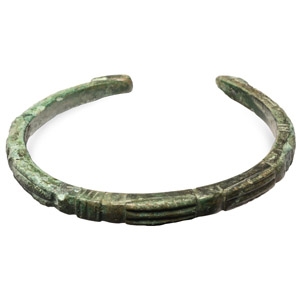
Late Roman Decorated Bronze Military Bracelet
4th-5th century A.D.Sold for (Inc. bp): £124
Thick penannular body with tapering finials, the upper faces divided into decorative panels with linear motifs. 24.1 grams, 65 mm
Ex German art market, 2000s. Acquired from an EU collector living in London. From the collection of a Surrey, UK, gentleman. This lot is accompanied by an illustrated lot declaration signed by the Head of the Antiquities Department, Dr Raffaele D'Amato. -
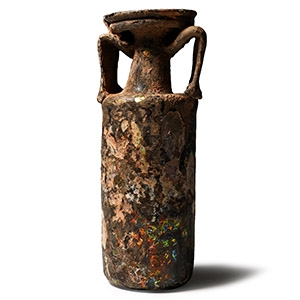
Large Roman Iridescent Glass Vessel
3rd-4th century A.D.Sold for (Inc. bp): £312
With broad shoulder, slender neck, stepped neck and upwards-flaring rim, two applied rectangular handles; iridescent surfaces. 143 grams, 17 cm high
Acquired early 1990s. Ex private American collection; thence by descent. Private collection since 1998. This lot is accompanied by an illustrated lot declaration signed by the Head of the Antiquities Department, Dr Raffaele D'Amato. -
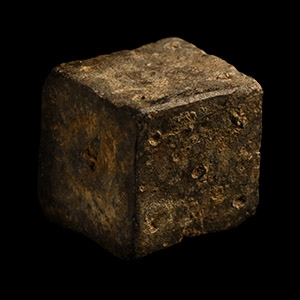
Large Roman Bronze Gaming Dice
1st-4th century A.D.Sold for (Inc. bp): £65
Cuboid with impressed points to each face. 38.8 grams, 18 mm
Property of a Cambridgeshire, UK, collector. From his private collection since the 1970s; thence by descent circa 2000. Ex private collection of a Bedfordshire gentleman. This lot is accompanied by an illustrated lot declaration signed by the Head of the Antiquities Department, Dr Raffaele D'Amato.
