
Loading, please wait...
_900x900.jpg "Roman Bronze Statue of Mercury")
_200x200.jpg "Roman Bronze Statue of Mercury")
_900x900.jpg "Roman Bronze Statue of Mercury")
_200x200.jpg "Roman Bronze Statue of Mercury")
_900x900.jpg "Roman Bronze Statue of Mercury")
_200x200.jpg "Roman Bronze Statue of Mercury")
.jpg "Roman Bronze Statue of Mercury")
.jpg "Roman Bronze Statue of Mercury")
.jpg "Roman Bronze Statue of Mercury")
LOT 0189
Roman Bronze Statue of Mercury
1ST CENTURY A.D.
5 5/8 in. (298 grams total, 14.3 cm including stand).
A youthful and muscular figure of the god Mercury (Greek Hermes) standing nude with his weight resting on his right leg, left leg slightly bent and the heel raised; his hair dressed in short curls, wearing a winged petasos, and a cloak wrapped over his shoulder and left arm, naturalistic anatomical detailing; mounted on a custom-made display base.
ProvenanceSwiss private collection, 1970.
Private collection, Zurich, Switzerland.
This lot has been checked against the Interpol Database of stolen works of art and is accompanied by a search certificate number no.12685-236368.
This lot has been cleared against the Art Loss Register database, and is accompanied by an illustrated lot declaration signed by the Head of the Antiquities Department, Dr Raffaele D'Amato.
Cf. Reinach, S., Repertoire de la statuarie grecque et romaine, Paris, 1930, p.151, no.10, for the type; Rolland, H., Bronzes Antiques de Haute Provence, Paris, 1965, items 27ff., for comparable examples; Menzel, H., Die Römischen Bronzen aus Deutschland I Speyer, Mainz, 1960, no.8; cf. The Metropolitan Museum, accession number 06.1057, for type.
CONDITIONTimeLine Auctions follows a vetting process to ensure the authenticity and legality of all items, reinforcing our commitment to integrity and responsible trading. Each antiquity, antique, and coin lot undergoes thorough examination by a vetting committee of at least ten external specialists, professional trade association members, scientists, and archaeologists: Our Vetting Process
AUCTIONS:
TimeLine is a leading auction house specialising in antiquities, ancient art, collectables, natural history, coins, medals, and books. Our auctions offer museums, collectors, historians, and enthusiasts the opportunity to acquire unique and historically significant pieces.
-
.jpg)
Roman Terracotta 'Favsti' Oil Lamp
1st century B.C.-1st century A.D.Sold for (Inc. bp): £2,340
An impressive oil lamp with rounded body and long nozzle with volute scrolls, deep discus with concentric circles and radiating lines emphasising the depth, loop handle beneath the leaf-shaped reflector; maker's marks 'FAVSTI' on the base. 443 grams, 31.9 cm
From the private collection of Ambassador G.P., no.126, before 1965. with Galerie Rhéa, Zurich, Switzerland. This lot is accompanied by an illustrated lot declaration signed by the Head of the Antiquities Department, Dr Raffaele D'Amato.
Donald Bailey (curator emeritus at the British Museum) believes that the workshop of 'FAVSTI' oil lamps was Italian in origin, later relocating to Petra and Egypt. A large quantity of these oil lamps were also found in Cyprus including those of the Cesnola Collection at the Metropolitan Museum of Art. -
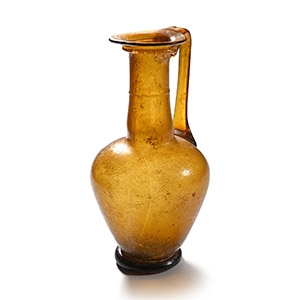
Roman Honey-Coloured Glass Flask
3rd-4th century A.D.Estimate: £1,500 - 2,000 (+bp*)
Opening Bid: £750
Ewer with biconvex body, tapering neck and applied collar beneath the flared rim; applied disc foot, strap handle to rear. 126 grams, 15 cm
From an important London collection of glass, 1990s. This lot has been cleared against the Art Loss Register database, and is accompanied by an illustrated lot declaration signed by the Head of the Antiquities Department, Dr Raffaele D'Amato. -
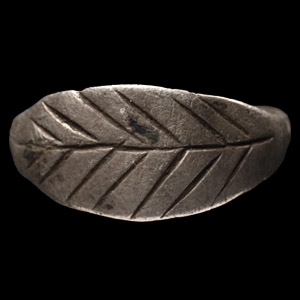
Roman Ring with Palm Branch
3rd-4th century A.D.Sold for (Inc. bp): £104
Rectangular hoop with a lentoid bezel bearing an incised palm branch motif. 2.47 grams, 19.30 mm overall, 16.66 x 14.81 mm internal diameter (approximate size British H 1/2, USA 4, Europe 6.81, Japan 6)
Ex German art market, 2000s. Acquired from an EU collector living in London. From the collection of a Surrey, UK, gentleman. This lot is accompanied by an illustrated lot declaration signed by the Head of the Antiquities Department, Dr Raffaele D'Amato.
