
Loading, please wait...
LOT 0782
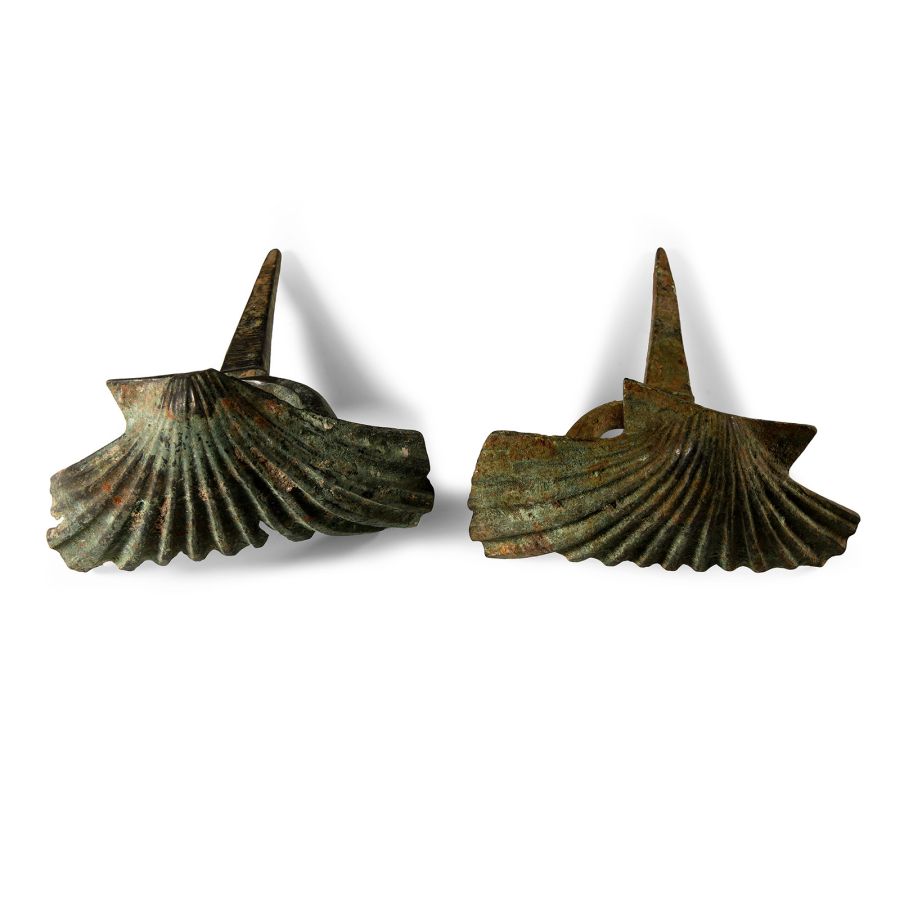
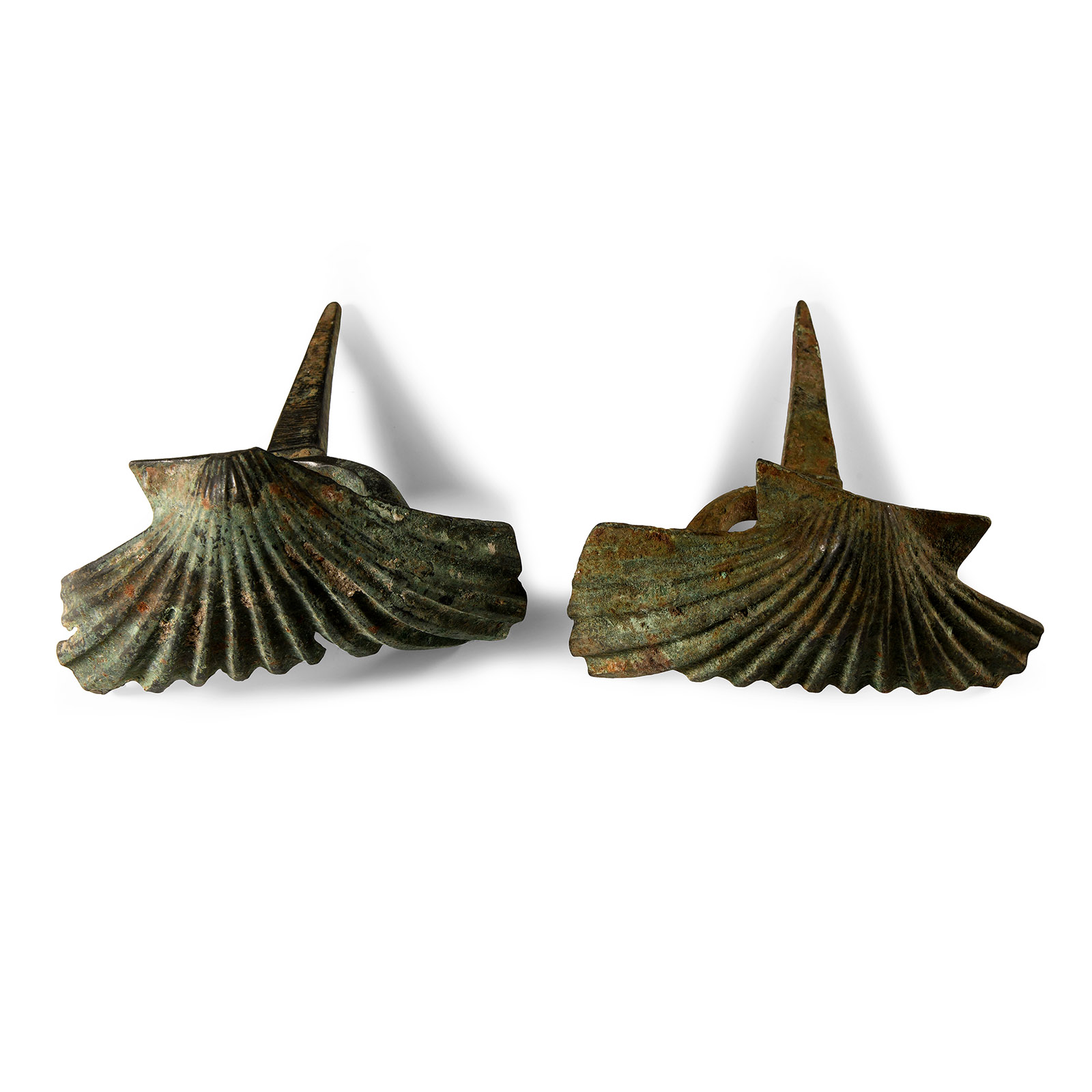
Roman Bronze Scallop Shell Attachment Pair
CIRCA 2ND-3RD CENTURY A.D.
5 in. (343 grams total, 12.5 cm each).
Each composed of shell-shaped body with a D-shaped lug to reverse, the lug with tapering spike to the centre. [2]
ProvenancePrivate collection, Rosenheim, Germany, 1960s.
This lot is accompanied by an illustrated lot declaration signed by the Head of the Antiquities Department, Dr Raffaele D’Amato.
This lot is accompanied by an illustrated lot declaration signed by the Head of the Antiquities Department, Dr Raffaele D'Amato.
Cf. Boucher, S., Inventaire des Collections Publiques Françaises - 17 Vienne: Bronzes Antiques, Paris, 1971, items 658ff., pp.200-201.
FootnotesThis pair could have been used as a double key or door lock, based on comparison with some keys from the territory of Gaul (Boucher, 1971, pp.200-201). They comprised a strong ring with polygonal-section stem and a rectangular point.
CONDITIONTimeLine Auctions follows a vetting process to ensure the authenticity and legality of all items, reinforcing our commitment to integrity and responsible trading. Each antiquity, antique, and coin lot undergoes thorough examination by a vetting committee of at least ten external specialists, professional trade association members, scientists, and archaeologists: Our Vetting Process
AUCTIONS:
TimeLine is a leading auction house specialising in antiquities, ancient art, collectables, natural history, coins, medals, and books. Our auctions offer museums, collectors, historians, and enthusiasts the opportunity to acquire unique and historically significant pieces.
LOT 0782
Roman Bronze Scallop Shell Attachment Pair
Estimate £600 - 800€700 - 930 (for guidance only)$810 - 1,080 (for guidance only)
-
.jpg)
Roman Gold Amulet in the Shape of a Phallus
1st-2nd century A.D. or laterSold for (Inc. bp): £2,340
Amuletic pendant of a phallus with testes, square suspension loop to the rear. 8.35 grams, 23 mm
Acquired in the mid 1980s-1990s. Private collection, Switzerland, thence by descent. Private collection, since the late 1990s. This lot has been checked against the Interpol Database of stolen works of art and is accompanied by a search certificate no.12593-232171. This lot has been cleared against the Art Loss Register database, and is accompanied by an illustrated lot declaration signed by the Head of the Antiquities Department, Dr Raffaele D'Amato.
Phallic amulets, symbols of fertility, prosperity and happiness in the Roman world, are represented by numerous examples in most museums and in many private collections. The typologies are various within the four main series: a) phallus seen from the front; b) phallus seen from the side; c) double phallus and d) triple phallus. -
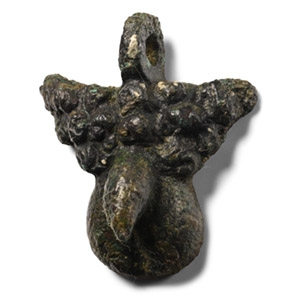
Roman Bronze Phallic Pendant
Circa 1st century A.D.Sold for (Inc. bp): £546
Anatomically depicted with tight curls to the lower abdomen. 27.8 grams, 38 mm
Ex London and Home Counties gentleman, R.W., 1970s. This lot is accompanied by an illustrated lot declaration signed by the Head of the Antiquities Department, Dr Raffaele D'Amato. -
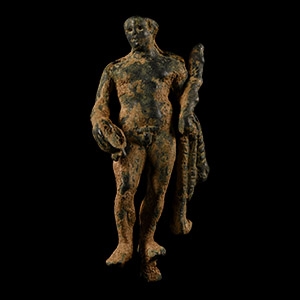
Roman Bronze Figure of Hercules
2nd-3rd century A.D.Estimate: £1,800 - 2,400 (‡+bp*)
Opening Bid: £900
Depicted nude in a contrapposto stance with the weight on his left leg, holding a club on the crook of his left hand with lion skin draped over the arm, and a cup in his right hand. 115 grams, 86 mm
Acquired in the 1980s. Private collection, Switzerland, thence by descent. Private collection, since the late 1990s. This lot has been checked against the Interpol Database of stolen works of art and is accompanied by search certificate number no.12615-234681. This lot has been cleared against the Art Loss Register database, and is accompanied by an illustrated lot declaration signed by the Head of the Antiquities Department, Dr Raffaele D'Amato.
The statuette, perhaps of Gallo-Roman origin, was likely part of a private lararium. It is a provincial work, but is well-proportioned. Unlike other statuettes of this type, Hercules is beardless. The upper part of the head was probably covered by a laurel crown.
