
Loading, please wait...
_900x900.jpg "Roman Bronze Ring with Standing Goddess")
_200x200.jpg "Roman Bronze Ring with Standing Goddess")
.jpg "Roman Bronze Ring with Standing Goddess")
LOT 0828
Roman Bronze Ring with Standing Goddess
2ND-4TH CENTURY A.D.
3/4 in. (3.39 grams, 21.26 mm overall, 18.03 mm internal diameter (approximate size British M 1/2, USA 6 1/4, Europe 13.09, Japan 12)).
Comprising a D-section hoop (split), and an oval bezel with standing goddess, possibly Venus. [No Reserve]
ProvenanceEx German art market, 2000s.
Acquired from an EU collector living in London.
From the collection of a Surrey, UK, gentleman.
TimeLine Auctions follows a vetting process to ensure the authenticity and legality of all items, reinforcing our commitment to integrity and responsible trading. Each antiquity, antique, and coin lot undergoes thorough examination by a vetting committee of at least ten external specialists, professional trade association members, scientists, and archaeologists: Our Vetting Process
AUCTIONS:
TimeLine is a leading auction house specialising in antiquities, ancient art, collectables, natural history, coins, medals, and books. Our auctions offer museums, collectors, historians, and enthusiasts the opportunity to acquire unique and historically significant pieces.
-
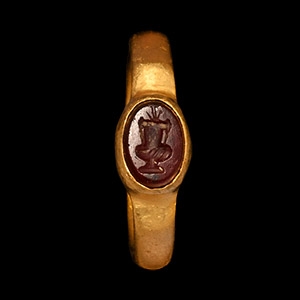
Roman Gold Ring with Vessel Gemstone
Circa 2nd-3rd century A.D.Sold for (Inc. bp): £910
With facetted hoop, ellipsoid cell to the bezel with inset carnelian gemstone, intaglio image of a kantharos; accompanied by a museum-quality impression. 5.88 grams, 24.02 mm overall, 19.60 mm internal diameter (approximate size British S, USA 9, Europe 20, Japan 19)
From the collection of a Surrey gentleman; acquired 1970-1980.
From the middle of the 3rd century AD, gem production in the Roman Empire declined rapidly. At the same time the first Christian motifs began to be visible on the rings. -
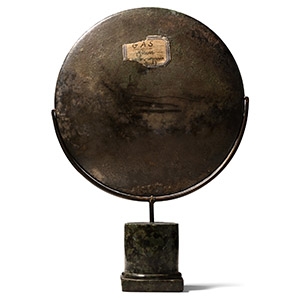
Roman Silver Mirror
1st-3rd century A.D.Sold for (Inc. bp): £1,755
Discoid with raised, rounded rim; a 19th-century collection label bearing a handwritten inscription: ‘GAS, Miroir, Gallo Romain’ indicating the findspot; mounted on a custom-made display stand with serpentine column base. 239 grams, 13.8 cm (426 grams total, 20.1 cm including stand)
19th century collection label inscribed in ink ‘GAS, Miroir, Gallo-Romain’, indicating that the mirror was discovered at Gas, Eure-et-Loir, northern France. Private collection, UK.
The British Museum houses several notable ancient Roman silver hand mirrors, including: 1. Bursa Treasure Mirror – Part of the Bursa Treasure, a 1st-century AD Roman silver hoard discovered near Bursa, Turkey. This collection includes a large silver mirror, reflecting the luxurious personal items used by elite Roman women. 2. Chaourse Treasure Mirror – found in 1883 near Chaourse, France, this 2nd–3rd century AD hoard contains various silver objects, including a silvered bronze mirror, offering insights into the affluent lifestyles of Roman society. These mirrors exemplify the exquisite craftsmanship and refined artistry of Roman silverwork, providing a glimpse into the daily grooming practices and material culture of the Roman elite. -
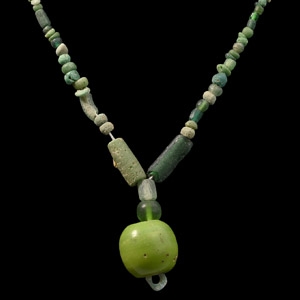
Roman Green Glass Bead Necklace String
1st-4th century A.D. and laterSold for (Inc. bp): £65
Restrung designer necklace string of tubular, oblate and other types with barrel-shaped pendant centrepiece. 31.8 grams, 36 cm
London, UK, collection, 2000s.
