
Loading, please wait...
_900x900.jpg "Roman Bronze Ring with Sol Invictus")
_200x200.jpg "Roman Bronze Ring with Sol Invictus")
.jpg "Roman Bronze Ring with Sol Invictus")
LOT 0738
Roman Bronze Ring with Sol Invictus
CIRCA 2ND-3RD CENTURY A.D.
3/4 in. (3.72 grams, 21.78 mm overall, 18.22 mm internal diameter (approximate size British K, USA 5 1/4, Europe 9.95, Japan 9)).
Composed of a carinated hoop and oval bezel set with a glass intaglio crowned bust facing left.
ProvenanceAcquired 1990s-early 2000s.
East Anglian private collection.
Cf. Humer, F., Kremer, G., Pollhammer, E., Pülz, A., AD 313 Von Carnuntum zum Christentum, Bad Voslau, 2014, nos.40, for similar gemstones representing the Sol Invictus.
FootnotesThe portrait could be interpreted as wearing a radiated crown, thus an image of Sol Invictus, common in gems for rings of the 3rd century A.D., where the young face of the Sun-Helios is often visible in profile, looking to the left, with the radiate crown on his head. The cult of Sol Invictus was favoured by the Illyrian emperors and elevated in Rome by Aurelian to one of the premier divinities of the Empire.
CONDITIONTimeLine Auctions follows a vetting process to ensure the authenticity and legality of all items, reinforcing our commitment to integrity and responsible trading. Each antiquity, antique, and coin lot undergoes thorough examination by a vetting committee of at least ten external specialists, professional trade association members, scientists, and archaeologists: Our Vetting Process
AUCTIONS:
TimeLine is a leading auction house specialising in antiquities, ancient art, collectables, natural history, coins, medals, and books. Our auctions offer museums, collectors, historians, and enthusiasts the opportunity to acquire unique and historically significant pieces.
-
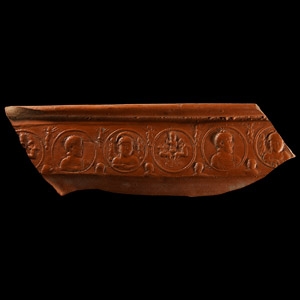
Roman Redware Sherd with Constantinian Portraits
4th century A.D.Sold for (Inc. bp): £416
From the upper part of the vessel, displaying a frieze of profile busts and figural scenes within roundels, winged Victory holding a wreath and standing on globe between the roundels; the central roundel with Sol Invictus and a sun chariot. 155 grams, 18.5 cm
Acquired 1960s-1990s. From the late Alison Barker collection, a retired London barrister.
This terra sigillata fragment appears to have been part of a large tray, celebrating the imperial triumph of an early 4th century emperor, possibly Constantine or a member of his family such as Crispus. The combination of triumphal symbols (palms, quadriga, radiated crown) with imperial figures is typical of the tetrarchy and early Constantinian era, where elements of dying paganism were still used to celebrate imperial glory. Note the detailed late Roman clothing, with a closed chlamys-paludamentum on the right shoulder and, in the profile figure, a thorax with hemispherical shoulder protections. -
.jpg)
Roman Lead Plaque with Magical Inscription
Circa 6th century A.D.Sold for (Inc. bp): £572
Rectangular plaque with 17 lines of Greek text in small (2mm) lettering. 8.6 grams, 50 mm
From the private collection of the late Mr S.M., London, UK, thence by descent. -
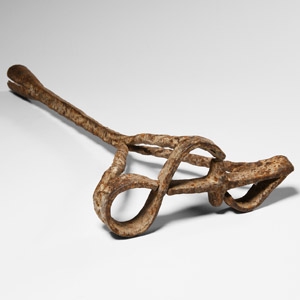
Late Roman Iron Branding Signaculum
5th-6th century A.D.Estimate: £100 - 140 (+bp*)
Opening Bid: £40
Featuring an elaborate monogram composed of Greek letters M and O, supported by decoratively twisted prongs; tapering cylindrical socket. 521 grams, 37.5 cm
Acquired 1990s-early 2000s. East Anglian private collection.
Branding stamps or signacula, in particular those with large single letters, were used for marking livestock to identify the ownership, the breed, the quality and other features of the animal. The signacula were usually made in bronze, but iron examples are also preserved.
